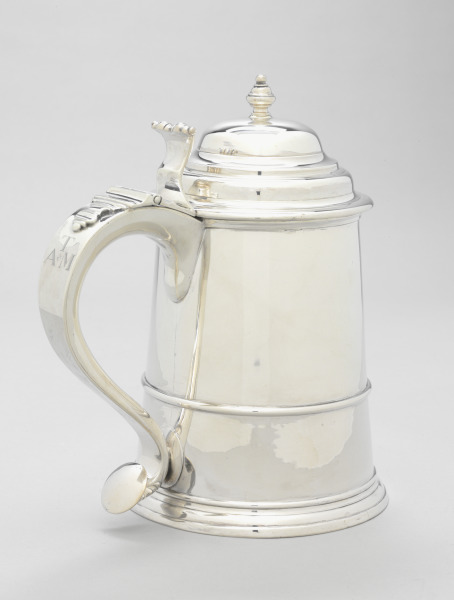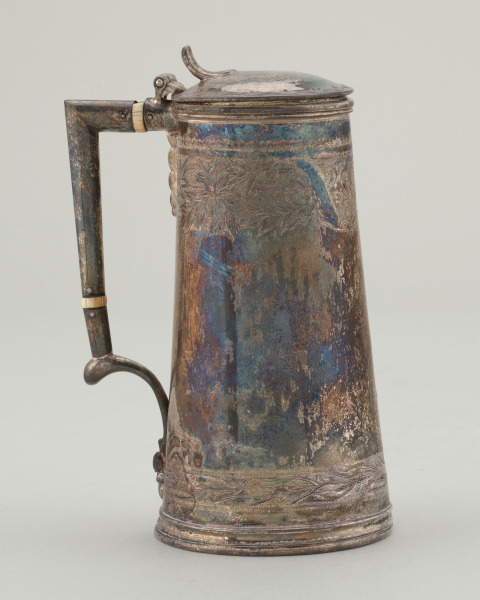

Thomas Mason
Tankard
1718
Scroll
Thomas Mason
Tankard
1718
Physical Qualities
Silver, Brittannia standard, 7 x 7 1/4 in. spread
Credit Line
Gift of Elizabeth F. Cheney, Oak Park, Illinois
Object Number
1981.98
The sterling standard was established in England by Edward I in 1300 requiring all articles of silver to contain 11 oz., 2 dwt. (penny weight) of pure silver to 18 dwt. Copper alloy in a 12 oz. (troy) pound. This rigidly enforced law has remained in effect to the present except of the period from 1697 to 1720, when a higher grade of silver was required. This was called the Britannia standard. By an act of Parliament in 1697, all wrought silver had to be of 11 oz., 10 dwt pure silver 10 dwt. Copper alloy in 12 oz. (troy) pound. This somewhat softer grade of silver was mandatory until 1719/1720 when the act was repealed and the sterling standard restored; the Britannia standard became optional after that time.
Because pure silver is very soft, another metal—often copper—may be added to make it easier to sculpt. Various admixtures have been used in different countries at different times. As silver is literally solid wealth, marks indicating the quality or purity of the metal are often found on individual pieces. Britannia silver is an alloy of silver containing 95.84% silver. The Britannia standard for silver was introduced by the English government in the late 1600s in an effort to discourage the clipping (shaving) and melting of sterling silver coinage. It was hoped that by maintaining a higher standard for solid silver objects there would be less incentive to melt down sterling coins.
AMW Reinstallation 2014
American Wing Rotations 2020
American Wing Rotations 2021
American Wing Rotations 2022
American Wing Rotations 2023
American Wing Rotations 2024
American Wing Rotations 2025
Inscribed: on handle: "M / P.M", "1719"
Markings: maker's marks on side: "M", unknown, unknown, "D"
 On View at the BMA