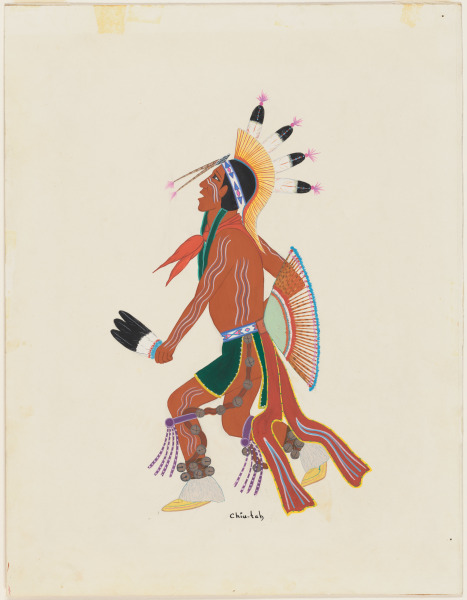
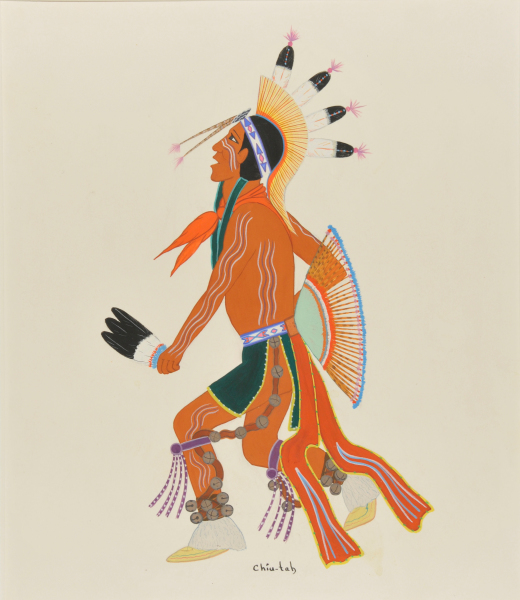
Vicent Mirabal (Chiu-Tah)
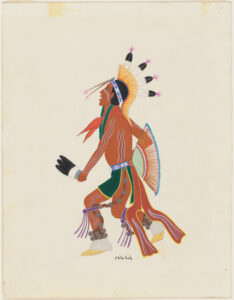
Taos Indian War Dancer
1939
Scroll
Vicent Mirabal (Chiu-Tah)
Taos Indian War Dancer
1939
Physical Qualities
Opaque watercolor over graphite on paper, Sheet: 324 × 250 mm. (12 3/4 × 9 13/16 in.)
Credit Line
Gift of Saidie A. May
Object Number
1941.378
This work depict traditional Native life, including scenes of bow-and-arrow hunting and dancing figures wearing ceremonial regalia. In 1883, Native dances and ceremonies were banned in the United States by the Code of Indian Offenses, which was only fully repealed in 1978. Many artists referenced historic images and objects in museum collections to portray these aspects of life, which had been either imperiled or eradicated due to settler colonialism. These figures hover against an empty background and intentionally lack depth and shading, demonstrating an artistic approach sometimes called flat style. In the early to mid-20th century, white arts educators taught many Native students at the Santa Fe Indian School in New Mexico—including Vicent Mirabal, Joe A. Quintana, and Harrison Begay—and members of the Oklahoma-based Kiowa Six group of artists—including Stephen Mopope. Many of these instructors viewed the stylistic conventions they taught as emergent from and emblematic of “authentic” Native art. Their misguided beliefs—which, ironically, held that students’ work should resist the influence of white art—homogenized Indigenous cultures and shaped the public’s understanding of what Native art should look like.
Preoccupied: Indigenizing the Museum
See Object File for references on artist...
Inscribed: Face: lower center (in black ink): 'Chiu-tau'; verso: at center (in graphite): 'Taos Indian War Dancer II Vicenti Mirabel-Indian name (Chiu-tau) means 'Dancing Bird' II Taos Indian II Taos Pueblo, N. Mex. II Price-12.00'
Artist
Vicent Mirabal (Chiu-Tah)
1916–1944
(Taos Pueblo) b. 1918, Taos Pueblo, New Mexico, U.S.A.; d. circa 1944, Germany
Meet Vicent →