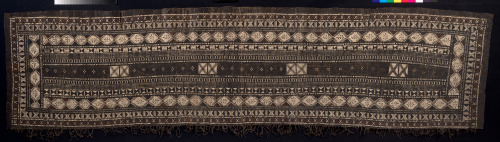


Tapa Cloth
Polynesian, 1900-1932
Scroll

Tapa Cloth
Polynesian, 1900-1932
Physical Qualities
Bark, pigments, 37 3/8 x 19 11/16 in. (95 x 50 cm.)
Credit Line
Gift of Mrs. Arthur H. Ward
Object Number
1964.30.1
In 1930, Matisse visited Tahiti for ten weeks. When he returned to France, he brought with him Polynesian tapa cloths to add to his personal textile collection. These cloths, created with pigments painted onto fabric of pounded bark, later adorned the walls of the artist's studio-bedroom and may have influenced Matisse's Écharpe (Scarf), the printed Oceania murals, and the Polynesia tapestries.
The Baltimore Museum of Art by gift 1964; Mrs. Arthur H. Ward (Elizabeth C. Ward), 1932.
Matisse Textile Rotation
Küchler, Susanne & Graeme Were.“The Social World of Cloth in the Pacific Islands,” in Berg Encyclopedia of World Dress and Fashion, Vol. 7, 381-385. 2010.
Page, Maud. “Paperskin: An Introduction,” in Paperskin: Barkcloth Across the Pacific, 11-19. Auckland: Museum of New Zealand Te Papa Tongarewa. 2009.
Neich, Roger and Mick Predergrast. Pacific Tapa. Honolulu: University of Hawai‘i Press. 1997.
Page, Maud. “Paperskin: An Introduction,” in Paperskin: Barkcloth Across the Pacific, 11-19. Auckland: Museum of New Zealand Te Papa Tongarewa. 2009.
Neich, Roger and Mick Predergrast. Pacific Tapa. Honolulu: University of Hawai‘i Press. 1997.