Unidentified
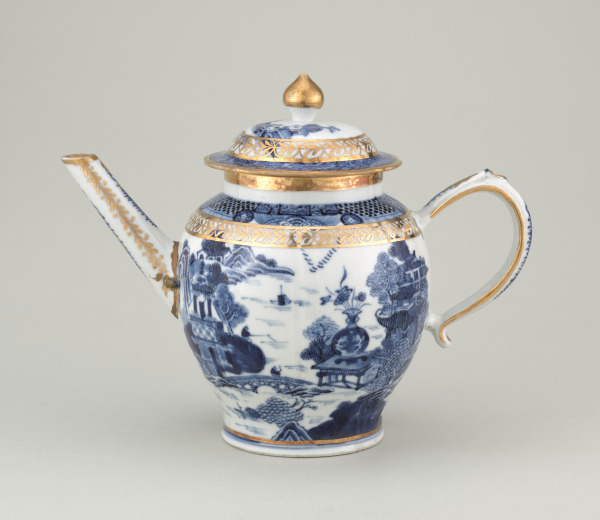
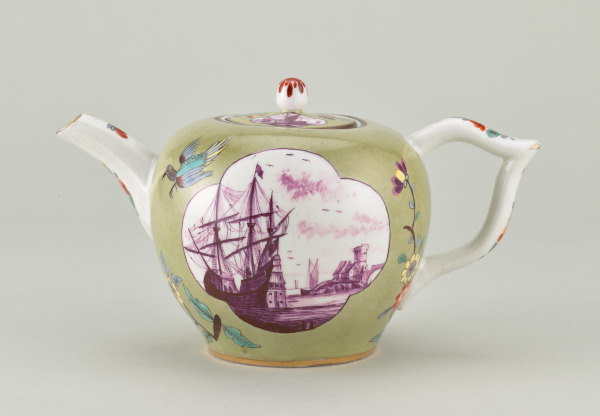
Teapot and Cover
1784-1794
Scroll
Unidentified
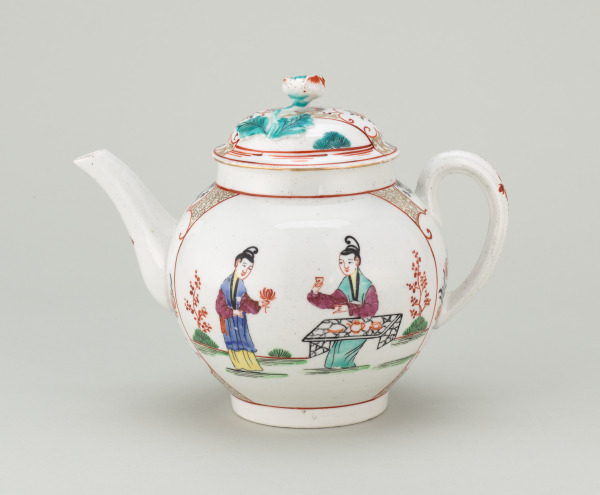
Teapot and Cover
1784-1794
Physical Qualities
Porcelain with overglaze enamels and gilding, 5 3/4 x 9 1/8 in. spread
Credit Line
Bequest of Anne Starr Gephart
Object Number
1957.68.17
Starting in the mid-16th century, porcelain became an important commodity for export form China to Europe, and, eventually, to America. First the Portuguese and later, the Dutch began trading with the Chinese for hard-paste porcelains, formulated from a combination of kaolin, feldspar, and quartz mixed into clay and then fired at an extremely high temperature. Although porcelains constituted no more than 6 percent of the value of East India Company cargoes, the quantity of exported porcelain was enormous. Over two centuries, 300 million pieces were sent to England alone. The popularity of these expensive wares spurred the development of a European porcelain industry during the 18th century. A new aesthetic emerged, blending Western forms with Eastern motifs and vice versa, as European and Americans ordered specially designed porcelains painted with coats of arms or armorials, flowers and birds, and scenic views based upon print sources.
America’s trade with China opened in 1784, when the Empress of China sailed out of New York, returning in May 1785. That same year, Captain John O’ Donnell (d. 1805) sailed an East India Company ship into Baltimore Harbor, bringing the city its first shipload of Chinese goods. Baltimore’s participation in trade with the East is reflected in the city’s “Canton” neighborhood, named after a province in South China and built on land once owned by Captain O’Donnell. He should not be confused with his fellow Irish-born Baltimorean John Donnell (1752-1827), who lived at Willow Brook from 1800 to 1827. Willow Brook was funded in part by the owner’s profitable trade with the East. The Donnell family possessed multiple sets of Chinese export porcelain.
Ceramics in Early Maryland
AMW Reinstallation 2014
American Wing Rotations 2020
American Wing Rotations 2021
American Wing Rotations 2022
American Wing Rotations 2023
American Wing Rotations 2024
American Wing Rotations 2025
Maker
Unidentified
2000-01-01 00:00:00–2000-01-01 00:00:00
 On View at the BMA