Wari
Textile
Wari, 500-800
Scroll
Wari
Textile
Wari, 500-800
Physical Qualities
Camelid Fiber, a: 44.4 x 53.4 cm.; b: 14 x 11 cm.
Credit Line
Purchase with exchange funds from Frank J. and Elizabeth L. Goodnow Collection
Object Number
1953.209.7
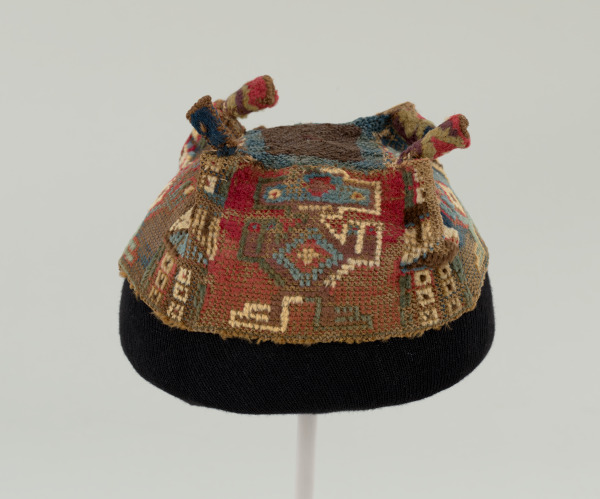
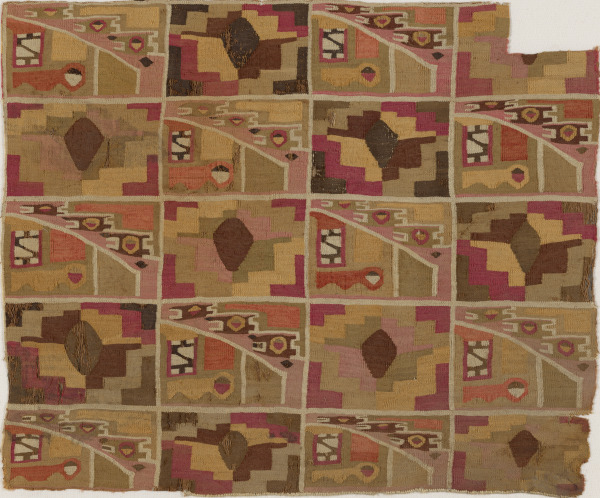
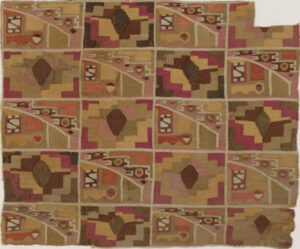
Cultures of the ancient Andes, including the Wari, regarded cloth as extraordinarily valuable and reflective of prestige. From around 600 to 1000 CE, the Wari people thrived in the highlands of what is now Peru and bred llamas and alpaca for their wool. Wari artists then used the material to craft high quality textiles and attire, like tunics and four-cornered hats.
The highly abstract and stylized patterns in Wari pieces like these were deliberately difficult to interpret and only decipherable to elite individuals. This textile, which was likely once part of a man’s tunic, bears repeating images of three animals and faces in profile. Vertically divided circles represent the eyes. The imagery on the four-cornered hat reveals a standing figure whose center is marked by a diamond shape. The four tips on top of the hat may represent animal ears or bird tufts.
The Baltimore Museum of Art, by purchase, 1953 - Present;
Ex. Guillermo Schmidt-Pizarro, Lima, Peru, ?? - 1953
Ex. Guillermo Schmidt-Pizarro, Lima, Peru, ?? - 1953
Ancient Americas Gallery Rotations 2023
Ancient Americas Rotations 2024
Stone, Rebecca Rollins. "Technique and Form in Huari-Style Tapestry Tunics: The Andean Artist, A.D. 500 - 800," Unpublished Ph.D. dissertation, Yale University, 1987 (Cat. No.: 146a-c)
Stone, Rebecca Rollins. "Technique and Form in Huari-Style Tapestry Tunics: The Andean Artist, A.D. 500 - 800," Unpublished Ph.D. dissertation, Yale University, 1987