Winslow Homer
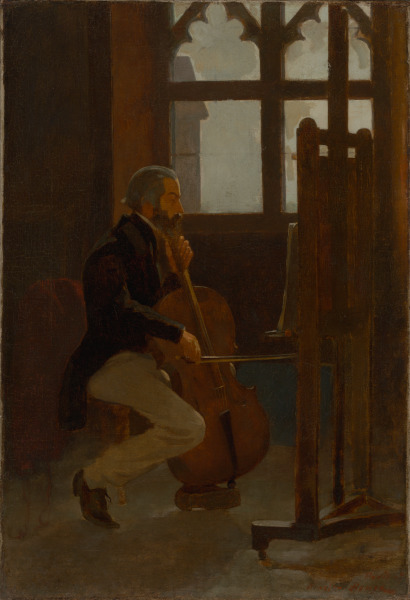
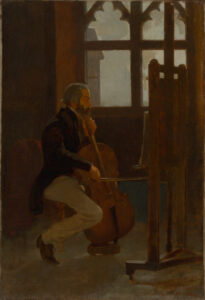
The Cellist
1866-1868
Scroll
Winslow Homer
The Cellist
1866-1868
Physical Qualities
Oil on canvas, Framed: 28 3/4 × 22 5/8 × 3 in. (73 × 57.5 × 7.6 cm.)
Unframed: 18 7/8 × 12 3/4 in. (47.9 × 32.4 cm.)
Credit Line
Given in Memory of Joseph Katz by his Children
Object Number
1964.52.2
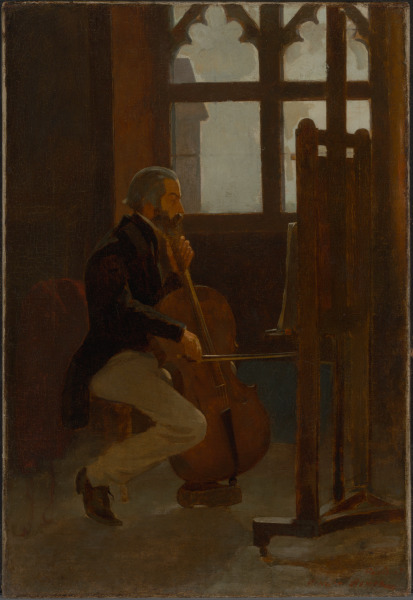
Winslow Homer made his first trip abroad when two of his Civil War paintings were selected for the American section of the 1867 Universal Exhibition in Paris. While there he stayed in a Montmartre studio and did some painting. The Studio (Metropolitan Museum of Art) depicts a violinist and a cellist playing together in front of a drapery. A virtually identical cellist appears in the BMA’s canvas, but he plays alone. Homer often recycled pictorial elements in his paintings and prints. The double date on the BMA canvas suggests that he completed it in New York, leaving out the violinist and draperies of the Met picture and adding gothic windows to the background. Perhaps they were drawn from the old New York University Building on Washington Square where Homer lived from 1861 to 1872.
The artist; to Charles DeKay, New York; to his daughter, Mrs. John Wheelock, ca. 1883; M. Knoedler and Co., New York, 1939; Kleeman Galleries, New York, by 1942; Joseph Katz, Baltimore, 1944; Victor Spark, New York, ca. 1960
The Art of Music from The Baltimore Museum of Art
AMW Reinstallation 2014
Sona K. Johnston, "American Painting 1750-1900 from the Collection of The Baltimore Museum of Art," 1983, pp. 82-83, ill. p. 82
Theodore Bolton, "The Art of WInslow Homer: An Estimate in 1932...with the First Catalogue of his Paintings in Oil," The Fine Arts, Feb. 1932, p.52 (as The Cello Player)
Inscribed: lower right: Paris-69/Winslow Homer