Barnaby Furnas
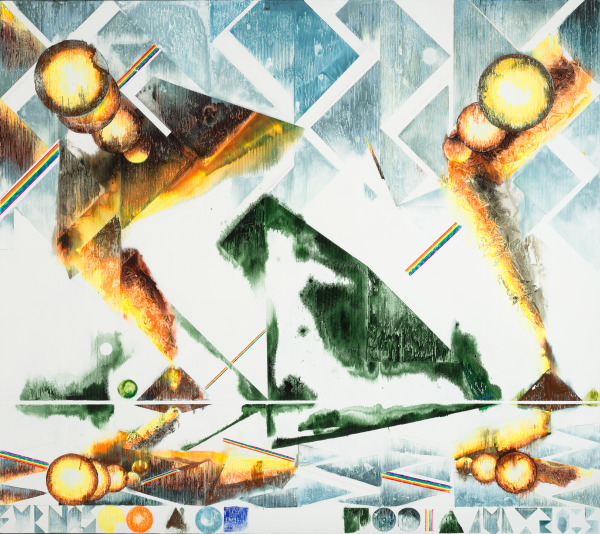
The First Morning (Twin Eruption)
2014
Scroll
Barnaby Furnas
The First Morning (Twin Eruption)
2014
Physical Qualities
Acrylic, dispersed pigment, pencil, and colored pencil on prepared linen, 64 3/16 x 72 1/8 x 1 5/8 in. (163 x 183.2 x 4.1 cm.)
Credit Line
Dr. Max Stern Trust Fund, and Frederick R. Weisman Contemporary Art Acquisitions Endowment
Object Number
2016.9
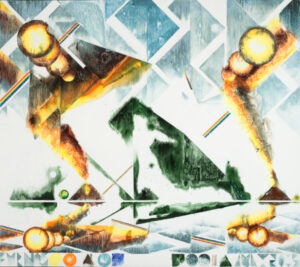
Barnaby Furnas’s First Morning (Twin Eruption) is a fantastical view of the geological origins of our planet or, in the artist’s words, “what the first morning on Earth might have looked like.” It is also a striking hybrid of art historical precedents such as Paul Cézanne’s (French, 1839–1906) faceted views of Mont Sainte-Victoire and Arthur Dove’s (American, 1880–1946) colorful, pulsating landscapes. Working without brushes on a floor or flat surface, the artist pours thinned paint and directs it under and around stencils, cloth, plastic shapes, and other textured materials to produce a variety of effects. For this piece, he created the upper portion of the composition first. He then replicated and condensed his hard-to-control techniques in the lower register of the image to suggest mountains reflected in water.
The dynamism of Furnas’s approach echoes the explosive energy of his subjects: shooting rainbows, erupting volcanos, and glowing orbs—in short, a visionary transformation of the natural world into active patterns, shapes, and colors. This work is among the first landscapes produced by the artist, whose past paintings feature bloody scenes drawn from sources such as Civil War battles and Shakespearean tragedies. Furnas was inspired to interpret the landscape in such an energetic manner after observing the playtime activities of his young son, who engaged dinosaurs, mountains, and the sky itself in imaginary “battle.” Furnas’s signature and the painting’s date are rendered across the bottom of the piece in a style that recalls both early 20th-century Futurist fonts and the appearance of icons and tool bars across computer screens, adding updated references to the primeval imagery.
The Baltimore Museum of Art by purchase, 2016; Marianne Boesky Gallery, NY
Inscribed: Recto: Signed and dated