Jean-François Millet
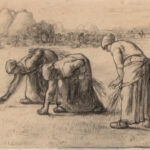
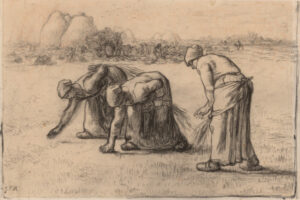
The Gleaners
1849-1859
Scroll
Jean-François Millet
The Gleaners
1849-1859
Physical Qualities
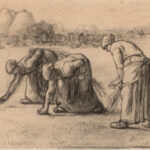
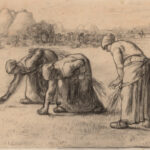
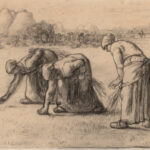
Black conté crayon with traces of red chalk on paper, Sheet: 200 × 291 mm. (7 7/8 × 11 7/16 in.)
Credit Line
The George A. Lucas Collection, purchased with funds from the State of Maryland, Laurence and Stella Bendann Fund, and contributions from individuals, foundations, and corporations throughout the Baltimore community
Object Number
1996.48.18686
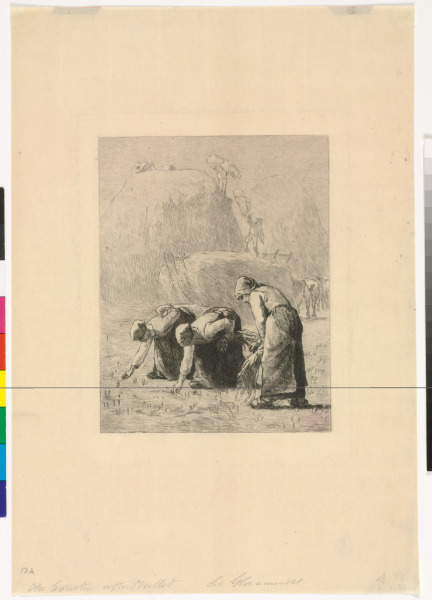
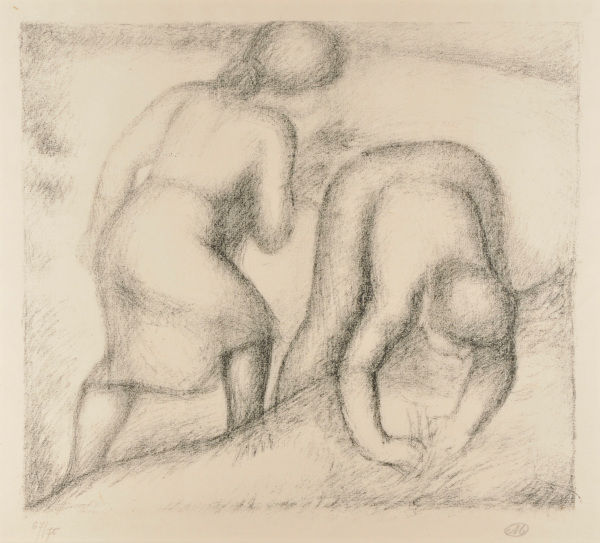
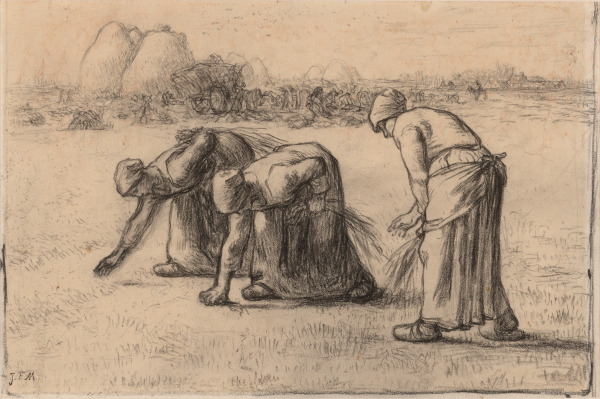
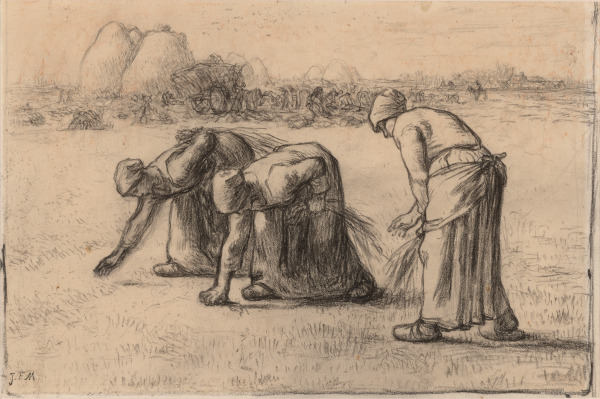
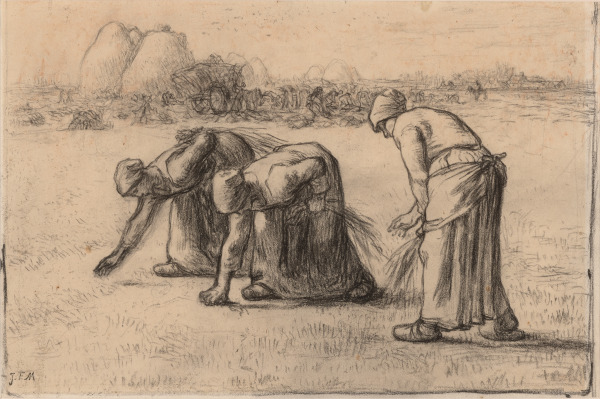
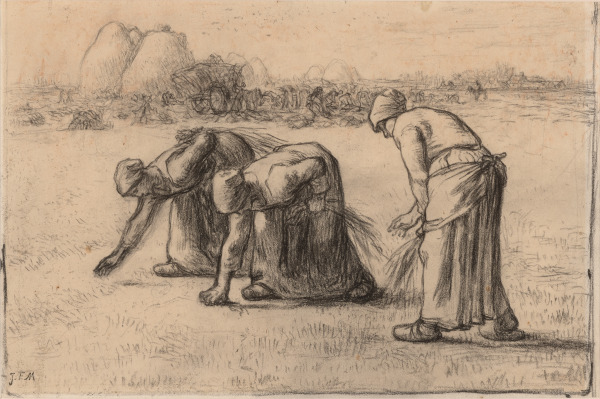
Gleaning comes at the end of the harvest. After most of
the crop is gathered, laborers canvass the field again to
collect the remnants. Historically performed by children,
the elderly, and women, gleaning in 19th-century France was
restricted by law to the poorest women and those unable
to do other labor. Farmers often used gleaned wheat to
augment their workers’ wages and so resisted this practice,
sometimes violently.
Jean-François Millet made several works related to this
subject, culminating in a monumental painting. That
work was not immediately popular, as critics found its
representation of poverty too confrontational.
The Baltimore Museum of Art by purchase, 1996; The Maryland Institute College of Art,
through Henry Walters, Baltimore, by bequest 1909; from George A. Lucas, Paris
through Henry Walters, Baltimore, by bequest 1909; from George A. Lucas, Paris
The Essence of Line: French Drawings from Ingres to Degas
2011-09-19 00:00:00
2011-09-19 00:00:00
Barbizon and Impressionist Works from The Baltimore Museum of Art
Deconstructing Nature: Environmental Transformation in the Lucas Collection
Gregory Hedberg, 'J.-F. Millet's The Gleaners', Nineteenth Century IV (Summer 1978), no. 7, p. 80.
Revue de l'art, 14 (1971), p. 101, fig. 12.
Stephen Eisenman, 'Exhibition Review, Jean-François Millet: Drawn into the Light', Historians of Nineteenth Century Art Newsletter, 6:2 (1999), ill. p. 4. Posted to website: www.museumserver.nl/museumkrant/editie28/pag7.htm
Cheryl Snay, 'Acquiring Minds: The Early Patrons of Nineteenth-Century French Drawings in Baltimore,' Master Drawings 42:1 (Spring 2004); ill. p. 72.
Sona K. Johnson et al, "Barbizon and Impressionist Works from The Baltimore Museum of Art," Tokyo: "Barbizon and Impressionist Works from The Baltimore Museum of Art" catalogue committee, 2003, no. 47, p. 78, ill.
Fisher, Jay McKean, et al. The Essence of Line: French drawings from Ingres to Degas. University Park, PA: Pennsylvania State University Press, 2005, p. 296-97, ill.
Carlson, Victor, and Carol Hynning Smith. Master Drawings and Watercolors of the Nineteenth and Twentieth Centuries: The Baltimore Museum of Art. New York, NY: The American Federation of Arts, 1979, pp. 39, ill.
Inscribed: RECTO: LL, black stamp, 'J.F.M.' [Lugt 1460]; VERSO: BLC, graphite, 'No 96'; LRQ, black stamp, 'Vente / Millet' [Lugt Suppl. 1816a].