Kerry James Marshall
The Ladder of Success
2002-2003
Scroll
Kerry James Marshall
The Ladder of Success
2002-2003
Physical Qualities
Plexiglas and inkjet print, Dimensions variable
Credit Line
The Caplan Family Contemporary Art Fund, and Collectors Circle Fund for Art by African Americans
Object Number
2004.112
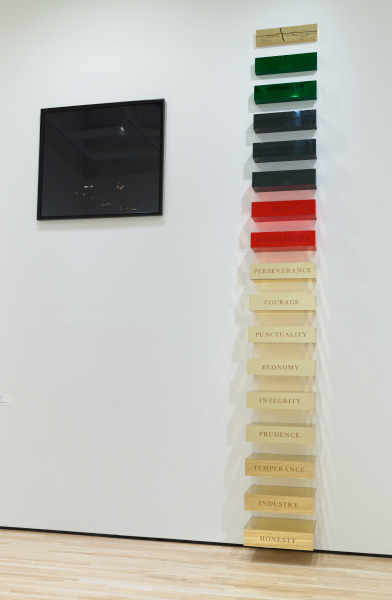
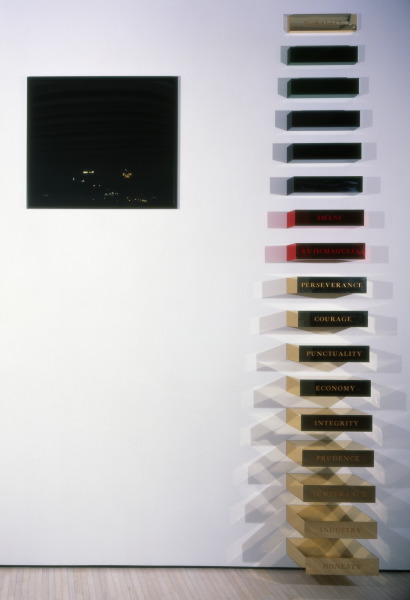
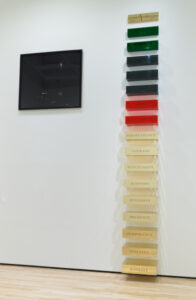
In Kerry James Marshall’s Ladder of Success, the smooth, gleaming surfaces of a soaring stack of boxes are not only pleasing to the eye, but evoke the sculpture of Donald Judd. Judd was associated with American Minimalism—an influential mid-20th century approach to abstraction that purged emotion and personal references from imagery and is most identified with white, male sculptors. Marshall re-thinks Judd’s work by featuring the colors of the Pan- African flag and Swahili words that identify the principles of Kwanzaa, the African American celebration of cultural heritage, family, and community. These words—ujima (collective work and responsibility), umoja (unity), ujamaa (cooperative economics), kuumba (creativity), nia (purpose), imani (faith), and kujichagulia (self-determination)—are inscribed on seven of the boxes, while the remainder bear English words that appear in a 19th century Currier & Ives print presenting attributes of character such as “economy” and “prudence” as a “ladder of fortune.”
Across from the upper reaches of Marshall’s abstracted ladder is a photograph of the former headquarters of Chicago-based Johnson Publishing, owners of Ebony and Jet lifestyle magazines. This juxtaposition raises the question of whether the principles invoked in the sculpture contribute to or contrast with the kind of achievement celebrated by these well-known publications.
The Baltimore Museum of Art by purchase, 2004; Jack Shainman Gallery, New York, New York
How Do We Know the World?
Kerry James Marshall TBD
"Kerry James Marshall: One True Thing, Meditations on Black Aesthetics"
Published by the Museum of Contemporary Art, Chicago, December 2003.
András Pálffy, Raél Salley, Annette Südbec (Interview), "Kerry James Marshall: Who's Afraid of Red, Black and Green," Vienna: Secession, 2012, ill. p. 28.
Inscribed: The inscriptions on the 17 Plexiglas boxes consist of a combination of the seven principles of Kwanzaa and 19th century principles of morality, taken from the 1875 lithograph "The Ladder of Fortune" by Currier & Ives. (Translations in parentheses are not included in the inscription.) Morality Ujima (Collective Work and Responsibility) Umoja (Unity) Ujamaa (Cooperative Economics) Kuumba (Creativity) Nia (Purpose) Imani (Faith) Kujichagulia (Self-Determination) Perseverance Courage Punctuality Economy Integrity Prudence Temperance Industry Honesty
Explore the Collection Further