The Sacrifice of Isaac
1800-1832
Scroll
The Sacrifice of Isaac
1800-1832
Physical Qualities
Silk, silk/cotton blend and wool embroidery threads, silk ground, cotton lining, Framed (Original): 27 × 28 3/4 × 2 1/8 in. (68.6 × 73 × 5.4 cm.)
Sight (Within mat window): 16 3/4 × 18 9/16 in. (42.5 × 47.1 cm.)
Image (Embroidered area): 17 1/8 × 19 7/8 in. (43.5 × 50.5 cm.)
Credit Line
Textile Acquisition Fund
Object Number
2009.140
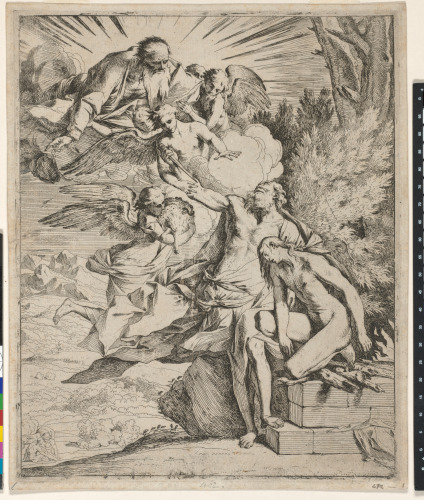
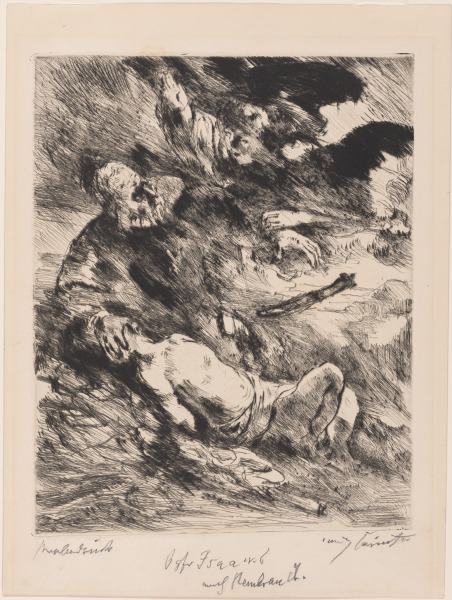
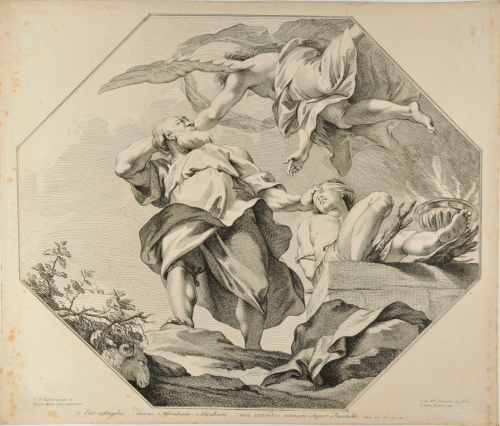
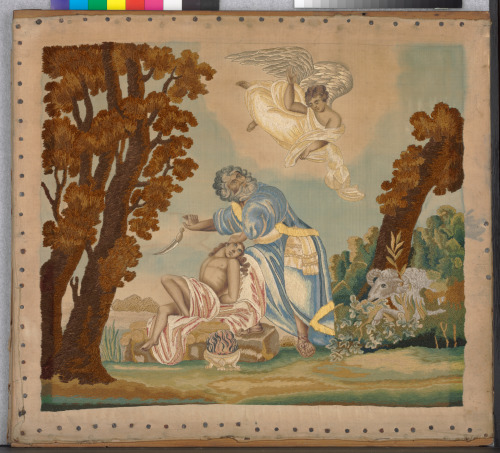
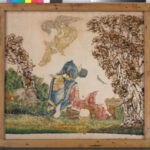
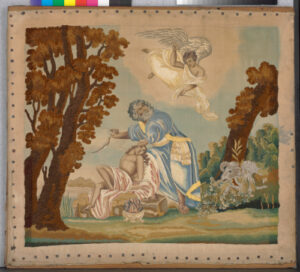
A silk-on-silk embroidery featuring the Old Testament story, "The Sacrifice of Isaac," also known as "The Binding of Isaac" and "The Sacrifice of Abraham." Abraham, standing to the viewer's right, is about to kill his son Isaac, who is bound and placed on a low altar when an angel appears to prevent the act. The angel does not physically stop Abraham, rather Abraham drops his weapon (a knife as mentioned in the telling of the story in Genesis rather than a sword as is often portrayed in needlework) as the angel tells him of God's decision to spare Isaac.
Isaac is bound, but kneeling and leaning backwards with his face and body to the viewer. Abraham has one hand on his son. Abraham is dressed in blue and gold robes. Isaac has a cloth of beige and red. The ram that God provides for the sacrifice after Isaac is freed is seen in the bushes to viewer's right with his horns caught on the foliage. The scene is set outdoors with trees, and bushes.
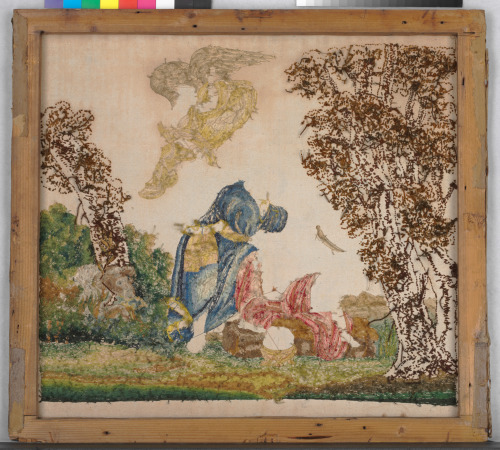
The painted faces are rendered in watercolor on the silk as are the hands, bodies, arms, and legs of Abraham and Isaac. The sky and background and the fire in the brazier are painted. The clothing, trees, ram, and other aspects of the work are embroidered. The needlework shows a variety of stitches and materials to achieve textural diversity. Straight stitches in silk threads are used to present the costume of Abraham with fringe. Extremely fine knotted stitches in silk threads are used to create the trees. Wool is used to depict the ram's wooly fleece. This piece has very a beautifully conceived scene with complex positions, and skilled and expressive faces.
The embroidery is framed in its original or period gessoed and gilded wooden frame.
Baltimore Museum of Art by purchase, 2009; Perry-Joyce Fine Art, Sawyer, MI.
Liz Arthur, Embroidery 1600-1700 at the Burrell Collection, London: John Murray in association with Glasgow Museums, 1995,pp. 86-87, fig. 61.
Lanto Synge, Art of Embroidery: History of Style and Technique, Woodbridge, England: The Royal School of Needlework/Antique Collectors' Club, 2001, p. 250 fig. 246 (Christ and Mary Magdalene), and fig. 247, (sheep); pp. 264-265, illus on p. 264 (similar religious scene worked in wool and silk ground with some parts painted. Imitates old master painting.
Barbara Morris, Victorian Embroidery: An Authoritative Guide, New York: Dover Publications, 2003, page 79, pl.16 "Abraham Offering Isaac" in the form of a Berlin wool-work, dated 1843. Same unusual variation of this theme in regard to the positions of the figures, clothing, etc.
Lanto Synge, Art of Embroidery: History of Style and Technique, Woodbridge, England: The Royal School of Needlework/Antique Collectors' Club, 2001, p. 250 fig. 246 (Christ and Mary Magdalene), and fig. 247, (sheep); pp. 264-265, illus on p. 264 (similar religious scene worked in wool and silk ground with some parts painted. Imitates old master painting.
Barbara Morris, Victorian Embroidery: An Authoritative Guide, New York: Dover Publications, 2003, page 79, pl.16 "Abraham Offering Isaac" in the form of a Berlin wool-work, dated 1843. Same unusual variation of this theme in regard to the positions of the figures, clothing, etc.