George Wesley Bellows
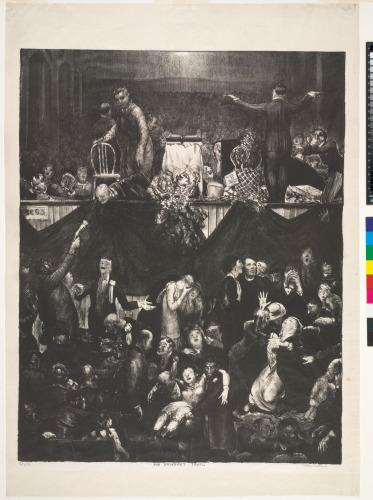
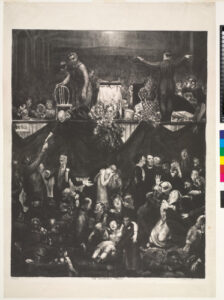
The Sawdust Trail
1916
Scroll
George Wesley Bellows
The Sawdust Trail
1916
Physical Qualities
Crayon and brush and tusche lithograph, Sheet: 774 x 554 mm. (30 1/2 x 21 13/16 in.)
Image: 646 x 508 mm. (25 7/16 x 20 in.)
Credit Line
Given by the Board of Trustees and Staff in Honor of Anthony W. Deering, Chairman, 1997-2000
Object Number
2000.52
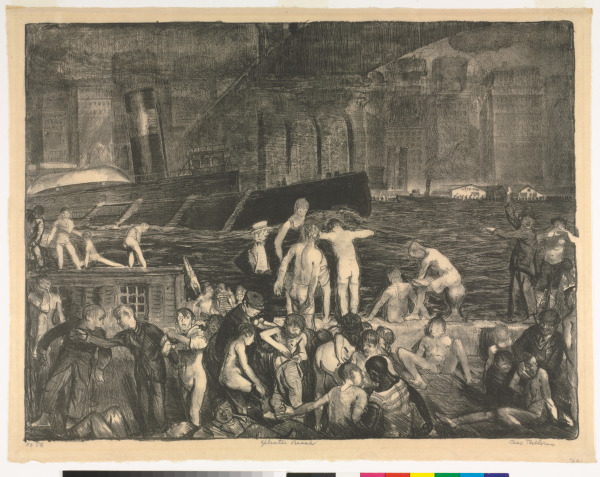
George Bellows was a member of the Ashcan School, so-called because of the group’s interest in portraying the gritty reality of life in New York during the early part of the 20th century. It was a period of rapid social and technological change that brought a shift from horse-driven carriages to automobiles, still photography to motion pictures, and a great influx of immigrants to the United States. Bellows completed several versions of the view of Splinter Beach underneath the Brooklyn Bridge, where working class boys cooled
off in the city’s busy East River. Another version was published in The Masses, a journal promoting socialist politics. Bellows’ socialist leanings led him to join reporter John Reed
(1887–1920) on a trip to a revival meeting in Philadelphia, organized by evangelist Billy Sunday (1862–1935). Reed was to write a story about the preacher for the magazine Metropolitan. At the meeting, they witnessed people lining up to present themselves as converts along the “sawdust trail,” the central aisle of the temporary tabernacle where sawdust was laid down to improve the acoustics. Despite Bellows’ and Reed’s determination to malign both the preacher and the service, both conceded that Sunday had immense appeal and charisma.
The Baltimore Museum of Art by purchase, 2000; Kennedy Galleries, New York
American Realism: Ashcan Artists
New Arrivals: Gifts of Art for a New Century
Mason, Lauris, The Lithographs of George Bellows: A Catalogue Raisonné, Millwood, NY: KTO Press, 1977, no. 48, ill.
Signed: 1
Inscribed: lower center in stone: "THE SAWDUST TRAIL"; lower left in graphite: "No 62"; lower right in graphite: "Geo Bellows"; by later hand, lower center verso in graphite: "I45605"