
Three Gorges Dam Migration - Image 1
Three Gorges Dam Migration - Image 2

Yun-Fei Ji, Rongbaozhai, Library Council of the Museum of Modern Art

Three Gorges Dam Migration

2009

Thumbnail 1
Thumbnail 2
Scroll

Yun-Fei Ji, Rongbaozhai, Library Council of the Museum of Modern Art

Three Gorges Dam Migration

2009

Physical Qualities Color woodcuts, mounted as a scroll, Image: 340 × 3065 mm. (13 3/8 × 120 11/16 in.)
Credit Line Gift of Brenda Edelson, Santa Fe
Object Number 2018.96
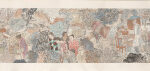
Started in 1994 and completed in the late 2000s, the Three Gorges Dam was built to curb flooding of China’s Yangtze River and provide hydroelectric power. However, this massive public works project was controversial: archaeological sites were destroyed, villages were inundated, and millions of residents were forced from their homes. Ji depicts the Three Gorges Dam’s “floating weeds”—his name for displaced people. He subverts a typically serene Chinese landscape by inserting realistic renderings of hardship: a woman sleeping on the ground, furniture littering the landscape, bags piled onto carts. The unreality of the situation is captured in the faces of people who move or stand like zombies around a hairy beast smoking a cigarette.
The Baltimore Museum of Art by gift, 2018; Brenda Edelson, Santa Fe, by purchase, 2014; Museum of Modern Art, New York
Time Frames: Contemporary East Asian Photography

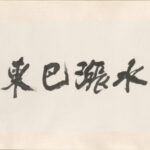
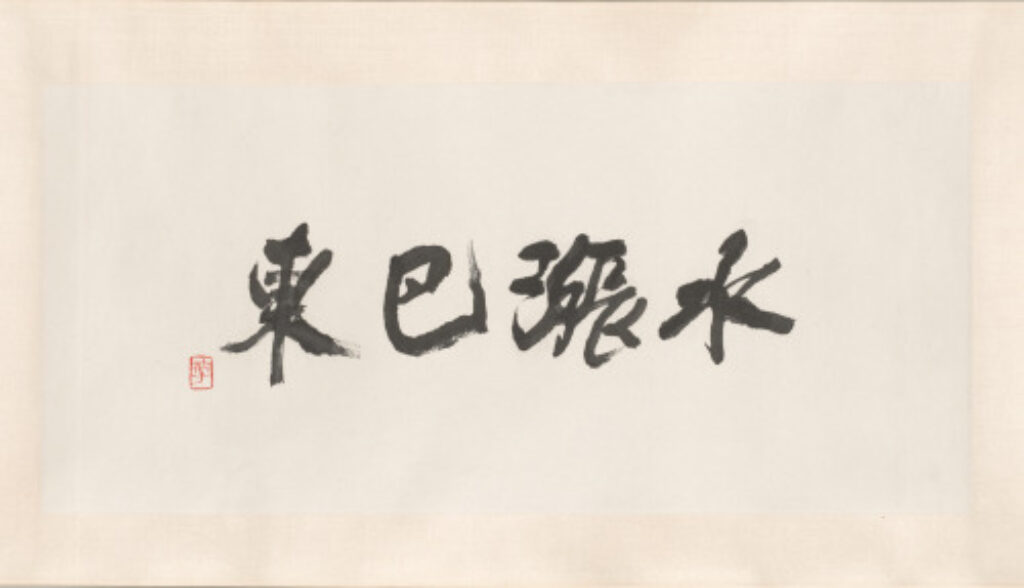
Inscribed: I. The closed cover of the scroll reads from top to bottom: "Three Gorges MIgration. Yun Fei Ji. MoMA. Rongbaozhai" II. The four larger characters at the beginning of the scroll (scroll reads right to left) read, "Rising Waters in Badun" III. Translation of the first section of the calligraphy on the right: "The taming of the waters by Yu the Great took place in the remote past, but every year flooding is still a danger along the Yangzi River. The populace on both sides of the river has been severely harmed by it. Early in the previous century, Sun Yat-sen put forth the idea of building a dam at the Three Gorges to interrupt the flow of the river. Several decades later, Chairman Mao Zedong also promoted this sugestion." (portion of print) "Work on the reservoir finally commenced in 1994, and will be completed next year. The reservoir has a depth of 175 m., a perimeter of 500 km., and it spans the two provinces of Hubei and Sichuan. Oceangoing freighters of up to 1000 tons will be able to sail directly to Chongqing. The reservoir will promote the economic prosperity of the interior and solve the problem of power generation for a vast area. It has become a milestone of Chinese construction and symbol of progress and modernization." (main body of print) "1.5 million people were displaced from the area of the reservoir. Wiht their own hands, they tore down and moved 13 cities, 140 townships and 1,3000 villages, brick by brick, tile by tile. They had no choice but to leave the homes which their ancestors had lived in for generations. Neighbors and friends were scattered to different places. I had visited Zigui, Ziangzi, and Fengjie and personally witnessed the sight of the people of the Badong area moving away. Although that was six years ago, I can still see it vividly, so I have made this painting of the dam migration as a record. Yufe, in the 4th month of the/wuxzi/year [2008]." In image BL: "YUN-FEI JI 2010 88/108" On title slip, in pencil, "88/108"

Artist

Yun-Fei Ji

1963-01-01 00:00:00

Chinese, born 1963
Meet Yun-Fei →

Printer

Rongbaozhai

Rongbaozhai is a renowned print studio over three centuries old that is located just off the main street of Beijing’s traditional arts district, Liulichang. Beginning as a shop dedicated to Chinese New Year’s prints, Rongbaozhai has come to specialize in the traditional Chinese woodblock printing method using water-based inks. Because their inks are identical to those used in traditional Chinese painting, Rongbaozhai artisans have become experts in reproducing famous examples of classical Chinese painting through the woodblock printing process. To the eye of an average viewer, the “paintings” that Rongbaozhai reproduces in their woodblock prints are nearly indistinguishable from the original works. The mastery of the artists at Rongbaozhai, combined with their vast knowledge of the classical tradition, led the Chinese government designate the studio part of China’s “intangible cultural heritage.� Rongbaozhai has flourished and grown over the past two decades as its wares have become increasingly appreciated across Asia. Harvard Visual China https://www.harvardvisualchina.com/rongbaozhai-workshop
Meet Rongbaozhai →

Publisher

Library Council of the Museum of Modern Art

Meet Library →