Unidentified Japanese Artist and Kano Naonobu
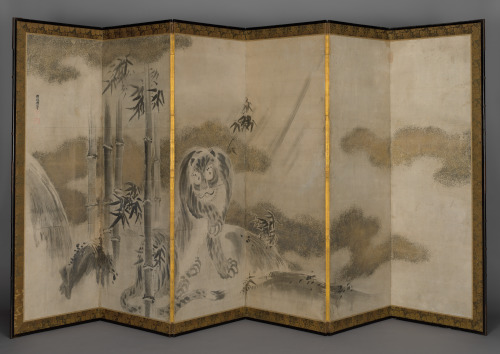
Tiger Seated in a Snowy Bamboo Stand
1844-1854
Scroll
- Artist: Unidentified Japanese Artist
- Artist: Kano Naonobu
Tiger Seated in a Snowy Bamboo Stand
1844-1854
Physical Qualities
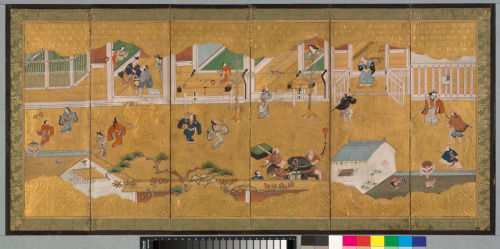
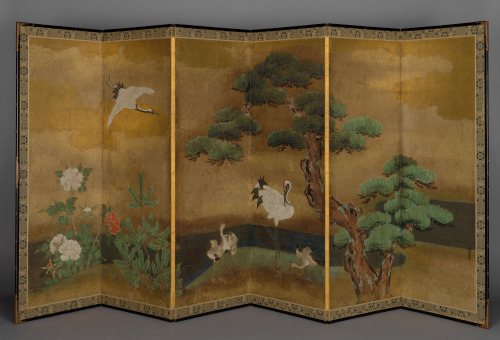
Ink and gold on paper mounted as a six-panel folding screen of paper and wood, 60 x 140 in.
Credit Line
Bequest of Sylvia G. Straton, Rhinebeck, New York
Object Number
2002.740
The tiger, native to China and Korea but not Japan, has been a popular subject for East Asian painting. This feline offers a paw in welcome to its bamboo grove. In Japan, the tiger was considered the only creature able to penetrate a thick bamboo forest; their pairing suggested a peaceful, harmonious society. In Korea, once known as the “Land of Tigers,” the animals were considered generous symbols of superiority and guardians against evil spirits. Scholars have noted the differences in the depiction of tigers in East Asian ink paintings: Japanese tigers are seen in a bamboo forest, while Korean tigers inhabit mountainous terrains with pine trees; and Chinese and Korean artists typically depict tigers with other symbolic creatures, such as magpies or monkeys.
Conservation stabilization of this screen was provided by the E. Rhodes and Leona G. Carpenter Foundation.
The Baltimore Museum of Art by bequest , 2002; Sylvia G. Straton, Rhinebeck, New York
Across East Asia: China's Cultural & Artistic Legacy
Michael Cunningham, Unfolding Beauty: Japanee Screens from The Cleveland Museum of Art, Cleveland: The Cleveland Museum of Art, 2001, pp. 14-15
Inscribed: FACE: signed, UL, 7 characters above 2 faint red seals: Jitekisai Kano Naonobu
Artist
Unidentified Japanese Artist
2000-01-01 00:00:00–2000-01-01 00:00:00