Paul Klee
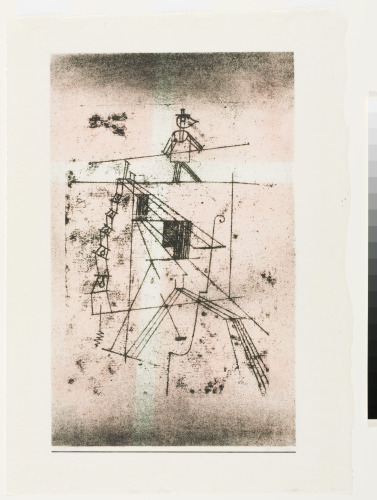
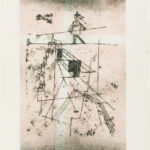
Tightrope Walker
1922
Scroll
Paul Klee
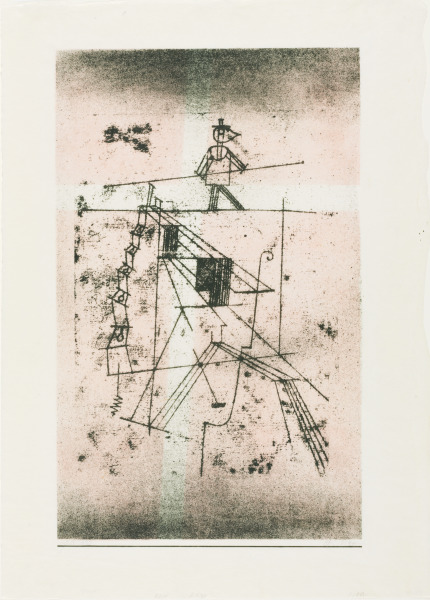
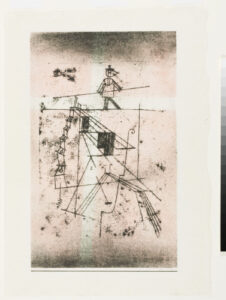
Tightrope Walker
1922
Physical Qualities
Color transfer lithograph with spatter and printed tone, Sheet: 527 x 377 mm. (20 3/4 x 14 13/16 in.)
Credit Line
Blanche Adler Memorial Fund
Object Number
1951.70
Paul Klee’s first serious contact with avant-garde art occurred in 1911 when he met Wassily Kandinsky and the Munich-based Der Blaue Reiter (The Blue Rider) group of artists. A highly independent artist, he assimilated aspects of Expressionism, Cubism, and Surrealism over the course of his career but never became defined by any particular style.
Klee kept a detailed diary in which he noted how impressed he was by a tightrope act that he witnessed when the famous Knie Circus performed in Bern in 1906. Later, in 1923, after becoming a teacher at the Bauhaus, a celebrated progressive German art school, he produced the delicate lithograph Tightrope Walker. The composition appears to include a face and a little ladder leading up to scaffolding where a figure walks a tightrope. This
delicate balancing act may be a metaphor for a kind of mental equilibrium. It may also suggest the fragile balancing of compositional components that the artistic process requires.
A Circus Family: Picasso to Léger
Inscribed: At lower left, in graphite: "723 138"; at lower right, in graphite: "Klee"; at bottom center, in graphite: "1211 EN 87"; at lower right, in graphite: "3120-"
Markings: None