Unidentified
Tray
1719-1729
Scroll
Unidentified
Tray
1719-1729
Physical Qualities
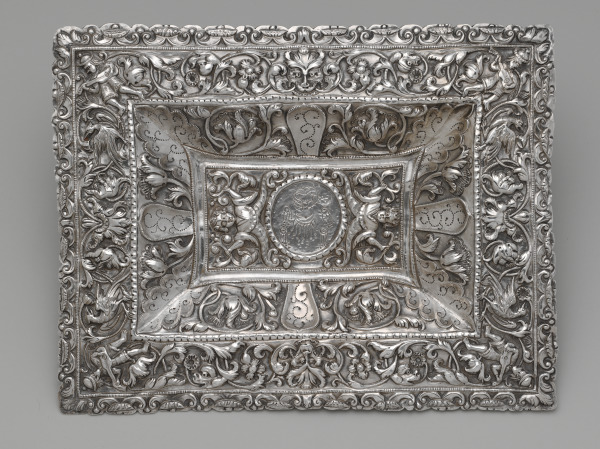
Silver, 15 1/2 × 12 in. (39.4 × 30.5 cm.)
Credit Line
Decorative Arts Acquisitions Endowment established by the Friends of the American Wing
Object Number
2020.9
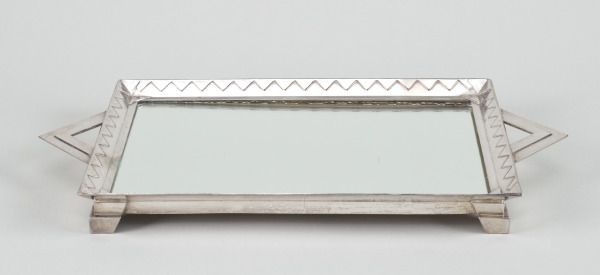
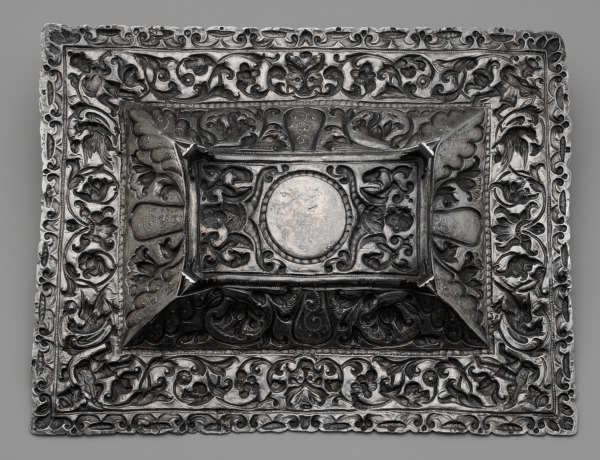
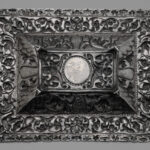
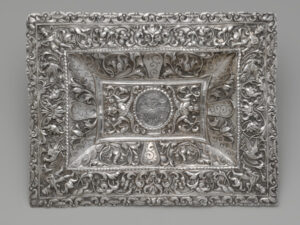
This silver tray features guitar players, birds, flowers, and Christian symbols such as angels and a crown of thorns. For more than 300 years, Indigenous and African people enslaved by Spanish colonizers excavated silver from the mines of Potosí in present-day Bolivia. Miners worked by candlelight in hazardous conditions inside a gigantic mountain within the Andes Mountain range. Most of the silver from Potosí was transported to Asia and North America, and Europe in mass quantities. This tray, however, was likely made by an Andean silversmith for a local aristocrat who later gifted it to a church.
The Baltimore Museum of Art by purchase, 2020; Javier Eguiguren, Eguiguren Arte de Hispanoamérica, Buenos Aires, Argentina by purchase, 2016; Carlos Alberto Cruz, Santiago, Chile and London, England, by 1997; possibly by descent in Cruz family, 19th century
American Wing Rotations 2021
American Wing Rotations 2022
American Wing Rotations 2023
American Wing Rotations 2024
Earth as Medium: Extracting Art from Nature
Cone Wing Rotations 2025
American Wing Rotations 2025
Cristina Esteras Martin, "Aproximaciones a la plateria virreinal hispanoamericana," fig 396 in Ramon Gutierrez, Pintura escultura y artes utiles en Iberoamerica: 1500-1824, Ed. Catedra, Madrid, 1995, pp 377-404
Plateria del Peru Virreinal 1535-1825, Groupo BBV/Banco Continental Madrid, 1997, pp 142-143, fig. 31
"Acculturation and Innovation in Peruvian Viceregal Silverwork" in Elena Phipps, Johanna Hecht and Cristina Esteras Martin et al, The Colonial Andes: Tapestries and Silverwork, 1530-1830. The Metropolitan Museum of Art, New York. Yale University Press, New Haven & London, 2004. pp 59-71 & 331-332, cat. 126.
Javier A Eguiguren Molina and Jose M. Eguiguren Molina, Highlights of Hispanic American Silver and Equestrian Silver in the River Plate, published Eguiguren Arte de Hispanoamerica, Buenos Aires, 2017, p32-33, ill p 33.
Sarah R. Cohen, Cynthia Kok, Brittany Luberda, and Sophie Tunney. "Raw Movement: Material Circulation in the Colonial Eighteenth Century." Studies in Eighteenth-Century Culture 52 (2023): 383-420. ill. p. 391.
Markings: Royal crown with spots trimming. Heraldry has thorns crown and five sores
Artist
Unidentified
2000-01-01 00:00:00–2000-01-01 00:00:00
Explore the Collection Further