
Tsuke Obi of Gold Brocade with Nandina (nanten) Motif
2009
Scroll

Tsuke Obi of Gold Brocade with Nandina (nanten) Motif
2009
Physical Qualities
Silk, synthetic fiber, cotton, 7 1/2 × 82 in. (19.1 × 208.3 cm.)
Credit Line
Gift of Charles W. Newhall III, Baltimore
Object Number
2014.81.1b
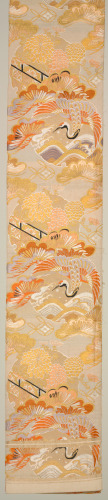
A woman's tsuke obi constructed of fancy "brocade" of (synthetic?) metallic gold ground with nandina (nanten) plant featuring red and also gold berries, dark and medium green leaves, blue leaves, purple leaves, and white, light pink, and off-white cherry blossoms created with long (weft) floats on the obverse. Parts of both obverse and reverse are constructed of plain beige or tan silk. Approximately 38" of the obverse at one end and 5" of the other end are made from the brocade which folds over the edges to the reverse, leaving a gap several inches wide of plain tan silk on the reverse. Approximately 38" of the length of this obi is of plain silk on both sides. The ends are partially slanted rather than square and attached to each end is a long narrow gold cotton tie. The obi has some interllining, making it somewhat stiff and weighty. All seams are machine sewn. The obi bow belonging to this obi is a separate piece. See 2014.81.1c.
The Baltimore Museum of Art by gift, 2014; Charles Newhall, Baltimore by purchase, Tokyo, Japan
Annie Van Assche (ed.), "Fashioning Kimono: Dress and Modernity in Early Twentieth-Century Japan," The Montgomery Collection, published in conjuntion with the exhibition held at the Victoria and Albert Museum, 13 October 2005-1 May 2006, Milan, Italy: 5 Continents, 2005.
Jill Liddell, "The Story of the Kimono." New York: E.P. Dutton, 1989.
Seiroku Noma, "Japanese Costume and Textile Arts." New York: Weatherhill/Heibonsha, 1983.
Norio Yomanaka, "The Book of Kimono." Tokyo: Kodansha International, 1986.
Ken-Ichi Kawakatsu, "Kimono." Tokyo: Japan Travel Bureau, 1954.
Ishimura Hayao and Muriyama Nobuhiko, "Robes of Elegance, Japanese Kimonos of the 16th-20th Centuries." Raleigh, N.C.: North Carolina Museum of Art, 1988.
Merrily A. Peebles, "Dressed in Splendor: Japanese Costume 1700-1926." Santa Barbara, CA: Santa Barbara Museum of Art, 1987.
"The New Encyclopaedia Britannica in 30 Volumes," 15th ed., s.v. "Japan, History of." Chicago: Helen Hemingway Benton, 1974.
"The New Encyclopaedia Britannica in 30 Volumes," 15th ed., s.v. "Ashikaga Takauji." Chicago: Helen Hemingway Benton, 1974.
Gunter, Susan. "Japanese Design Motifs and Their Symbolism as used on Itajime-dyed Juban." master\., University of Georgia, 2003.
https://www.fcs.uga.edu/ss/docs/gunter_susan_e_200305_ms.pdf.
Jill Liddell, "The Story of the Kimono." New York: E.P. Dutton, 1989.
Seiroku Noma, "Japanese Costume and Textile Arts." New York: Weatherhill/Heibonsha, 1983.
Norio Yomanaka, "The Book of Kimono." Tokyo: Kodansha International, 1986.
Ken-Ichi Kawakatsu, "Kimono." Tokyo: Japan Travel Bureau, 1954.
Ishimura Hayao and Muriyama Nobuhiko, "Robes of Elegance, Japanese Kimonos of the 16th-20th Centuries." Raleigh, N.C.: North Carolina Museum of Art, 1988.
Merrily A. Peebles, "Dressed in Splendor: Japanese Costume 1700-1926." Santa Barbara, CA: Santa Barbara Museum of Art, 1987.
"The New Encyclopaedia Britannica in 30 Volumes," 15th ed., s.v. "Japan, History of." Chicago: Helen Hemingway Benton, 1974.
"The New Encyclopaedia Britannica in 30 Volumes," 15th ed., s.v. "Ashikaga Takauji." Chicago: Helen Hemingway Benton, 1974.
Gunter, Susan. "Japanese Design Motifs and Their Symbolism as used on Itajime-dyed Juban." master\., University of Georgia, 2003.
https://www.fcs.uga.edu/ss/docs/gunter_susan_e_200305_ms.pdf.