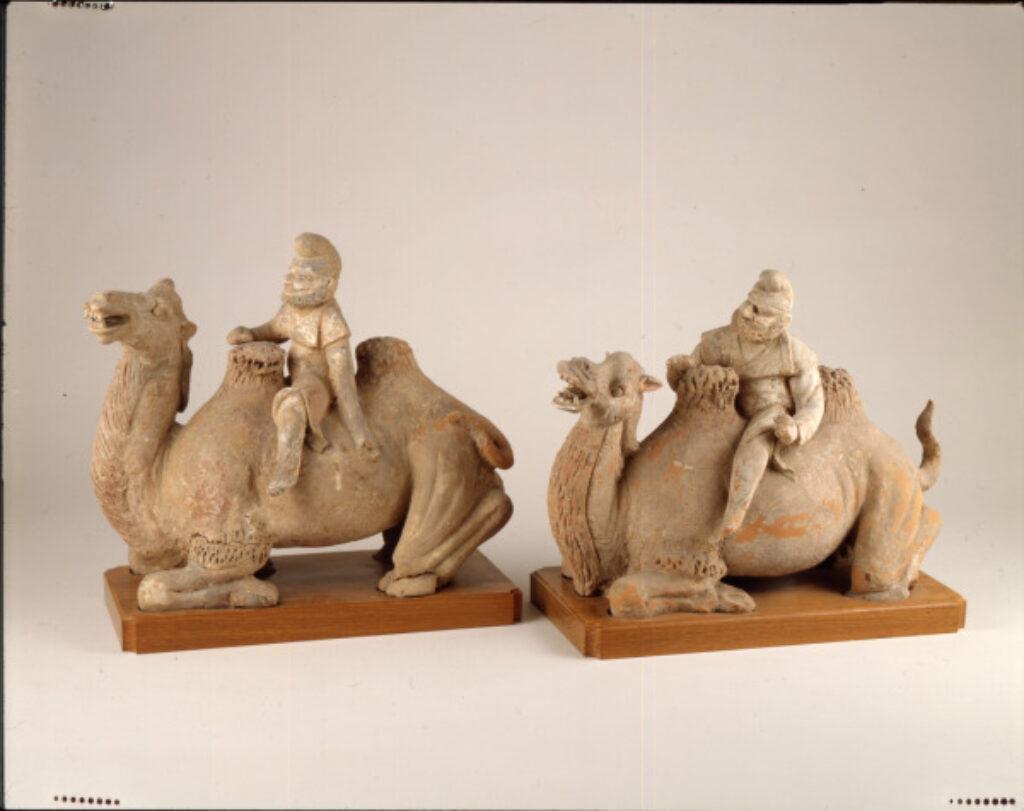
Two Camels with Sogdian Riders
601-700
Scroll
Two Camels with Sogdian Riders
601-700
Physical Qualities
Earthenware with unfired pigments, 12 1/2 x 15 1/2 x 7 3/4 in. (31.8 x 39.4 cm.); 14 lbs.
(.2): 14 x 16 x 7 3/4 in. (35.6 x 40.6 x 19.7 cm.)
Credit Line
Julius Levy Memorial Fund
Object Number
1950.65.1-2
This rider's soft felt hat associates him with the region of Sogdiana in present-day Uzbekistan, some 2,800 miles from Xian, China's capital city at the time. Central Asian men usually handled the camels along the trade routes that spanned Asia. The total distance of the overland route--some 7,500 miles--was broken up into shorter stretches as merchants and camels traveled back and forth between trading posts and cities along its length. Traveled into the 20th century, the way crossed dry and empty expanses characterized by extreme termperatures, wind, and dust storms.
The Baltimore Museum of Art by purchase, 1950; The Baltimore Museum of Art on loan, 1949; from C. K. Chang, Baltimore, through Tenney & Ferman, Inc., Baltimore
Collection installation, "Asia. Exchange across Land & Sea," Levy Gallery, Baltimore Museum of Art, October 5, 2023- [1950.65.1 only]
The Morning Sun, Baltimore, July 26, 1950.
Frances Klapthor, "Chinese Ceramics," Baltimore: BMA, 1993, no. 7, p. 18, ill. p. 19.
Linda Andre, 'Braying Camel, Chinese, Tang dynasty,' "School Arts," vol. 109, no. 4, December 2009, pp. 25-28, ill. pp. 25.
 On View at the BMA