
Nasca
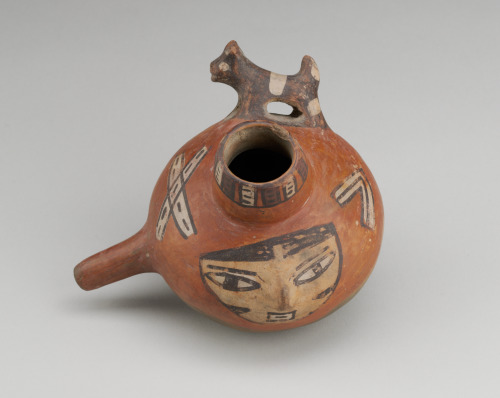
Vessel in the Shape of a Head
500
Scroll

Nasca
Vessel in the Shape of a Head
500
Physical Qualities
Earthenware, polychrome slip paint, 8 × 5 1/2 in. (20.3 × 14 cm.)
Credit Line
Gift of A. Lyndon Bell and Family
Object Number
2016.202
Head jars comprise a unique category of Nasca polychrome ceramics. They represent an idealized ceramic variant of actual human heads that in practice, were severed by combatants, stuffed and collected by chiefs, and monitored by priests. The production of head jars spans about three centuries after which they ceased to be made. There are no two jars that are alike although the form is fairly standardized: The base portion of the jar is painted or painted and modeled (usually nose and ears), as a human face. The upper portion of the jar is painted to resemble a headdress. This jar is painted, with the nose modeled. A deceased man is shown, indicated from his upturned eyes and white mouth. Facial hair is indicated above and below the mouth. A row of bangs, and a few hair locks at the ears fall below a headdress of red horizontally arranged stripes. On the reverse, hair appears as a black band. The jar is painted on the exterior in red (2 shades), black, white, and cream. The interior rim is painted in black, but the remainder of the interior is unslipped. The surface is burnished to a high gloss. The shape, dimensions, and iconography indicate a stylistic date of “Nasca 4/5” or roughly, the sixth century (Kroeber and Collier 1998: figs. 226, 230, 237). - Lisa DeLeonardis, June 2016
The Baltimore Museum of Art, by gift, 2016; Kelley Bell, by descent from Carl T. Bell, 2013-2016; 2016; Carl T. Bell, by descent from A. Lyndon Bell, 1981-2013; A. Lyndon Bell, by purchase, August 1956-1981
Kroeber, Alfred L., and Donald Collier, “The Archaeology and Pottery of Nazca, Peru: Alfred L. Kroeber’s 1926 Expedition,” edited by Patrick H. Carmichael, Walnut Creek, CA: Sage, 1998.