

Turkana
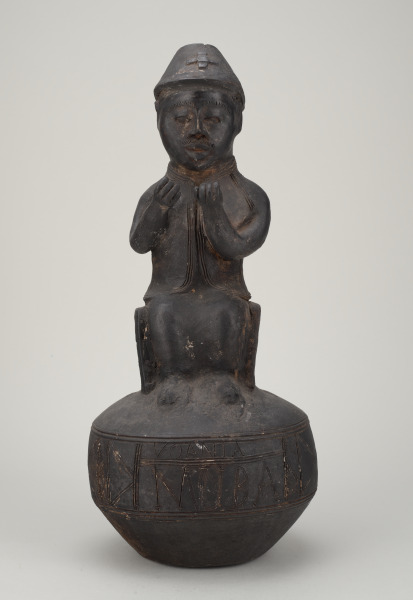
Vessel with Cup (Akarum)
Turkana, 1933-1966
Scroll

Turkana
Vessel with Cup (Akarum)
Turkana, 1933-1966
Physical Qualities
Wood, leather, cowrie shells, metal, pigment, 18 7/8 H (w cup) x 7 7/8 D in. (48 H w cup x 20 D cm.)
Credit Line
Gift of Carolyn Barnes, Alexandria, Virginia, in Memory of Murvil and Katherine Barnes
Object Number
1998.588.1-2
In an ecosystem hostile to permanent agriculture, a family’s survival revolved primarily around the formation and maintenance of a large and healthy herd of cattle, goats, and camels. These animals, and the milk and meat they provided,
were among the only consistent sources of nutrition throughout much of inland, east Africa, and movement between watering holes and grazing fields was frequent. Unsurprisingly, containers for storing and consuming water, milk, and meat are among the most common objects produced by this region’s nomadic populations. Engineered for life on the move, the shape of these lightweight
objects was designed to enhance their portability. Note the gentle curve on the incised Maasai vessel. It is easy to imagine how this object, displayed here with its animal hide strap still intact, would have fit over the shoulder of a man or woman traveling across the highlands of Kenya or Tanzania. However, the beads and careful geometric designs indicate that these objects were created with an eye toward beauty. Even the negative space of the humble Turkana bowl echoes the shape of the Turkana shield displayed behind you. Taken together, these works demonstrate that even the most functional objects were created with an eye toward aesthetics.
The Baltimore Museum of Art by gift, 1998; collected by donor in Turkanaland in northern Kenya in 1972 while on assignment for USAID.
Design for Mobile Living: Art from Eastern Africa
VANISHING AFRICA, pp. 142-143.
Horrobin, David F. A Guide to Kenya and Northern Tanzania. Aylesbury (UK): Medical and Technical Publishing, 1971, p. 32.
Robbins, L. H. “Turkana Material Culture Viewed from an Archaeological Perspective.” World Archaeology vol. 5, no. 2 (Oct., 1973): pp. 209-214.
Fedders, Andrew and Cynthia Salvadori. Turkana Pastoral Craftsmen. Nairobi, Kenya: Transafrica Book Distributors in association with East African Literature Bureau, 1977.
See sections “Pastoral craftsmen."
Brown, Jean. “The Useful Arts of Kenya.” African Arts vol. 13, no. 4 (Aug., 1980): p. 78.
Sieber, Roy. African Furniture and Household Objects. New York: American Federation of Arts, 1980, pp. 178-9.
Burt, Eugene C. East African Art in the Collection of the Seattle Art Museum. Seattle, WA: Seattle Art Museum, 1985, p. 28, no. 21.
McCabe, J. Terrence and James E. Ellis. “Beating the Odds in Arid Africa.” Natural History vol. 96, iss. 1 (Jan., 1987): p. 35.
Donovan, Alan. ”Turkana Functional Art.” African Arts vol. 21, no. 3 (May, 1998): pp. 44-47, fig. 1, 2, 6.
Horrobin, David F. A Guide to Kenya and Northern Tanzania. Aylesbury (UK): Medical and Technical Publishing, 1971, p. 32.
Robbins, L. H. “Turkana Material Culture Viewed from an Archaeological Perspective.” World Archaeology vol. 5, no. 2 (Oct., 1973): pp. 209-214.
Fedders, Andrew and Cynthia Salvadori. Turkana Pastoral Craftsmen. Nairobi, Kenya: Transafrica Book Distributors in association with East African Literature Bureau, 1977.
See sections “Pastoral craftsmen."
Brown, Jean. “The Useful Arts of Kenya.” African Arts vol. 13, no. 4 (Aug., 1980): p. 78.
Sieber, Roy. African Furniture and Household Objects. New York: American Federation of Arts, 1980, pp. 178-9.
Burt, Eugene C. East African Art in the Collection of the Seattle Art Museum. Seattle, WA: Seattle Art Museum, 1985, p. 28, no. 21.
McCabe, J. Terrence and James E. Ellis. “Beating the Odds in Arid Africa.” Natural History vol. 96, iss. 1 (Jan., 1987): p. 35.
Donovan, Alan. ”Turkana Functional Art.” African Arts vol. 21, no. 3 (May, 1998): pp. 44-47, fig. 1, 2, 6.