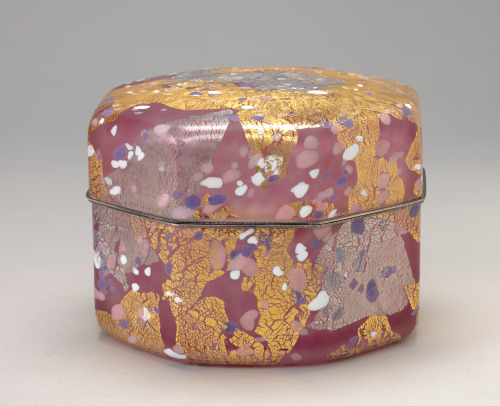
Kyohei Fujita
“Village of Fallen Flowers” Glass Box
1987
Scroll
Kyohei Fujita
“Village of Fallen Flowers” Glass Box
1987
Physical Qualities
Glass, gold and platinum leaf, silver, 7 x 7 x 5 in. (17.8 x 17.8 x 12.7 cm.)
Credit Line
Gift of Linda and G. Arnold Kaufman, Baltimore
Object Number
2017.163
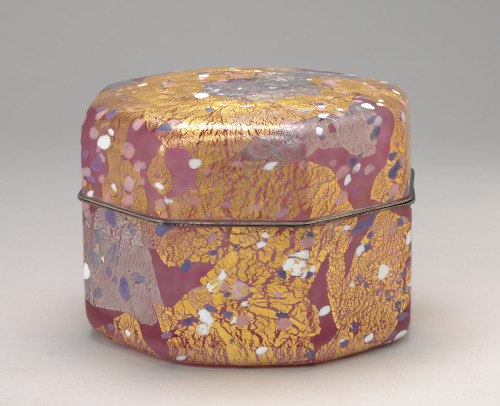
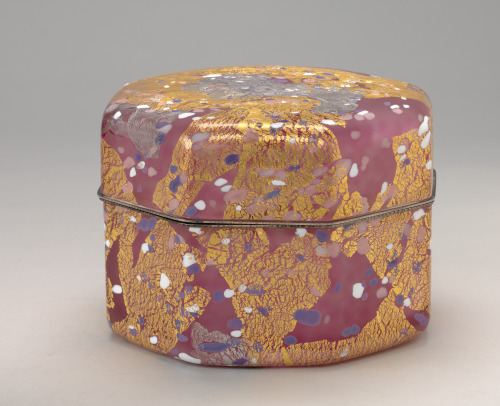
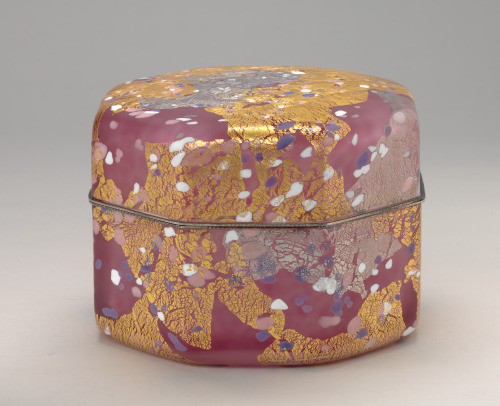
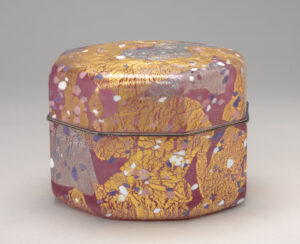
Kyohei Fujita’s glass box is a study of surface texture and allegory. Fujita was one of the first artists to raise glass-making from an industrial production to an artistic medium in mid-twentieth-century Japan. The shape is made by blowing melted, mauve glass into lid and base molds. Added flecks of molten white, pink, and purple float in the glass like fallen petals. Sheets of gold and platinum wrap the closed container in striations, perhaps alluding to a village beside water. These multi-toned surfaces recall decorative patterns in Rinpa School painting from the Edo period (1615-1868) which drew from Yamato-e painting of the Heian period (794-1185). The name of this box derives from chapter 11 of the Heian novel The Tale of Genji by noblewoman Murasaki Shikibu (970-1016) titled, “Village of Fallen Flowers.”
The Baltimore Museum of Art by gift, 2017; Arnold and Linda Kaufman, Baltimore, by purchase, 1988; Heller Gallery, New York
New Arrivals: Gifts of Art for a New Century
American Wing Rotations 2022
Silbert, Susie J, ed. "New Glass Now: 40th-Anniversary Issue of New Glass Review," ill. p 264