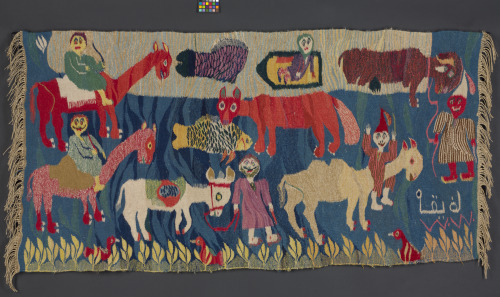
Workers in the Nile Marsh

Fayek Nicolas and Wissa Wassef Art Center

Workers in the Nile Marsh

1951-1961
Scroll

Workers in the Nile Marsh

1951-1961

Physical Qualities Hemp warp, wool weft, 36 x 76-1/2 in. (91.5 x 194.4 cm.); w/o fringe: 36 x 69-1/2 in. (91.5 x 176.6 cm.)
Credit Line Gift of Dena S. Katzenberg, Baltimore, MD.
Object Number 1993.520
A rectangular tapestry-woven hanging depicting people and animals along the banks of the Nile River in Egypt. The upper portion of the scene appears to represent the river with light blue and beige colored wefts depicting the water. The lower and larger portion appears to represent land depicted with a dark blue background. At the upper right a man wearing a striped tunic and fez leads a water buffalo out of the river. A second man in a striped tunic and fez rides a two-humped camel in the right foreground. A third man leads a donkey in the foreground at left. Just above this a fox carries a large yellow fish in its mouth. Two more men appear on camels at the left. At the top a figure appears on a boat or raft with a large purple fish nearby. At the bottom of the tapestry, water fowl swim along amidst the marsh grasses. Colors used for the patterning include white, three shades of blue, green, black, tan, rose, purple, red, brown, yellow-gold, and intermediate colors created by blending of yarns of different colors. The tapestry is woven on hemp warps (8 per inch; fiber i.d. by Christine Downie, objects conservator) with wool wefts (approx. 15 per inch) dyed in bright colors. The warps run horizontally and the pattern wefts run perpendicular to the warps when displayed. Warp fringes approx. 3" long finish the work at both short ends.
Baltimore Museum of Art by gift, 1993; Dena Katzenberg by purchase, 1973; David B. Williams, Phoenicia-Lost World Art, Box 702, Sonoma, CA.
Tony Horwitz, 'In Pyramids' Shadow, A Weaving Workshop,' The Wall Street Journal, Leisure & Arts section, August 24, 1989.

'Tapisseries de L'Atelier de Ramses Wissa Wassef, Egypte,' May 1973, La Demeure, Paris.

Dena S. Katzenberg, 'Tapestries from Egypt Woven by the Children of Harrania,' The Baltimore Museum of Art Record, Vol. 3, No. 8 (May 1973), p. 2.

W. & B. Forman and Ramses Wissaf Wassef, trans. by Jean Layton, Tapestries from Egypt Woven by the Children of Harrania, London: Paul Hamlyn, 1961.

John Feeney, 'Tapestries of Harraniya,' Aramco World Magazine, Vol. 33, No. 5 (September-October 1982), pp. 32-41.

Inscribed: Woven into tapestry in rose-red threads at the lower right are the initials of the atelier: 'W.W.' [Wissa Wassef]; Woven into the tapestry in white arabic letters at the lower right above the atelier initials: ' ' [trans. according to Dr. Siham Osman is 'Fayah' except that the last letter is turned backwards as if done by a small child.] Attached to reverse is printed white fabric label which reads differently front and back: Obverse: Symbol or trademark including triangle or delta with rounded corners into which grows a flower, the top of which has a bird motif. Around the floral design are letters "HARRANIA". Below are abstract bird-like designs and the letters "ATELIER RAMSES WISSA WASSEF" on one line. Below this are block letters in black with letter appearing in white on black ground "MITIH" H may be N. There may be a space between T and H rather than an I] Reverse: Again have delta with rounded corners, flowering stalk, bird like geometric designs. outside of delta are four llines of writing, possibly in Arabic. Printed black paper label on reverse of frame: "FRAMED BY FERDINAND ROTEN GALLERIES, INC. 123 W. Mulberry St.Baltimore, Md. 21201 R"

Weaver

Fayek Nicolas

2000–2000
One of the first generation weavers at the Ramses Wissa Wassef Art Centre in Harrania, Egypt. Egyptian translator said name woven into work was "Fayah" but "Fayek" is the only name remotedly similar.
Meet Fayek →

School

Wissa Wassef Art Center

1951–2010

established 1952
Meet Wissa →

Explore the Collection Further

BY SAME ARTIST
TEXTILES
LaToya Ruby Frazier
More Than Conquerors: A Monument for Community Health Workers of Baltimore, Maryland 2021-2022
2021
Gayle Fraas and Duncan W. Slade
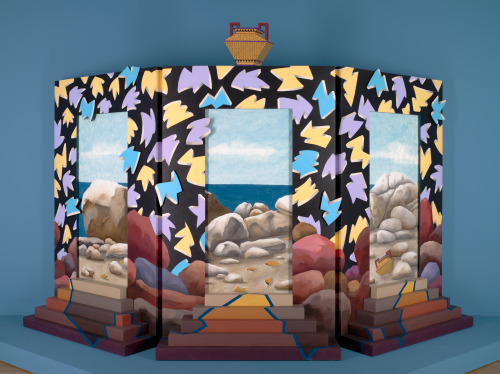
Marsh Island
1985
George Keating and Henry Singleton
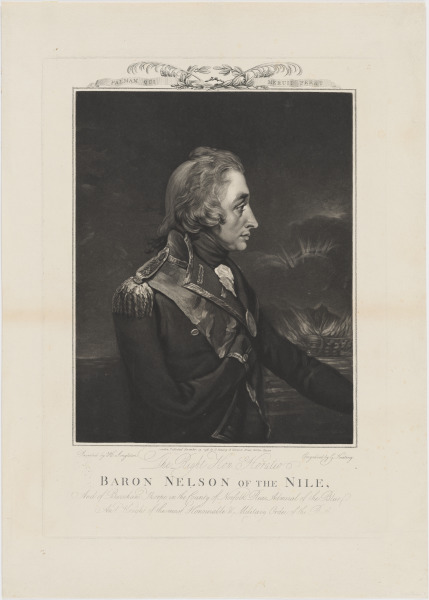
Baron Nelson of the Nile
1797
Thomas Hodgetts, John Boaden, and others
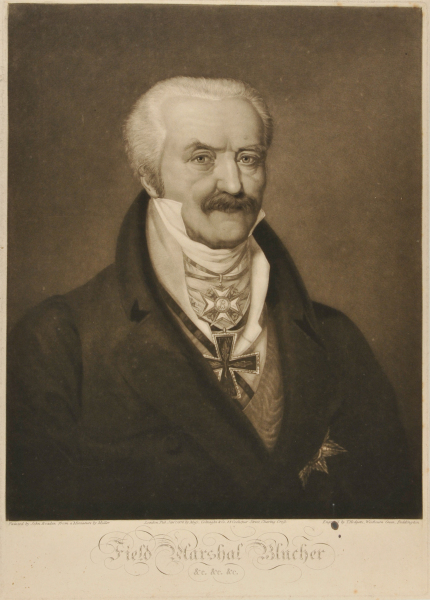
Field Marshall Blucher
1815
Ralph McGuire
Two Workers in Front of a Liquor Store
1944
Johann Baptist Wilhelm Adolf Sonderland, Schulgen-Bettendorf, and others
Workers at Evening
1832–1842
Marco San Martino
The Infant Moses Set Adrift on the Nile
1634–1679
Henry Farrer
Old House on the Marsh
1876
George Thomas Doo and Sir Thomas Lawrence P.R.A.
Field Marshal H. R. H. Duke of York
1823
Alfred Alexandre Delauney
Marshy Pool
1849–1893
Alfred Alexandre Delauney
River Landscape with Marshes
1849–1893
Alfred Alexandre Delauney
Marshy Pool
1849–1893