Jean-Henri Riesener
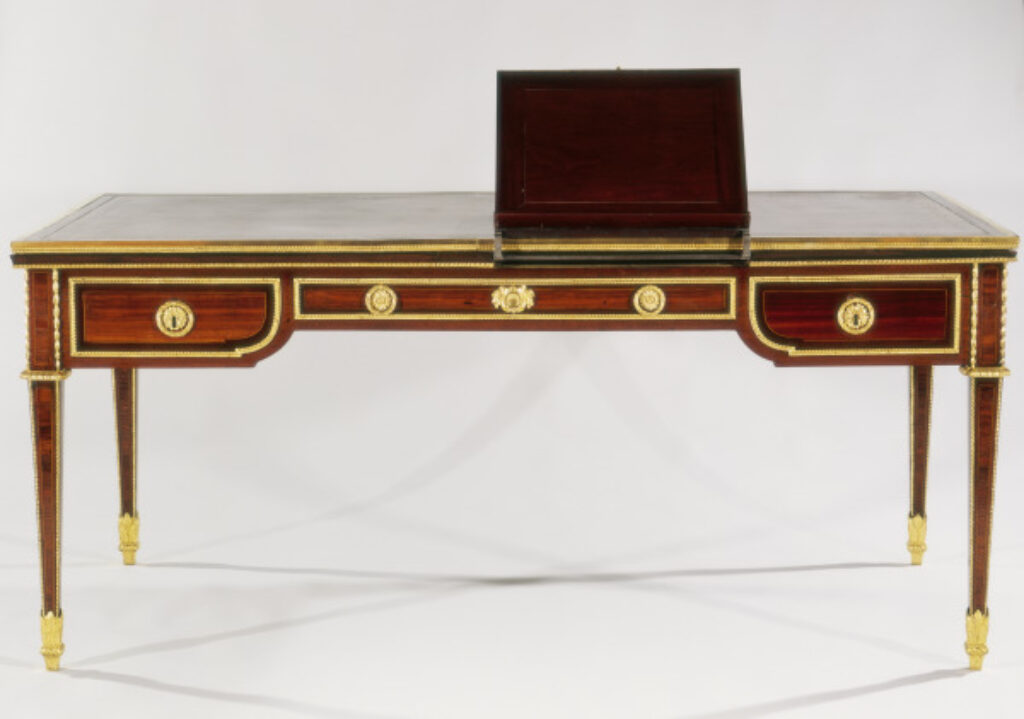
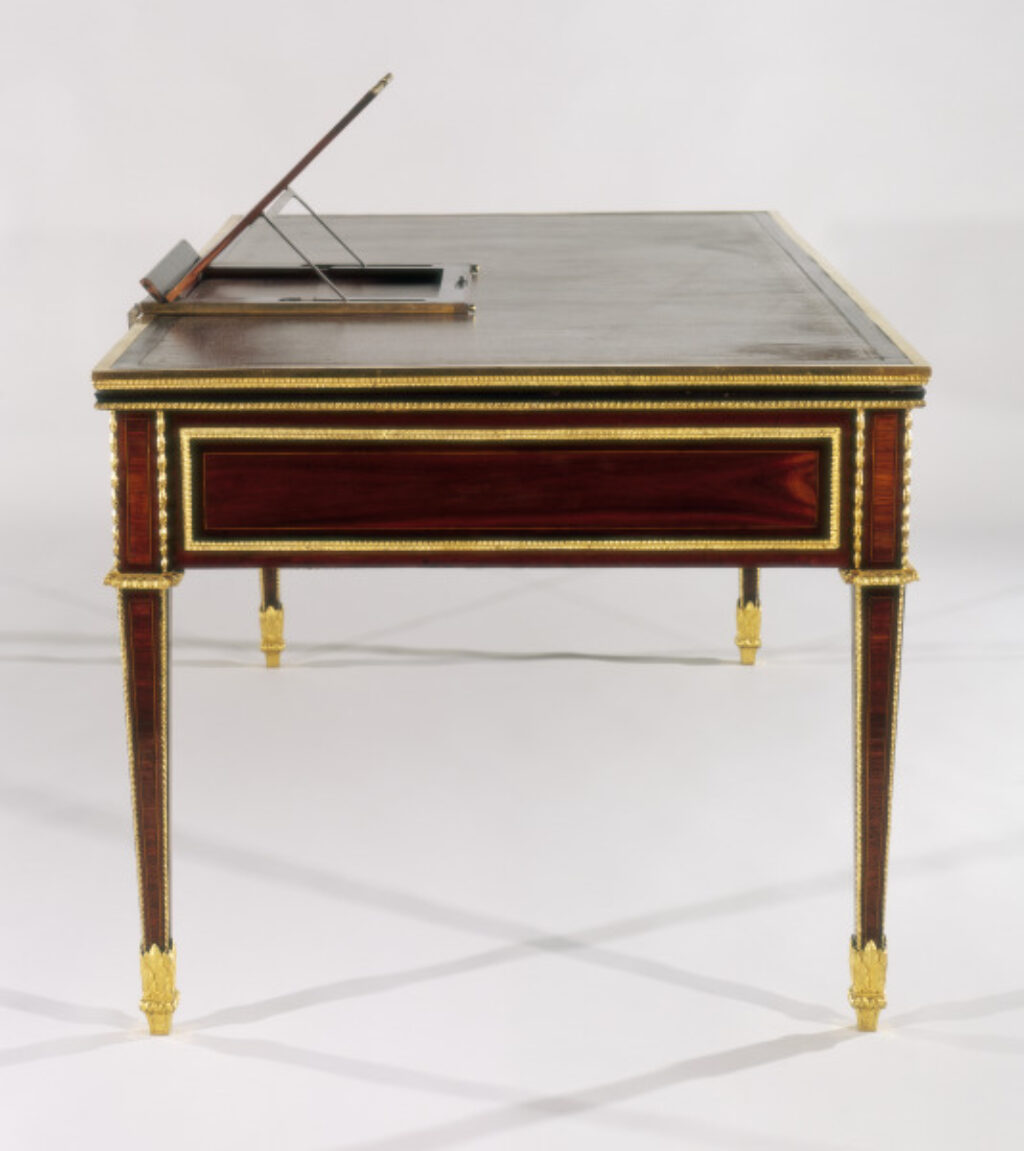
Writing Table (Bureau Plat)
1784
Scroll
Jean-Henri Riesener
Writing Table (Bureau Plat)
1784
Physical Qualities
Oak (structure); mahogany and rosewood; secondary woods include veneers of mahogany and rosewood, holly and ebony stringing inlays, and veneers of bloodwood (satiné) and possibly purpleheart; gilt bronze, gilt brass, and steel., 30 3/8 x 67 7/8 x 35 5/8 in. (77.2 x 172.4 x 90.5 cm.)
Credit Line
The Mary Frick Jacobs Collection
Object Number
1938.275
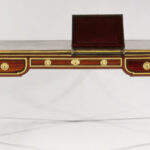
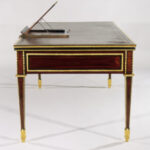
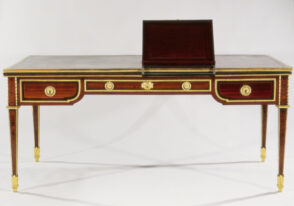
The significance of reading and writing in 18th-century France can be seen in the costly materials used to create this writing table; imported mahogany, ebony, gilt bronze and brass. Writing tables, or desks, were designed for libraries of elite residences where several hours a day were spent on written correspondence. This desk has innovative mechanical features, including a movable book support and extendable leaf for the owner's secretary to take dictation. Its maker, Jean-Henri Riesener, was the royal cabinetmaker of Queen Marie-Antoinette of France (1755-1793). Riesner was a leader of French neoclassicism, a style which emphasized symmetrical lines and classical motifs- like laurel wreaths- popularized by archaeological excavations of Roman sites during the 18th century.
Conservation Close-Up
In the early 2000s, conservators treated this writing table to stabilize its mechanical elements. Although refined in engineering, the large extension leaf- incorporated into the main body of the piece- and its mechanical devices caused increased stress for the table. The central section began to settle rupturing some veneers and drawer surrounds. Furniture conservators fabricated a non-intrusive brace to correct such structural problems. Conservators also restored the briliance of the gilt bronze and brass and carefully replicated the original 18th-century tooled leather tabletop.
The Baltimore Museum of Art by bequest, 1938; Mary Frick Jacobs, Baltimore
'BMA News,' April, 1958


 On View at the BMA
Explore the Collection Further