




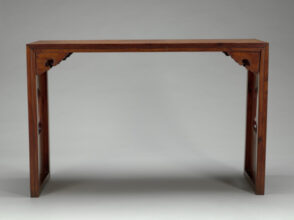
Zither (Qin) Table
1699
Physical Qualities
Rosewood (huanghuali), 31 1/4 x 48 3/8 x 15 9/16 in. (79.5 x 123 x 39.5 cm.)
Credit Line
Julius Levy Memorial Fund
Object Number
1951.37
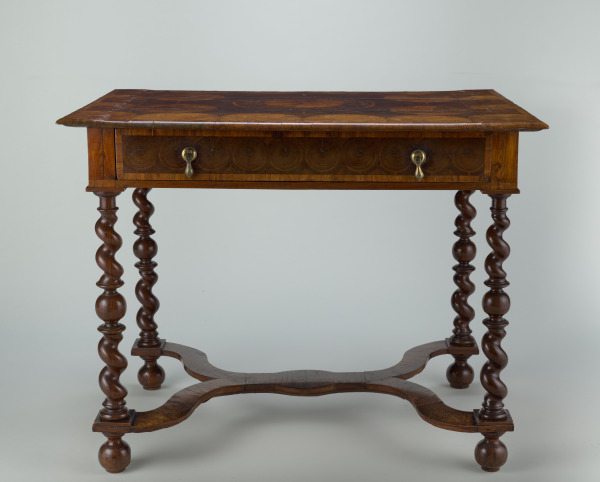
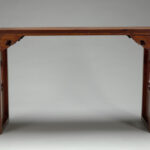
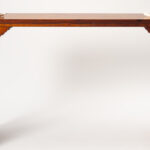
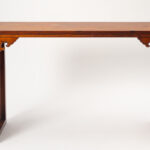
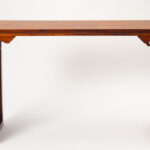
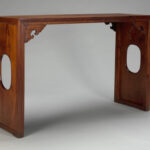
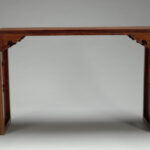
This table, made to hold a long, flat, stringed musical instrument, was constructed of a beautifully patterned hardwood. Huang huali is a strong and light material, admired especially for its almost translucent polished appearance. The beauty of the wood is enhanced by the simplicity of the design which features a single-board top, and legs pierced by carefully placed ovals. The brackets at the tops of the legs recall the shape of upside-down bats in flight, a symbol of happiness, and a suggestion of the contentment felt by the person playing the zither or any privileged guests gathered to listen.
The qin (today, guqin) is one of China's oldest and most revered musical instruments, closely associated with Confucius (551–479) and the Huizong emperor (reigned 1101–25) of the Song dynasty (960–1279). A quiet instrument, the qin's strings vibrate to produce plucked tones, sliding tones, and overtones. The instrument's case also resonates. Originally the qin had five strings, but modern guqins have seven.
The storage jar in the center of this gallery shows a sage in exile, accompanied by an attendant who carries a wrapped qin. Associated with meditation and prolonged life, the instrument long has been the companion of scholars and the subject of literature and painting. The poet Tao Yuanming (365–427), the subject of the blue-and-gold vase in the case to the right, wrote a famous couplet that speaks poignantly to the presence of such an august instrument in a museum:
Having acquired the qin's inner significance,
why take the trouble of putting on the strings to play it?
In 1977, NASA sent Voyager 1 and 2 into space carrying recordings of sounds representing humanity. The longest of the musical selections, Liu Shui (Flowing Water) performed by Guan Pinghu, was played on a qin.
Intersection: Tabels & Chairs, Nov 22, 2017 - Dec 2, 2018:
Inspired by European chairs that were introduced to West Africa by the Portuguese during the 16th century, this chair merges foreign styling with indigenous form, function, and scale. In addition to providing comfort and support for sitting, the seat could also serve as a headrest. It was a distinct honor for young Gere and Dan girls to borrow such seats from their grandfathers and use them in initiation dances for coming of age ceremonies. The multicultural influences and dual purposes of this chair, as well as its use by young and old, male and female, give it a hybrid nature that recalls the way disparate qualities come together in Artschwager’s Drawing of Table.
The Baltimore Museum of Art by purchase, 1951; William R. Drummond
"17th and 18th Century Chinese Furniture," Jun 16, 1946 - Sep 15, 1946, BMA.
"Intersection: Tabels & Chairs", Nov 22, 2017 - Dec 2, 2018, BMA.
Gustave Ecke, "Chinese Domestic Furniture," Peking, 1944, no. 60, pl. 77.
"Chinese Furniture," "BMA News," June 1946, p. 1, ill.
Jeanne Chapman, "The Baltimore Museum's 1946 Exhibition of Chinese Furniture," "Journal of the Classical Furniture Society," vol. 3, no. 3, summer 1993, pp. 67-70, ill. p. 68 and 69.