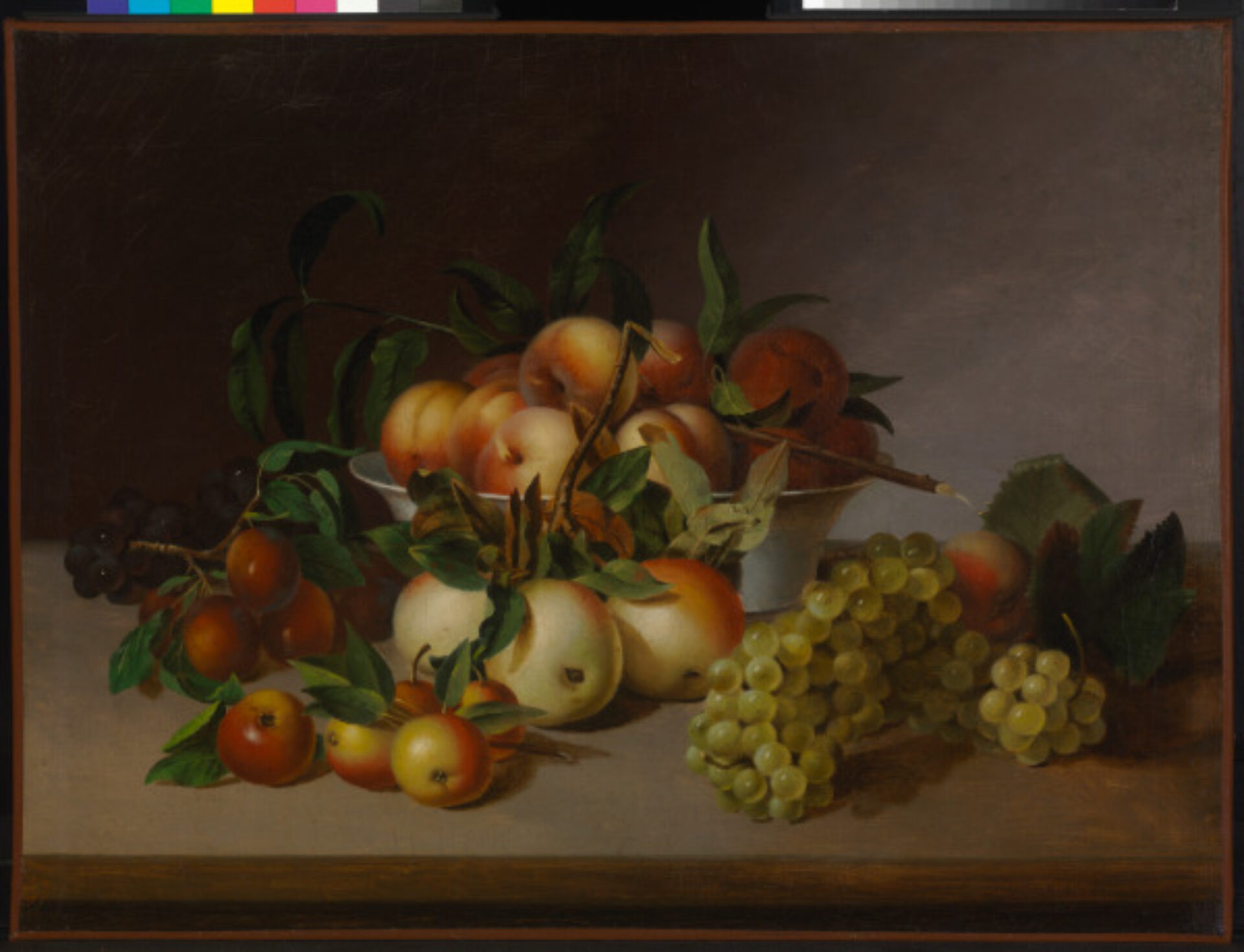
Still Life with Bowl of Peaches and Grapes
0:00
/
1:13
James Peale
Date:
c.1824-1831
Medium:
Oil on canvas
Size:
Width: 23 1/2″
Height: 19 1/4″
James Peale, eight years younger than American master Charles Willson Peale, joined his brother as a frame-maker after Charles returned in 1769 from studies in London with Benjamin West. Within a few years, James was painting as well, creating still lifes inspired by Dutch art. Unlike Charles, James never traveled abroad, but he did have access to Dutch paintings in Philadelphia. His work was regularly shown in the annual exhibitions of the Pennsylvania Academy of the Fine Arts. By 1823, at least one still life by James was in a Baltimore collection and was featured in the Second Annual Exhibition of the Peale Museum in Baltimore. Although still life was considered a lowly form of art in the hierarchy of academic painting, such pictures continued to find patrons throughout the 19th century. Today, works such as Still Life with Bowl of Peaches and Grapes are counted among the finest American pictures created during the Federal period.
Gift of William Bose Marye, Baltimore BMA 1948.14
Additional Audio
Transcript
[Aneta Georgievska-Shine] James Peale. He comes from a whole dynasty of Philadelphia-based painters.
This is an 18th century family of painters who create almost like a mini school, the Peale school of painting,
by learning from each other and conveying the tradition from one generation to the next.
[Aaron Henkin] So what I’m hearing you say is that what we’re looking at right now is the very beginnings of
art as a profession in America.
[Aneta Georgievska-Shine] In some ways you’re absolutely right. The very beginnings of art as a profession
in America, that’s what’s happening here.