[Cecilia Wichmann] I’m Cecilia Wichmann, Curator and Head of Contemporary Art at the BMA.
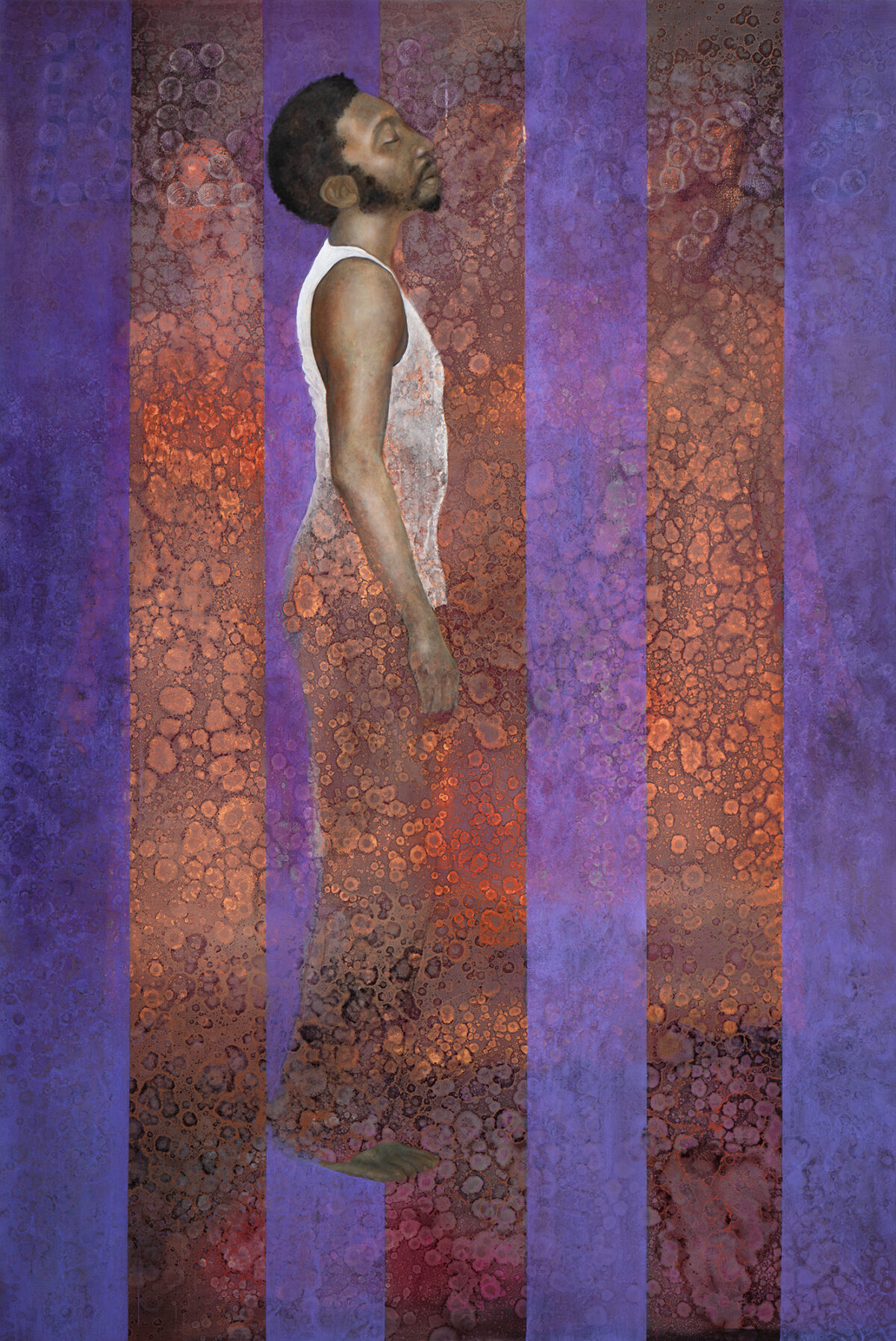
This is "Hangman," painted in 2007, making it the earliest work in the exhibition. In it, a man in profile floats as if submerged in bands of purple and rust-orange. Sherald created this textured surface by layering colors of paint and dripping turpentine to let the tones beneath show through. The result is luminous, like air or water absorbing the figure.
"Hangman" represents a turning point in Sherald’s career both in content and form. She has described this painting as a “reverse lynching” and it is the most direct visual reference to the legacy of racial terror in the United States. Rather than depicting violence or suffering, Sherald imagines transcendence—a moment of peace, of the body freed from harm. The subject floats. His head tilts upward and his eyes are closed, as if in quiet meditation or contemplation.
This was the first painting she made after committing to representing the fullness and beauty of Black life—most often through portraits of singular Black figures. You can faintly make out self-portraits hovering, nearly invisible, in the ground layers. The next year, she would begin painting her subjects in shades of gray, or grisaille, focusing our attention on the inner life of each person.
In this way, "Hangman" opens a new path in Sherald’s practice.
Amy Sherald
(1973)
Date:
2007
Medium:
Oil on canvas
Size:
Width: 67″
Height: 100″
Made in Baltimore and featuring a Baltimore-based model.
A full-body painting of a man dark-toned skin shown in profile, wearing a white tank top, with his eyes closed and head tilted up. His body is partially transparent, blending into a background of alternating purple and mottled orange-brown vertical stripes.