Antoine-Louis Barye
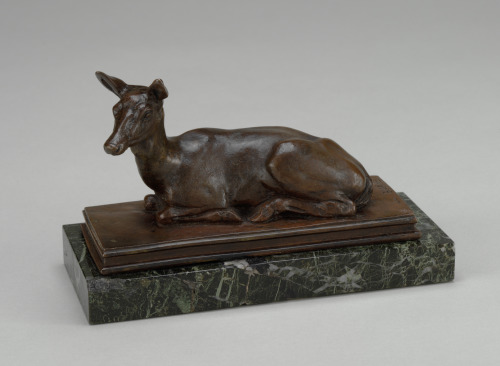
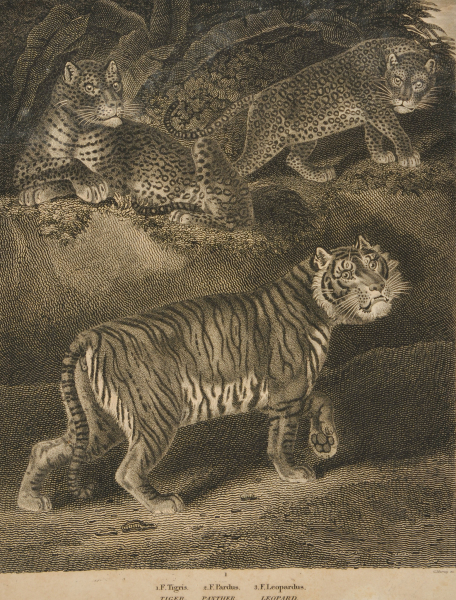
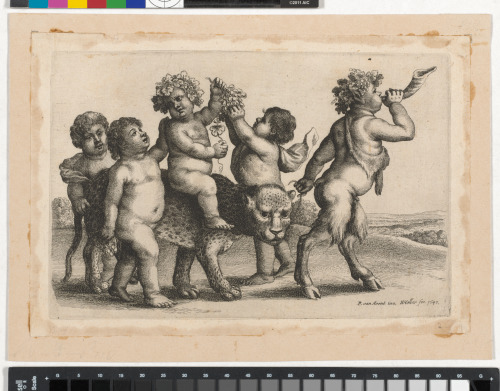
(a) Théséé combattant le centaure Bienor (esquisse); (b) Panthère marchant; (c) Léopard
1825-1908
Scroll
Antoine-Louis Barye
(a) Théséé combattant le centaure Bienor (esquisse); (b) Panthère marchant; (c) Léopard
1825-1908
Physical Qualities
Bronze, a: brown-red-green patina; b&c: brown patina, (a) 13 1/2 H x 14 5/8 L x 6 D in.
(b) 3 1/8 H x 5 3/4L in.
(c) 3 1/16 H x 5 3/4 W in.
Credit Line
The George A. Lucas Collection, purchased with funds from the State of Maryland, Laurence and Stella Bendann Fund, and contributions from individuals, foundations, and corporations throughout the Baltimore community
Object Number
1996.46.41a-c
(A)Theseus is shown astride the Centaur (seated on a cloth that is draped down the centaur's proper right side and through his hind legs) with his (Theseus) proper right arm raised and ready to strike the Centaur with what looks like a small club, while he pushes the Centaur's head away with his proper left hand. The Centaur's head is thrown back over Theseus's proper rith leg, and his proper right hand is gripping Theseus's proper left arm, while he pushes Theseus in the chest with his proper left hand. The Centaur is rearing back with his proper left front leg raised, and proper right hind leg bent and forward; his bushy tail is also raised. Theseus is seated on a cloth that is draped from the centaur's proper left side under its body and through its hind legs. The modeling of the muscular figures of man and horse owe much to Greek Hellenistic sculpture. Base: oval rocky ground; no rim; sculpture is mounted on the sliding top of an elaborate wooden box; the top slides to the viewer's right.
(B)Bas-relief plaque depicting a panther walking. The panther's right foreleg and proper right hind leg are forward; its tail is curled between its hind flanks; its head slightly lowered, and its mouth closed. The ground is depicted as a shallow straight line. Border: none; plaque is inserted in base of an elaborate wooden box.
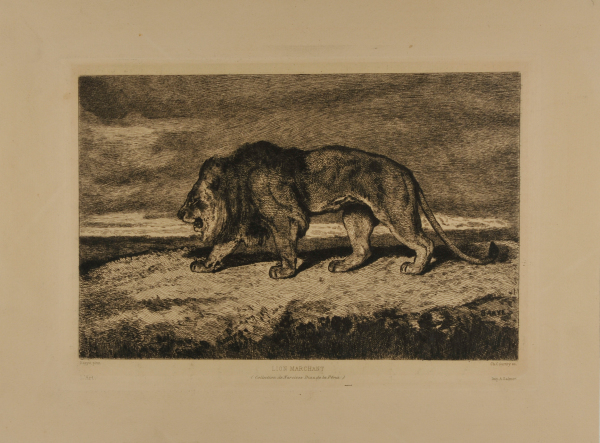
(C)Bas-relief plaque depicting a lion walking with its proper right front and back legs forward; its head raised and mouth open; its tail curled down between its hind legs. The ground is depicted as a shallow straight line. Border: none; plaque is inserted in base of an elaborate wooden box.
The Baltimore Museum of Art by purchase, 1996; from Maryland Institute, College of Art, Baltimore, by gift 1910; from Henry Walters, Baltimore, by bequest 1909; from George Aloysius Lucas, Paris
Pivar: F22 (p. 70) 35 x 35 cm. (A) Photo in book: Photograph couretesy of Walters Art Gallery. Note: Does not match photo in book; different base.
Pivar References: F 21, p. 69 and F 22, p. 70 (A)
Pivar References: R 11, p. 246 (B); R 11, p. 246 (C)
Michel Poletti and Alain Richarme, "Barye Catalogue Raisonné des Sculptures," Paris: Gallimard, 2000, pl. 62 p. 111 (A); pl. 369, p. 361 (B); pl. 368, p. 360 (C).
Lillian M. Burgunder, "Antoine-Louis Barye Sculptures and Decorative Objects in the Collection of The Baltimore Museum of Art," September 2006, pp. 170 (A), 181(B), 182 (C).
Sotheby's, "19th & 20th Century European Sculpture," London Sale, 23 November 2010, Lot 31, bought in (£ 20,000-30,000).
Pivar References: F 21, p. 69 and F 22, p. 70 (A)
Pivar References: R 11, p. 246 (B); R 11, p. 246 (C)
Michel Poletti and Alain Richarme, "Barye Catalogue Raisonné des Sculptures," Paris: Gallimard, 2000, pl. 62 p. 111 (A); pl. 369, p. 361 (B); pl. 368, p. 360 (C).
Lillian M. Burgunder, "Antoine-Louis Barye Sculptures and Decorative Objects in the Collection of The Baltimore Museum of Art," September 2006, pp. 170 (A), 181(B), 182 (C).
Sotheby's, "19th & 20th Century European Sculpture," London Sale, 23 November 2010, Lot 31, bought in (£ 20,000-30,000).
Inscribed: Signed on base: 'A.L.BARYE'. Three labels bottom of base: L.64.15.49; BMA cat. #412,A,B; 6.667.97a. White paint, center of base: 'Lucas'(underlined). Signed bottom of lid in white paint: 'Lucas' (underlined).