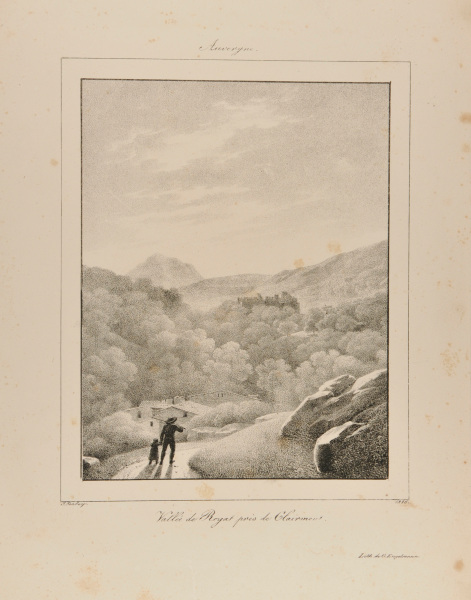






Théophile Narcisse Chauvel
At Trembleaux near Marlotte
1861
Physical Qualities
Etching, Sheet: 190 x 254 mm. (7 1/2 x 10 in.)
Plate: 148 x 216 mm. (5 13/16 x 8 1/2 in.)
Credit Line
The George A. Lucas Collection, purchased with funds from the State of Maryland, Laurence and Stella Bendann Fund, and contributions from individuals, foundations, and corporations throughout the Baltimore community
Object Number
1996.48.11032
The Forest of Fontainebleau is celebrated not only for its
lush greenery but also for its distinctive limestone and
sandstone rock formations. Weathered boulders, rocky
outcrops, and dramatic gorges formed in this area over
millions of years of erosion. These sites became popular
destinations for tourists and hikers, as well as geologists
and naturalists. Artists including Théophile Chauvel and
Théodore Rousseau found inspiration in the beauty of the
rugged landscape and these traces of prehistoric weather.
While Rousseau’s etching incorporates the rock formations
as part of an ecosystem, Chauvel’s work draws attention to
their stark geometry through the play of natural light and
shadow on stone.
The Baltimore Museum of Art by purchase, 1996; The Maryland Institute College of Art, through Henry Walters, Baltimore, by bequest 1909; from George A. Lucas, Paris
Joanna Karlgaard and Robin Owen Joyce, BMA, "Deconstructing Nature: Environmental Transformation in the Lucas Collection," August 27, 2025 - January 11, 2026.
Inscribed: Signed in plate: lower right "T. Chauvel"
Markings: Watermark: Hudelist