Lamy et Giraud (1884-1910) now Prelle et Cie. (founded 1752) and Gillow & Co., Lancaster and London, 1728-1962 (later Waring & Gillow)
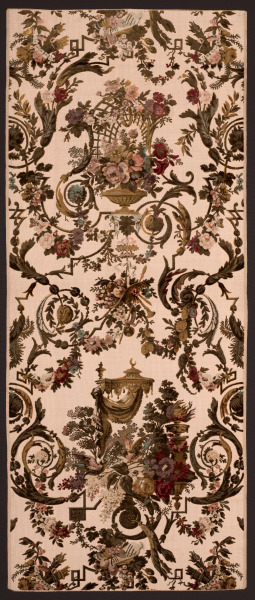
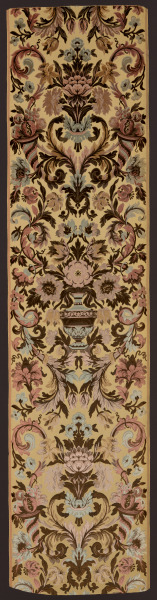
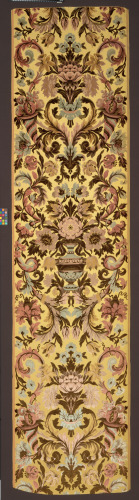
Baroque Revival Voided Ciselé Velvet with Central Urn and Floral Bouquet
1875
Scroll
- Manufacturer: Lamy et Giraud (1884-1910) now Prelle et Cie. (founded 1752)
- Retailer: Gillow & Co., Lancaster and London, 1728-1962 (later Waring & Gillow)
Baroque Revival Voided Ciselé Velvet with Central Urn and Floral Bouquet
1875
Physical Qualities
Silk, 90 1/2 x 21 7/8 in. (229.9 x 55.6 cm.)
Credit Line
The Jane and Worth B. Daniels, Jr. Fund
Object Number
2007.309
Many Victorian textiles were designed to recall historical eras. This luxurious French velvet, produced in the silk weaving capital of Lyon for the London decorating firm Gillow & Co. (1728–1962, later Waring & Gillow), represents a revival of the Baroque style. Its bold scrolling leaves and naturalistic daffodils, tulips, and chrysanthemums spill over their vases in perfect balance, suggesting the wealth and stability of the grand mansions of both established and nouveau riches.
This voided ciselé velvet (having both cut and uncut pile restricted to certain areas) features the large symmetrically arranged floral pattern, urns and cornucopia characteristic of fabrics of the 17th century. However, as a textile produced in 1876 by an important French manufacturer, Lamy & Giraud, for a well-established British furniture and decorating firm, it represents the revival of an earlier style once again fashionable among the upper class. Bold curving, scrolling leaves, naturalistic daffodils, tulips, and chrysanthemums spill over their vases in perfect balance, suggesting the wealth, abundance, and stability pervading the interiors of the grand mansions of both established and nouveaux riches. Created in the silk weaving capital of Lyon, this velvet shows a high degree of attention to technique and quality. Although the design is far more rigid than that of the rococo revival fabric displayed nearby, movement and variation are enhanced through the weave structure. A voided gold cannetillé ground (woven with short ribs on the surface to give the appearance of small monochrome checks) reflects the light that the looped uncut pile partially absorbs. The cut pile absorbs even more light, thus producing deeper shades from the same color of yarn used to create the uncut areas of pattern.
Baltimore Museum of Art by purchase, 2007; The Lotus Collection, San Francisco, CA by purchase, 1989; Spink & Sons, Ltd.
Curator's Choice Rotation
New Arrivals: Gifts of Art for a New Century
The Art of Textiles: An Exhibition for Sale by Spink & Son, LTD, 1989, by Francesca Galloway and Jacqueline Simcox; printed by BAS Printers Limited; page 147, item # 204.
Mary Schoeser and Kathleen Dejardin. French Textiles Ffrom 1760 to the Present.
Retailer
Gillow & Co., Lancaster and London, 1728-1962 (later Waring & Gillow)
2000–2000
Meet Gillow →