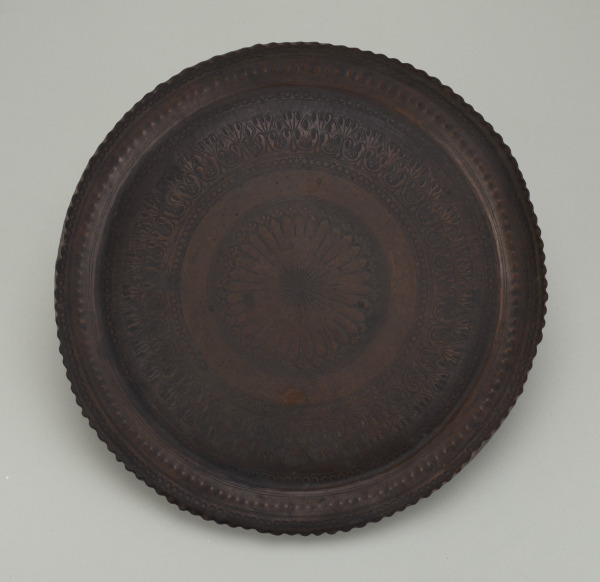

Bidriware Tray with Circular Medallion Design
Hindu, 1600-1899
Scroll

Bidriware Tray with Circular Medallion Design
Hindu, 1600-1899
Physical Qualities
Zinc-alloy, silver inlay, 7 1/2 in. (19.1 cm.) Diam.
Credit Line
Lockwood de Forest Collection
Object Number
1922.2.54
Persian artisans brought the technique of copper or steel inlaid with gold and silver to India under the patronage of sultans of the Bahmani dynasty (south and central India, 1347-1490). Named for Bidar, the place it was originally produced, the craft continues to be practiced in Hyderbad. Indian Bidriware is produced in a unique and complex process. The unique features of the ware include the use of zinc alloy as the ground metal and a mixture of a particular soil with chemicals to produce the distinctive black color.
Bidriware is basically made of an alloy of zinc and copper. After being cast in a mold, the article is smoothed and then treated with copper sulphate to turn the surface dark temporarily so the hand-drawn design will be visible. In three successive steps, the design is outlined, chiseled and inlaid with silver wire or flattened chips. The unfinished article is then buffed to make its surface smooth. A paste made of local soil mixed with aluminum oxide or ammonium chloride and water is rubbed over the surface of the heated vessel, turning the metal alloy black but leaving the silver unchanged - a bright design against the dark ground.
The Baltimore Museum of Art by purchase, 1922; American Art Galleries, New York; Lockwood de Forest purchased in India, probably 1914
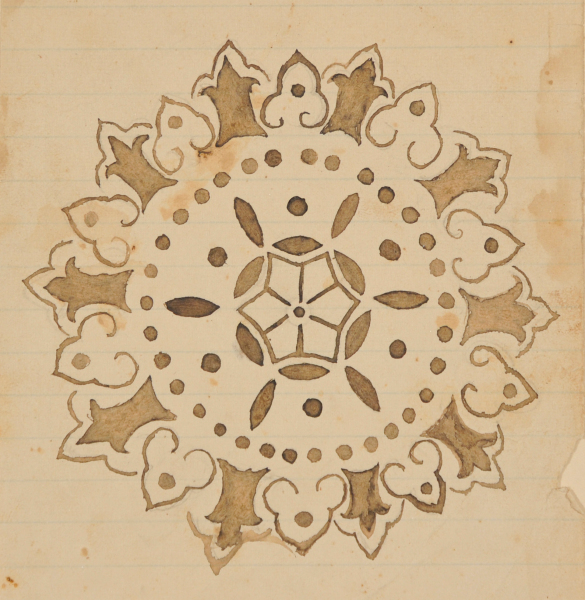
Ornamental Art of India
2025-05-23 00:00:00
2025-05-23 00:00:00
Catalogue of the Rare and Valuable Examples of East Indian Persian and Syro-Damascan Art and Curios forming the private collection of the widely known artist and connoisseur Lockwood De Forest, Esq. of New York City, NY: American Art Association, 1922, no. 174.
Anne Suydam Lewis, Lockwood de Forest Painter Importer Decorator, Huntington, NY: Hecksher Museum, 1976, pp. 4-10, 12-32.
Roberta A. Mayer, "The Aesthetics of Lockwood de Forest," "Winterthur Portfolio," 31:1, The Henry Hrancis du Pont Winterthur Museum, Inc., 1996, pp. 1-22.
Roberta A. Mayer, "The Aesthetics of Lockwood de Forest," "Winterthur Portfolio," 31:1, The Henry Hrancis du Pont Winterthur Museum, Inc., 1996, pp. 1-22.