Buddhist Priest’s Robe (Kesa) with Narcissus Design
1749-1867
Scroll
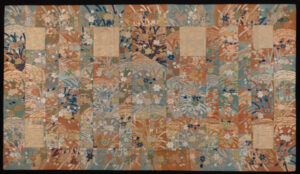
Buddhist Priest’s Robe (Kesa) with Narcissus Design
1749-1867
Physical Qualities
Silk, gold-leafed mulberry paper strips, 46 × 81 in. (116.8 × 205.7 cm.)
Mount (with plexi cover): 50 3/4 × 86 × 2 3/8 in. (128.9 × 218.4 × 6 cm.)
Credit Line
Gift of Elizabeth F. Cheney, Oak Park, Illinois
Object Number
1980.195
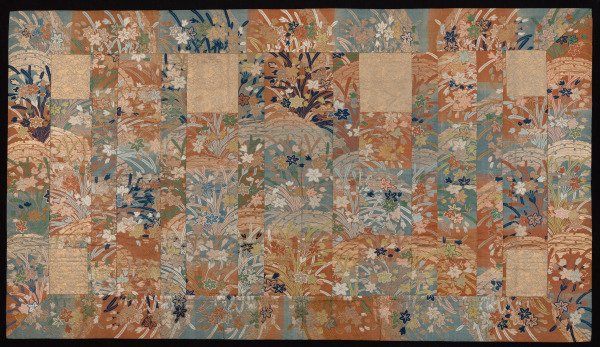
This kesa (priest’s robe) provides an expansive view of winter-blooming narcissus flowers crowding around a stream’s snowy banks. Wavy lines capture the water’s
movement while scalloped circles represent snowflakes.
More than a garment, the kesa is a symbolic depiction of the Buddhist realm based on the rows of a rice field arranged as a series of columns. The central and widest
column represents the Buddha. The two plain gold squares flanking the central column represent Buddha’s principal attendants, the bodhisattvas of benevolence and wisdom.
The four corner squares represent the Heavenly Kings who guard the four directions. When the kesa is worn, the priest becomes part of this symbolic diagram.
The Baltimore Museum of Art by gift, 1980; Elizabeth F. Cheney, Oak Park, Illinois, by purchase; Marshall Field & Company, Chicago
The Way of Nature: Art from Japan, China, and Korea
BMA Today, August/September 1999, ill. p. 9.
 On View at the BMA