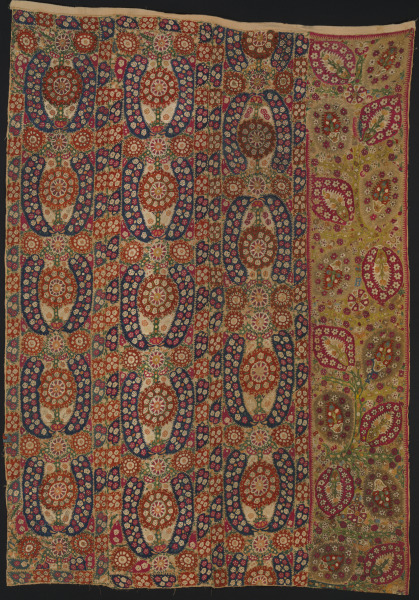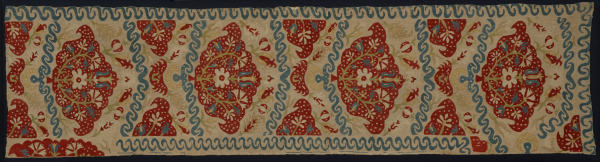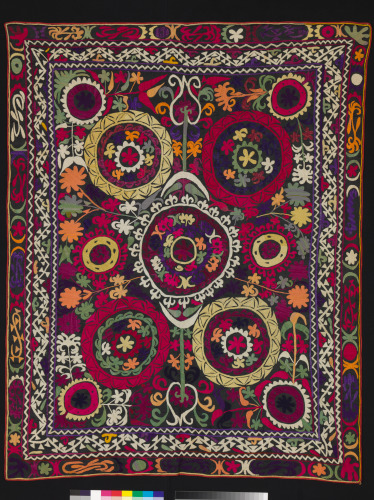

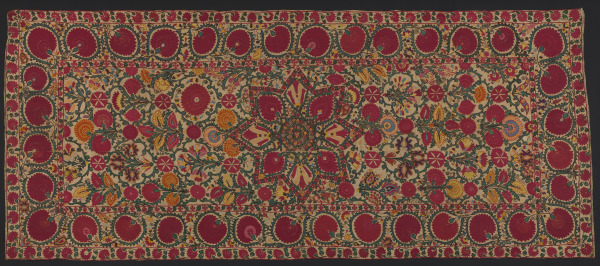
Embroidered Cover (borpush suzani)
Turkish Uzbek or Persian Tadjik tribes, 1800-1899
Scroll
Embroidered Cover (borpush suzani)
Turkish Uzbek or Persian Tadjik tribes, 1800-1899
Physical Qualities
Cotton ground, silk embroidery threads, silk piping, cotton backing, 90 1/4 x 37 3/4 in. (229.2 x 95.9 cm.)
Credit Line
The Cone Collection, formed by Dr. Claribel Cone and Miss Etta Cone of Baltimore, Maryland
Object Number
1950.1986.12
Label for:
"Collecting Matisse and the Modern Masters: The Cone Sisters," The Jewish Museum May 11, 2011 - September 25, 2011, circulating to The Vancouver Art Gallery, May 11, 2011-September 25, 2011, The Nasher Museum of Art November 1, 2012 - February 10, 2012:
Cover or Mat (Borpush Suzani), 19th century
Uzbekistan
Cotton, multicolored silk embroidery threads
The Baltimore Museum of Art: The Cone Collection,
BMA 1950.1986.12
Label for: "Textiles from the Cone Collection, Baltimore Museum of art, Sept. 2-Nov. 23, 1986, no catalogue:
BORPUSH
Uzbekistan, U.S.S.R.
Cotton ground, silk embroidery threads
The Cone collection
TNE 3.7
1950/86.12
Central Asian embroideries of this type are sometimes generally referred to as suzani (derived from the Persian word for needle "suzan"). However, a textile of this size is more correctly called a borpush. Such embroideries played a vital role in Central Asian society where they decorated the mosques and courts of the cities of Bokhara, Tashkent, and Samarkand. They also constituted the most prized items included in the dowries of prespective brides. An older woman in the family or a professional artist (kalamkash) drew the design. The panels were then separated, embroidered individually by the women of the bride's family, and reassembled, resulting in slight discrepancies in the pattern.
The Baltimore Museum of Art by gift, 1950; Etta Cone. Bequest of Etta Cone. Probably purchased by Claribel Cone.
Collecting Matisse and Modern Masters: The Cone Sisters of Baltimore
Levitov,Karen. "Collecting Matisse and Modern Masters: The Cone Sisters of Baltimore." New York: The Jewish Museum, 2011, p. 78.
Michael Franses and Robert Pinner, "Large Medallion Suzani from South-West Uzbekistan," Hali, Vol. 1, No. 2, (Summer, 1978),
pp. 128-33.
Loretta N. Staples, Textile masterworks from the Yale University Art Gallery, 1981, p. 37.
David Lindahl, Uzbek, Switzerland, n.p., n.d. pp. 61-67.
Tent and Town: Rugs & Embroideries from Central Asia: the JH. McCoy Jones Collection, the Fine Arts Museum of San Francisco, Nov. 1982-Feb. 1983.
Cathryn M. Cootner, "Gardens of Paradise," Hali, April-June, 1986,
pp. 44-49.
Daniel Shaffer, "History & Technique," Hali, April-June, 1986, pp. 50-51.
Pamela Clabburn, The Needleworker's Dictionary, New York: William Morrow and Co., 1976, p. 33.
Yevsey Levinsteyn, "Unraveling Central Asian Embroidery," Hali, Vol. 4, Nol. 2, 1981, pp. 152-153.
Kathleen Taylor-The Lotus Collection. http:// www.ktaylor-lotus.com/pages/tearsheet/tearsheet.html?item=3700 and found 8/23/10.
pp. 128-33.
Loretta N. Staples, Textile masterworks from the Yale University Art Gallery, 1981, p. 37.
David Lindahl, Uzbek, Switzerland, n.p., n.d. pp. 61-67.
Tent and Town: Rugs & Embroideries from Central Asia: the JH. McCoy Jones Collection, the Fine Arts Museum of San Francisco, Nov. 1982-Feb. 1983.
Cathryn M. Cootner, "Gardens of Paradise," Hali, April-June, 1986,
pp. 44-49.
Daniel Shaffer, "History & Technique," Hali, April-June, 1986, pp. 50-51.
Pamela Clabburn, The Needleworker's Dictionary, New York: William Morrow and Co., 1976, p. 33.
Yevsey Levinsteyn, "Unraveling Central Asian Embroidery," Hali, Vol. 4, Nol. 2, 1981, pp. 152-153.
Kathleen Taylor-The Lotus Collection. http:// www.ktaylor-lotus.com/pages/tearsheet/tearsheet.html?item=3700 and found 8/23/10.
Inscribed: Handwritten in black ink, reverse lower left corner: "100175" Handwritten in blue ink reverse upper left corner: "29/800 [? unintelligible no. could be "29" again] See photo Handwritten in black ink reverse upper left corner: "69"[?] or "79" [?] See photo "