
Embroidered Drawn Net Bad Valance with Bobbin Lace Border
1765-1832
Scroll
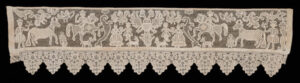
Embroidered Drawn Net Bad Valance with Bobbin Lace Border
1765-1832
Physical Qualities
Linen ground, linen embroidery threads, Overall: 67 × 16 in. (170.2 × 40.6 cm.)
Framed: 21 1/4 × 73 3/4 in. (54 × 187.3 cm.)
Credit Line
The Cone Collection, formed by Dr. Claribel Cone and Miss Etta Cone of Baltimore, Maryland
Object Number
1950.2010.20
Claribel and Etta Cone appreciated the less sophisticated, so-called “peasant” laces of Russia and Eastern Europe as well as the refined products of France and Belgium. Their collection included at least fifteen pieces identified as Russian. Russian laces and embroideries exhibited at international exhibitions in Vienna and London spurred
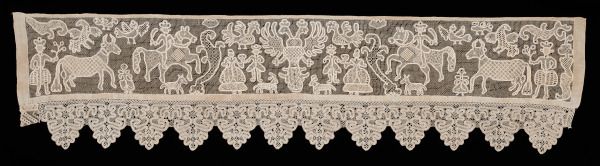
interest in collecting this kind of work in Western Europe in the latter part of the 19th century. In Paris, the shop Aux Bibelots Russes (Russian Knick Knacks) carried Russian laces and other crafts. Claribel Cone visited this shop in July 1925. Perhaps one of her purchases was this valance of embroidered drawn-threadwork with a wide border of bobbin lace.
Typical of 18th-century Russian linen embroidery, the valance consists largely of an embroidered drawn-threadwork net. The net ground is created by removing most of the warps and wefts of an existing fabric nd then wrapping those remaining with threads. On this ground, motifs were darned in coarse linen thread with smaller threads
providing decorative stitches and some use of appliqué. Centered on a double-headed eagle, a symbol of czarist Russia, are motifs of horse and rider, beasts, birds, plant forms, and people inspired by both Russian folklore and fine arts. This type of embroidery was used on table linens, bed valances, and personal articles. The valance is finished in a typical wide Russian bobbin lace. This simple tape lace is ornamented with a meandering red or rose thread (now faded) and minimal wheatears—elongated ornamental stitches with pointed ends.
Baltimore Museum of Art by gift, 1950; Etta Cone, Baltimore, MD
Collecting Matisse and Modern Masters: The Cone Sisters of Baltimore
Karen Levitov, "Collecting Matisse and Modern Masters: The Cone Sisters of Baltimore," New York: The Jewish Museum, 2011, p. 78.
Halle, Titi. Cora Ginsburg LLC: a Catalogue of exquisite & rare works of art including 17th to 19th century costume textiles & needlework. 2018, pp. 4-5.