
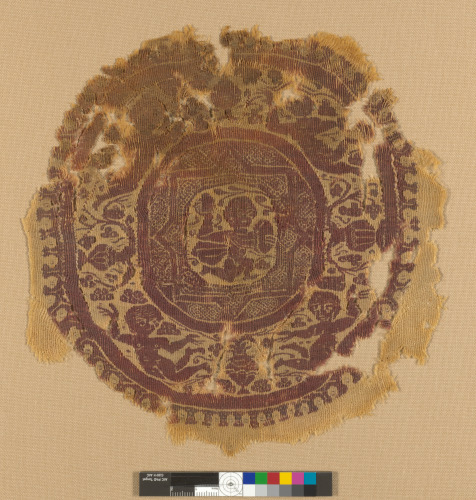
Fragment of Roundel (Orbiculus) with Pyrrhic Dancer and Nereids
300-600
Scroll
Fragment of Roundel (Orbiculus) with Pyrrhic Dancer and Nereids
300-600
Physical Qualities
Wool, 8 3/4 x 8 3/4 in. (22.2 x 22.2 cm.)
Credit Line
The Cone Collection, formed by Dr. Claribel Cone and Miss Etta Cone of Baltimore, Maryland
Object Number
1950.2016.1
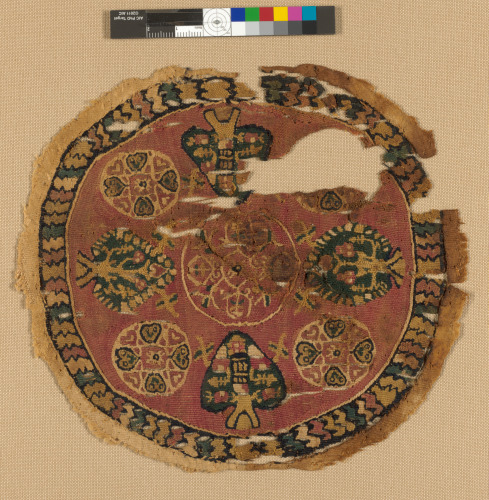
This exquisite tapestry-woven roundel is probably one of a pair from a tunic. In the center circle, a kneeling Pyrrhic dancer holds a shield in one hand while raising the other in a signal of victory. The Pyrrhic dance was used in Greece over the centuries for military training, and was still recognized at the time this medallion was woven. The outer section is filled with swimming Nereids (water nymphs) alternating with vessels filled with flowering grapevines—references to the celebration of fertility and abundance associated with the Greek god of wine Dionysus. The religious and political changes taking place in Egypt from the 4th through 12th centuries gave rise to an intermingling of Greek, Roman, Muslim, Jewish, and Christian traditions. In Egypt, Greek images of Nereids might have been interpreted as a celebration of the Nile River. Egyptians who wore such emblems on their clothing depended on the Nile for their wealth and elevated lifestyle.
The Baltimore Museum of Art by gift, 1950; Etta Cone.
Timeless Weft: Ancient Tapestries and the Art of Louise B. Wheatley
Thomas, Deborah. Coptic Textiles In the Brooklyn Museum, New York 1971,
pp70-71, No. 30 illus.
Rutschowscaya, Marie-Helene. Coptic Fabrics. Paris: Editions Adam Biro, 1990
p. 26, illus, p. 27, pp. 92-93, illus; p.144, illus. 145.
Maguire, Eunice Dautermann, .The Rich Life and The Dance: Weavings From Roman,Byzantine and Islamic Egypt, Urbana-Champaign: Krannert Art Museum, University of Illinois, B20, p. 116 illus. 117, and C16, p. 158.(Roundel of fine weft-Square with a kneeling Pyrrhic dancer, Tapestry weave with warp of wool).
Maguire, Eunice Dautermann and Henry P. Art and Holy Powers in the Early christian House. Illinois Byzantine Studies II. Krannert Art Museum/University of Illinois at Urbana-Champaign, Urbana and Chicago: University of Illinois Press, pp. 138-143, Cat. 69, p. 145; p. 158, fig. 44.
Carroll, Diane Lee, " Looms and Textiles of the Copts: First Millennium Egyptian Textiles in the Carl Austin Rietz Collection of the California Academy of Sciences," San Francisco: California Academy of Sciences, 1988, pp. 92-93, cat. #8 illus.; pp. 94-95, cat. #9, illus.
Kybalovά, Ludmila. Coptic Textiles. London: Paul Hamlyn, Prague: Artia,1967,
pp. 72-73, Dated fourth-5th centuries. pp. 119-125, # 69-77.
pp70-71, No. 30 illus.
Rutschowscaya, Marie-Helene. Coptic Fabrics. Paris: Editions Adam Biro, 1990
p. 26, illus, p. 27, pp. 92-93, illus; p.144, illus. 145.
Maguire, Eunice Dautermann, .The Rich Life and The Dance: Weavings From Roman,Byzantine and Islamic Egypt, Urbana-Champaign: Krannert Art Museum, University of Illinois, B20, p. 116 illus. 117, and C16, p. 158.(Roundel of fine weft-Square with a kneeling Pyrrhic dancer, Tapestry weave with warp of wool).
Maguire, Eunice Dautermann and Henry P. Art and Holy Powers in the Early christian House. Illinois Byzantine Studies II. Krannert Art Museum/University of Illinois at Urbana-Champaign, Urbana and Chicago: University of Illinois Press, pp. 138-143, Cat. 69, p. 145; p. 158, fig. 44.
Carroll, Diane Lee, " Looms and Textiles of the Copts: First Millennium Egyptian Textiles in the Carl Austin Rietz Collection of the California Academy of Sciences," San Francisco: California Academy of Sciences, 1988, pp. 92-93, cat. #8 illus.; pp. 94-95, cat. #9, illus.
Kybalovά, Ludmila. Coptic Textiles. London: Paul Hamlyn, Prague: Artia,1967,
pp. 72-73, Dated fourth-5th centuries. pp. 119-125, # 69-77.