



John Singleton Copley
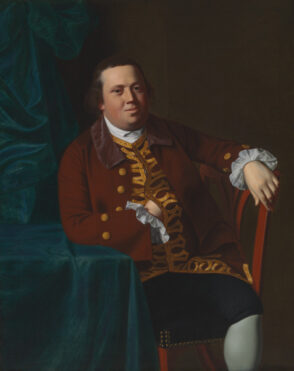
Joseph Hooper
1764-1774
Physical Qualities
Oil on canvas, Framed: 59 3/4 x 47 3/4 x 4 1/4 in. (151.8 x 121.3 x 10.8 cm)
Sight: 48 1/4 x 38 3/4 in. (122.6 x 98.4 cm)
Credit Line
Gift of Dr. Morton K. Blaustein, Barbara B. Hirschhorn, and Elizabeth B. Roswell, in Memory of Jacob and Hilda K. Blaustein
Object Number
1981.75
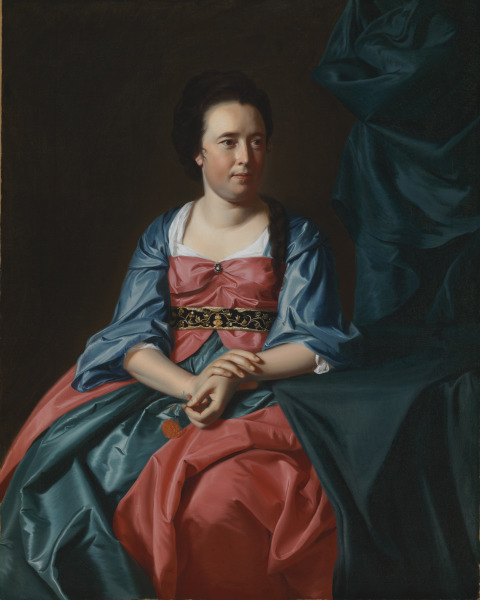
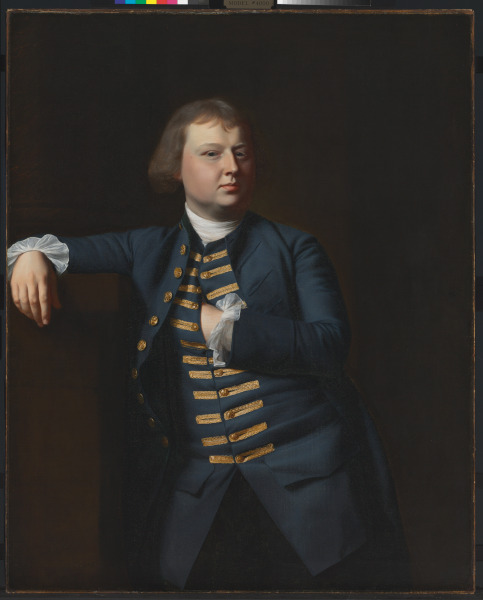
John Singleton Copley incorporated references to the natural world into his paintings to emphasize his subjects’ wealth and social status. The sparkling gilt trim on the vest of Joseph Hooper and the gold-embroidered belt of Mary Harris Hooper’s Turkish-inspired dress reflect both the opulence and fashion of the time. These portraits also indicate the importance of plants in colonial trade. Joseph was a manufacturer of cordage, the ropes and rigging crucial to shipping in 18th-century oceanic commerce. Cordage was made from fibers of hemp, a plant native to Asia and introduced by Spanish colonists to the Americas. Mary holds what seems to be a marigold, a flower that originated in Central and South America. Brought to Europe and used in offerings to the Virgin Mary, it became known as “Mary’s gold.”
The Baltimore Museum of Art by gift, 1981; Samuel Hooper, Boston; Frank W. Bayley, Boston; Israel Sack, Boston; Sack Sale, New York, 1929; John Levy Galleries, New York; M. Knoedler and Co., New York; Jacob and Hilda K. Blaustein, Baltimore, 1940; to their children.
Museum of Fine Arts, Boston, 1929.
Detroit Institute of Arts, "A Loan Exhibition of American Colonial and Early Federal Arts," 4 Feb--2 Mar 1930.
Philbrook Art Center, Tulsa, "Inaugural Exhibition," 1935.
M. Knoedler and Co., New York, "Portraits of George Washington and Other 18th Century Americans," 13 Feb-4 Mar 1939.
Walters Art Gallery, Baltimore, "English and American Portraits of the Late XVIII and Early XIX Centuries from Baltimore Collections," 23 Oct-5 Dec 1948.
Detroit Institute of Arts, "A Loan Exhibition of American Colonial and Early Federal Arts," 4 Feb--2 Mar 1930.
Philbrook Art Center, Tulsa, "Inaugural Exhibition," 1935.
M. Knoedler and Co., New York, "Portraits of George Washington and Other 18th Century Americans," 13 Feb-4 Mar 1939.
Walters Art Gallery, Baltimore, "English and American Portraits of the Late XVIII and Early XIX Centuries from Baltimore Collections," 23 Oct-5 Dec 1948.
"Important Colonial Furniture & Decorations...Property of Israel Sack, Boston, MA," Sold by His Order. American Art Association, Anderson Galleries, Inc. New York: 1929. no. 378A, reproduction p. 143.
'Antiquarian,' Mar 1930. reproduction p. 56.
Prown, Jules David, "John Singleton Copley." Cambridge, MA: Harvard University Press, 1966. vol. 1, p. 60, 77, 219, fig. 277.
"Antiques," Nov 1982. Reproduction p. 990.
BMA Calendar, Mar/Apr 1982, ill.
Johnston, Sona K., "American Paintings 1750-1900 from the Collection of The Baltimore Museum of Art," 1983, ill.
Carrie Rebora, Paul Staiti et al, "John Singleton Copley in America," New York, Metropolitan Museum of Art, 1995, fig. 209, p. 290; fig. 221, p. 310.
Winterthur Portfolio, "A Journal of American Material Culture," vol. 36, no. 2/3, Summer/Autumn 2001. reproduction, p.115.
Breskin, Isabel "On the Periphery of a Greater World: John Singleton Copley's Turquerie Portraits", The Henry Francis du Pont Winterthur Museum, Inc: 2001, p.115, ill.
Inscribed: None


 On View at the BMA

![[UNIDENTIFIED SCENE]](https://artbmadevsite.org/wp-content/uploads/2026/02/103350_35210609.jpg)