Joyce J. Scott
Mammie Wada
1980
Scroll
Joyce J. Scott
Mammie Wada
1980
Physical Qualities
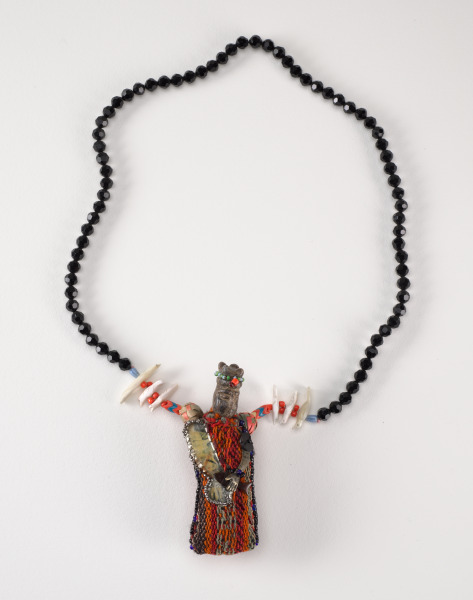
Leather, fabric, vegetable fiber, crab claws, yarn, synthetic hair, tinned iron, glass beads, brass buttons, sheet brass, laminated photograph, 6 1/2 × 19 1/2 × 8 1/2 in. (16.5 × 49.5 × 21.6 cm.)
Credit Line
Gift of J.B. Hanson and Tom Haulk, Baltimore
Object Number
2000.160
“I’m a water sign. I also have always lived near water. Many religions see underwater as where a lot of the powerful Orishas or gods are. Bones are at the bottom, people who jumped off slave ships or who were thrown off. Ships that went down, planes that drop.”
Among Scott’s earliest explorations in sculpture, this series is named for the African diasporic water deity Mami Wata (Mother Water), a half-female, half-fish or half-serpent figure who symbolizes good fortune, fertility, healing, and the threat of destruction. Her mythology developed between the 15th and 20th centuries through the interaction of Africans and Europeans via the Transatlantic Slave Trade. Powerful and dangerous, Mami Wata combines aspects of capitalist merchants, mermaids, snake charmers, water spirits, and saints. Scott assembled faux hair, found photographs, beaded leather, bone, raffia, coiled yarn, and shells from discarded crab claws to evoke mysterious, unsettling goddesses. Similar in scale to an infant yet masked with the faces of adult women, these uncanny creatures also resemble amphibians and crustaceans, recalling the primordial origins of life on the ocean floor.