Ndebele
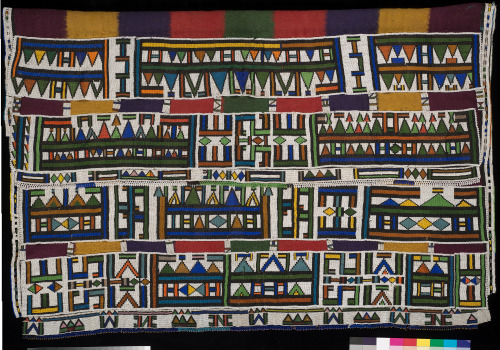
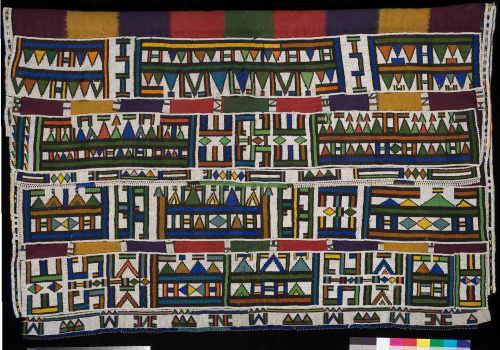
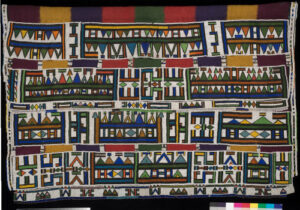
Married Woman’s Blanket Cape (Ngurara)
Ndebele, 1933-1966
Scroll
Ndebele
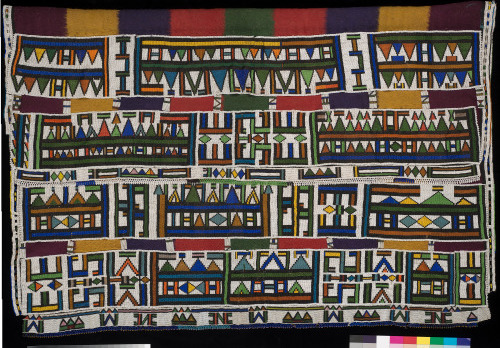
Married Woman’s Blanket Cape (Ngurara)
Ndebele, 1933-1966
Physical Qualities
Middelburg wool blanket, glass beads, string, 63 x 57 1/2 x 1 9/16 in. (160 x 146 x 4 cm.)
Credit Line
Gift of Aaron and Joanie Young, Baltimore
Object Number
2002.631
Pushed off of their land during apartheid, a period of racial segregation and legal discrimination in South Africa, members of the Ndebele community lost many of their rights to white settlers. The bright geometric patterns seen on Ndebele homes grew increasingly complicated over the course of the 20th century. These complex patterns were an assertion of ethnic identity in the face of oppression, and were transferred in beadwork as well.
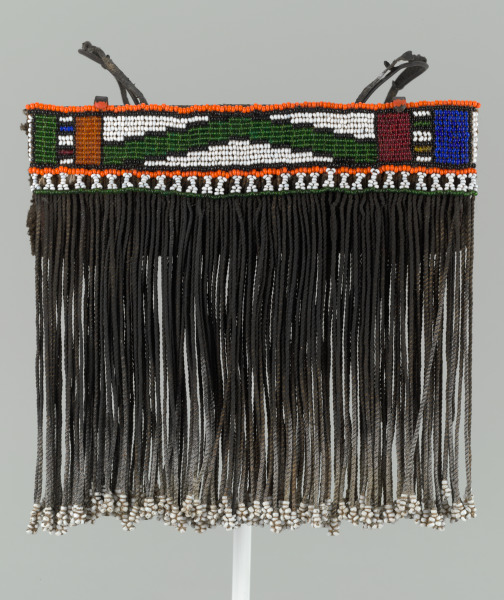
Until the 1980s, Ndebele women living in South Africa customarily wore extensive beadwork after marriage. This elaborately beaded cape announced that a young woman had become a bride. The heavy cape is formed from a colorful manufactured woolen blanket and hand-made decorative beadwork panels. The delicate fringe on the panels of the BMA cape is particularly fine, as are the small borders separating the stripes on the woolen blanket and linking the bands of beads together.
The Baltimore Museum of Art by gift, 2002; Aaron and Joanie Young, Baltimore, MD; purchased by the donor from a dealer of African objects in South Africa, near Soweto, in 1981.
African Reinstallation
Adorned: African Women & the Art of Identity
Frederick John Lamp, "See the Music Hear the Dance: Rethinking African Art at the Baltimore Museum of Art." New York: Prestel, 2003, p.48, ill.
Baltimore Museum of Art. "The Baltimore Museum of Art: Celebrating a Museum." Baltimore: The Baltimore Museum of Art, 2014.
"Adorned: African Women & The Art of Identity" BMA Today, no 162 (fall 2019): p 8.
Tribal Art, "Museum News: Adorned," 94, no.4 (2019): 48.