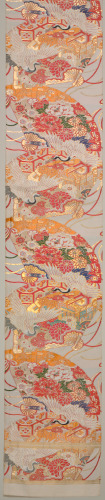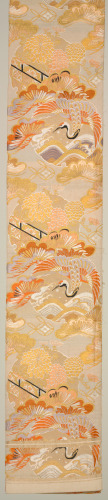
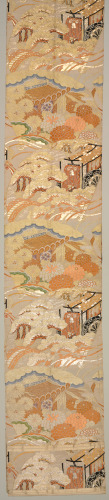
Maru Obi with Gosho-guruma (Noble’s Carriage) and Chinese Building
1911-1939
Scroll
Maru Obi with Gosho-guruma (Noble’s Carriage) and Chinese Building
1911-1939
Physical Qualities
Silk with supplementary wefts of silk, and metal-leafed paper strips wrapped around a silk or cotton thread core
, 150 x 12-3/4 in.
Credit Line
Bequest of Sylvia G. Straton, Rhinebeck, New York
Object Number
2002.686
Label text for "Kimono and Obi: Romantic Echoes from Japan's Golden Age," July 10, 2016 - January 15, 2017:
Maru Obi with Gosho-guruma and Chinese Building
1912–1940, Taisho/Early Showa Eras
Japan
Silk with supplementary wefts of silk, and metal-leafed paper strips wrapped around silk or cotton thread core
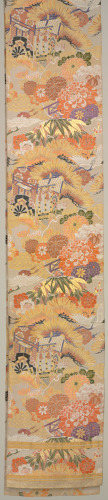
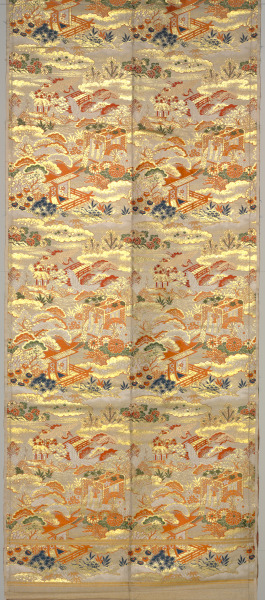
Woven into this maru obi is a repeating design of two overlapping hi-ogi (court fans). The Heian motif of a noble’s carriage (gosho-guruma) is enclosed within the silhouette of one hi-ogi. It is accompanied by pines (symbols of faithfulness and longevity), and a bridge (a common landscape feature on Heian estates with their large artificial lakes). The other hi-ogi encloses an exoticized Chinese building surrounded by clouds, chrysanthemums, and pine boughs. The building is not an accurate representation of Chinese architecture, but serves as a reminder of the hold Chinese culture had on the imaginations of Heian courtiers.
Bequest of Sylvia G. Straton, Rhinebeck, New York
BMA 2002.686
The Baltimore Museum of Art by bequest , 2002; Sylvia G. Straton, Rhinebeck, New York
Kimono and Obi: Romantic Echoes from Japan's Golden Age
Gluckman, Dale and Takeda, Sharon. When Art Became Fashion: Kosode in Edo-Period Japan, Los Angeles County Museum of Art, 1992, general.
Yang, Sunny and Narasin, Rochelle M. Textile Art of Japan. Tokyo: Shufunotomo Co., Ltd., 1989, pp. 101-109.
Liddell, Jill. The Story of the Kimono. New York: E. P. Dutton, 1989.
Yang, Sunny and Narasin, Rochelle M. Textile Art of Japan. Tokyo: Shufunotomo Co., Ltd., 1989, pp. 101-109.
Liddell, Jill. The Story of the Kimono. New York: E. P. Dutton, 1989.