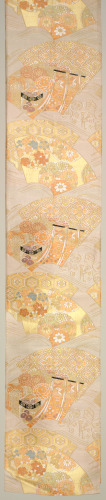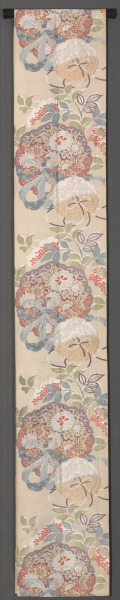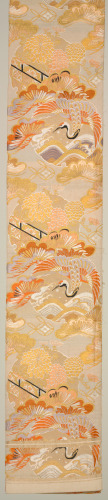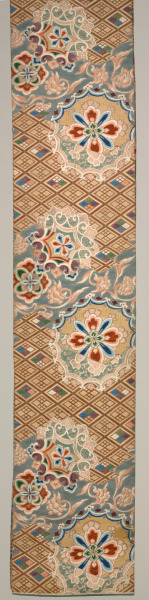

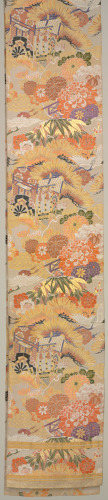
Maru Obi with Gosho-guruma (Noble’s Carriage) and Cranes
1911-1939
Scroll
Maru Obi with Gosho-guruma (Noble’s Carriage) and Cranes
1911-1939
Physical Qualities
Silk with supplementary wefts of silk, metal leafed paper strips wrapped around a silk or cotton core., 162-1/4 x 12-3/4 in.
Credit Line
Bequest of Sylvia G. Straton, Rhinebeck, New York
Object Number
2002.689
(Anita Jones and Ann Marie Moeller, The Baltimore Museum of Art, Baltimore, MD, "Kimono and Obi: Romantic Echoes from Japan's Golden Age," July 10, 2016 - January 15, 2017. Wall label text.)
Maru Obi with Gosho-guruma
(Noble’s Carriage) and Cranes
1912–1940, Taisho/Early Showa Eras
Japan
Silk with supplementary wefts of silk,
and metal-leafed paper strips wrapped
around silk or cotton thread core
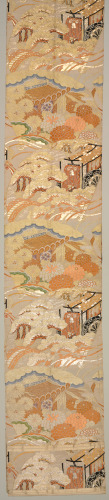
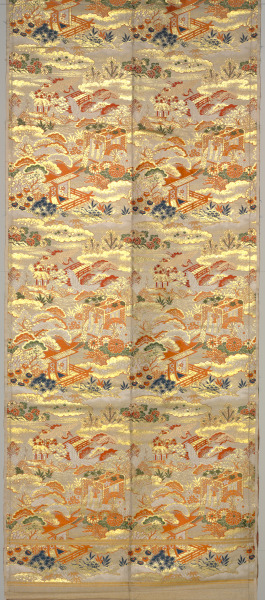
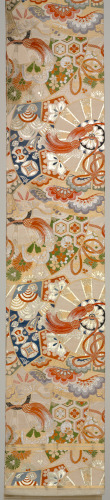
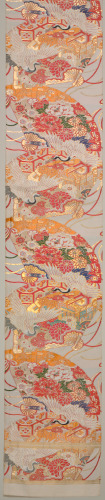
The details of the Heian nobles’ carriages (gosho-guruma) on this obi are a testament to the skill of the weaver and the vision of the fabric designer, who also included many auspicious symbols. These carriages are accompanied by snow medallions (yuki wa) outlined in white containing chrysanthemums and a glimpse of a garden fence. Chrysanthemums are symbols of longevity, while the yuki wa suggest the prosperity that winter snow will bring by providing abundant water for spring rice cultivation. “The Three Friends in Winter” (pine, bamboo, and plum blossoms) representing faithfulness,flexibility, and fortitude, also occupy a yuki wa. Clouds are patterned with the ancient textile motif of Chinese flowers within diamond shapes (karabanabishi). Cranes symbolize longevity and marital fidelity.
Bequest of Sylvia G. Straton,
Rhinebeck, New York, BMA 2002.689
The Baltimore Museum of Art by bequest , 2002; Sylvia G. Straton, Rhinebeck, New York
Kimono and Obi: Romantic Echoes from Japan's Golden Age
Gluckman, Dale and Takeda, Sharon. When Art Became Fashion: Kosode in Edo-Period Japan. Los Angeles County Museum of Art, 1992, general.
Yang, Sunny and Narasin, Rochelle M. Textile Art of Japan. Tokyo: Shufunotomo Co., Ltd., 1989, pp. 101-109
Liddell, Jill. The Story of the Kimono. New York: E. P. Dutton, 1989.
Yang, Sunny and Narasin, Rochelle M. Textile Art of Japan. Tokyo: Shufunotomo Co., Ltd., 1989, pp. 101-109
Liddell, Jill. The Story of the Kimono. New York: E. P. Dutton, 1989.