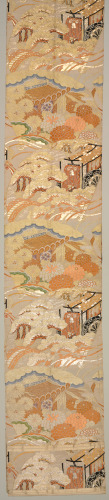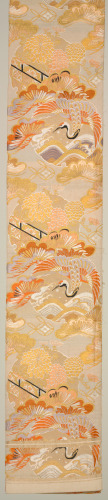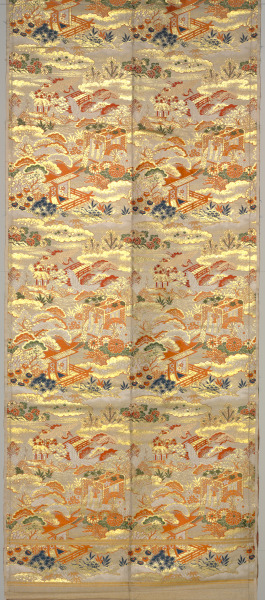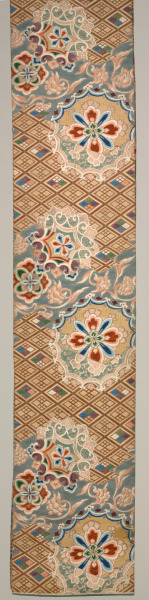

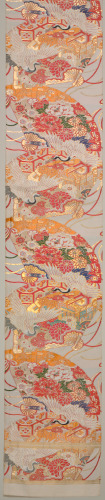
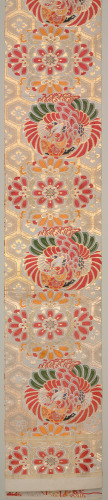
Maru Obi with Hi-ogi (Heian Imperial Fans) and Cranes
1911-1939
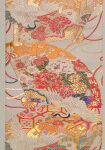
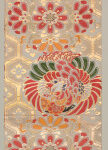
Scroll
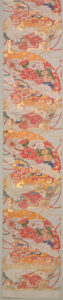
Maru Obi with Hi-ogi (Heian Imperial Fans) and Cranes
1911-1939
Physical Qualities
Silk with supplementary wefts of silk, flat metal-leafed paper strips, and metal-leafed paper strips wrapped around a silk or cotton thread core, possibly synthetic materials, 151 x 12-3/4 in.
Credit Line
Bequest of Sylvia G. Straton, Rhinebeck, New York
Object Number
2002.685
Label for: "Kimono and Obi: Romantic Echoes from Japan's Golden Age," July 10, 2016 - January 15, 2017.
Maru Obi with Hi-ogi (Heian Imperial Fans) and Cranes
1912–1940, Taisho/Early Showa Eras
Japan
Silk with supplementary wefts of silk, metal-leafed paper strips, and metal-leafed paper strips wrapped around silk or cotton thread core,
possibly synthetic materials
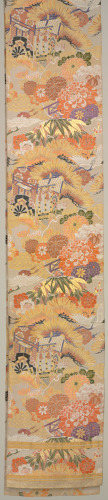
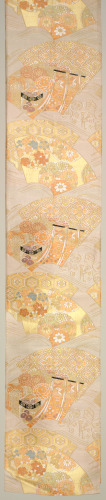
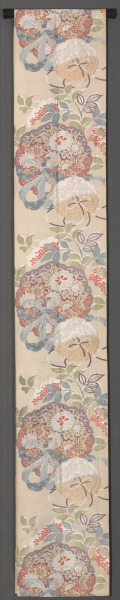
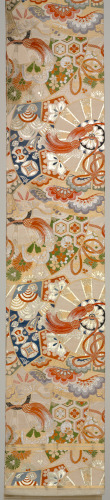
Large fans composed of cypress blades (hi-ogi) were used by Heian court women during ceremonies and on other occasions to hide their faces. Silk cords of multiple colors held the blades together and descended from the outermost fan guards. This obi has layered hi-ogi decorated with a Heian noble’s cart (gosho-guruma), auspicious plants, flowers, and the ancient textile pattern of squares and octagons called "shokkou-mon." The motif of spreading fans is an auspicious design for weddings, symbolizing the wish for marriage to open a happy chapter in the bride’s future. Pairs of cranes flying above the hi-ogi on this obi are similarly appropriate as cranes were believed to mate for life and therefore represent marital fidelity.
Bequest of Sylvia G. Straton, Rhinebeck, New York
BMA 2002.685
The Baltimore Museum of Art by bequest , 2002; Sylvia G. Straton, Rhinebeck, New York
Kimono and Obi: Romantic Echoes from Japan's Golden Age
Gluckman, Dale and Takeda, Sharon. When Art Became Fashion: Kosode in Edo-Period Japan. Los Angeles County Museum of Art, 1992, general.
Yang, Sunny and Narasin, Rochelle M. Textile Art of Japan. Tokyo: Shufunotomo Co., Ltd., 1989, pp. 101-109.
Liddell, Jill. The Story of the Kimono. New York: E. P. Dutton, 1989.
Yang, Sunny and Narasin, Rochelle M. Textile Art of Japan. Tokyo: Shufunotomo Co., Ltd., 1989, pp. 101-109.
Liddell, Jill. The Story of the Kimono. New York: E. P. Dutton, 1989.