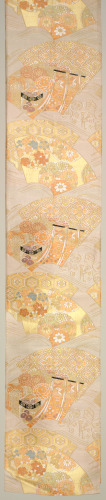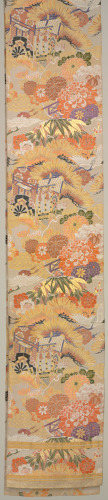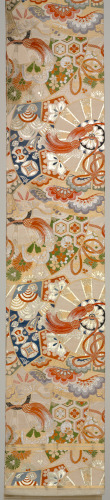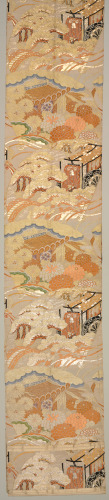

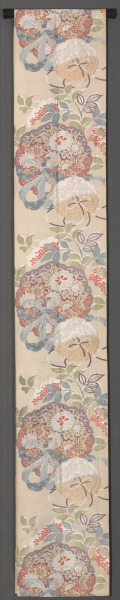
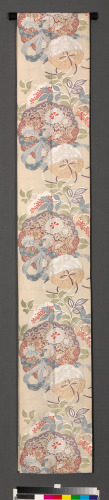
Maru Obi with Overlapping Mirrors
1911-1988
Scroll
Maru Obi with Overlapping Mirrors
1911-1988
Physical Qualities
Silk with brocading patterning wefts of silk and silver-leafed paper strips wrapped
around a cotton thread core, 157 x 12-1/4 in.
Credit Line
Bequest of Sylvia G. Straton, Rhinebeck, New York
Object Number
2002.688
Label text for, "Kimono and Obi: Romantic Echoes from Japan's Golden Age," July 10, 2016 - January 15, 2017.
Maru Obi with Overlapping Mirrors
1912–1989, Taisho/Showa Eras
Japan
Silk with brocading patterning wefts of silk and silver-leafed paper strips wrapped around a cotton thread core
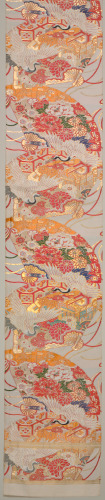
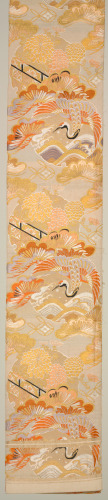
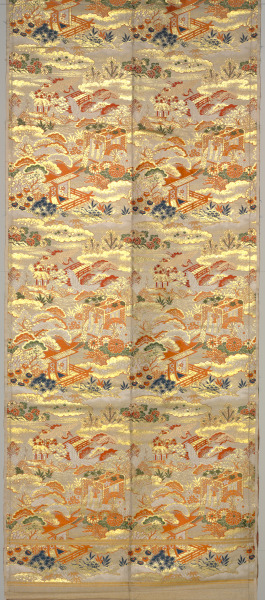
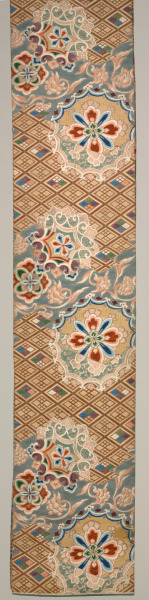
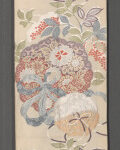
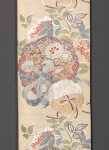
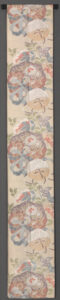
The circular lobed designs woven into this obi are stylized representations of the backs of ancient metal mirrors. Each has a central boss through which a cord or ribbon is tied for easier handling. During the Heian Era (794–1185), similar metal mirrors became prized possessions in courtier palaces. Mirrors have been associated with women’s beauty ever since; therefore, if this obi were worn at a wedding, the mirrors would reflect symbolically upon the beauty of the bride and her status as “Princess for a Day.” The sprig of greenery depicted on this obi comes from the evergreen bush nandina (nanten). An auspicious plant, it is associated with longevity and the New Year, and is often depicted on mirrors. Nanten is a Japanese homophone (similar sounding word) for “difficulties” and “changing,” and therefore symbolizes good fortune ahead.
Bequest of Sylvia G. Straton, Rhinebeck, New York
BMA 2002.688
Label text for: "Curator's Choice: Recent Additions to the Textiles Collection, " April 27 - November 27, 2011.
The obi (sash) is an important part of traditional Japanese female dress, in some cases becoming even more important and elaborate than the kimono. This example is a Maru obi --made of nishiki, an intricate hand-woven silk brocaded with multiple colored silk and metallic wefts that create the motifs. The fabric was woven so that the pattern repeats across the width and along the entire length. When folded in half lengthwise, it formed a long, stiff, double sided obi of the most formal and expensive kind. Although popular during the Meiji and Taisho eras, such obi are rarely worn today except on the most formal of occasions.
Bequest of Sylvia G. Straton, Rhinebeck, New York
BMA 2002.688
The Baltimore Museum of Art by bequest , 2002; Sylvia G. Straton, Rhinebeck, New York
Curator's Choice Rotation
Kimono and Obi: Romantic Echoes from Japan's Golden Age
Gluckman, Dale and Takeda, Sharon. When Art Became Fashion: Kosode in Edo-Period Japan. Los Angeles County Museum of Art, 1992, general.
Yang, Sunny and Narasin, Rochelle M. Textile Art of Japan. Tokyo: Shufunotomo Co., Ltd., 1989, pp. 101-109
Liddell, Jill. The Story of the Kimono. New York: E. P. Dutton, 1989.
Yang, Sunny and Narasin, Rochelle M. Textile Art of Japan. Tokyo: Shufunotomo Co., Ltd., 1989, pp. 101-109
Liddell, Jill. The Story of the Kimono. New York: E. P. Dutton, 1989.