
Faith Ringgold
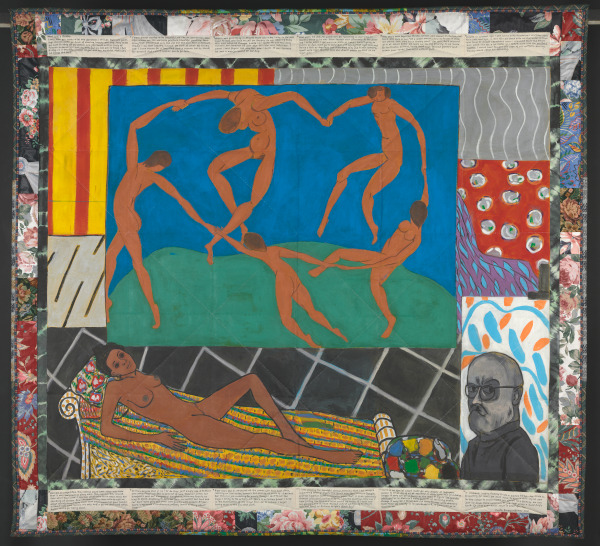
Matisse’s Model (The French Collection, Part I: #5)
African-American, 1990
Faith Ringgold
Matisse’s Model (The French Collection, Part I: #5)
African-American, 1990
Inscribed: Obverse: Printed in ink by hand at the top and bottom of the quilt is the entire text of story. The work is signed and dated at the lower right corner: 'Faith Ringgold [copyright mark] 1991 NYC' Text of: Matisse's Model (The French Collection Part I: #5): " 1 Every little girl wants to be une danseuse. I still do. Matisse's paintings always make me think of dancing, beauty and love. They make me want to strip off my clothes and join hands with a circle of friends to dance till both my body and my soul are so tired I fall asleep on a beautiful chaise longue and say Ahhhhhhh. Matisse's La Danse did that. 2 I have always wanted to be beautiful, not like an anonymous beautiful woman but like une belle peinture. Something that pleases not only the eye but the soul. Here in Matisse's studio I am that beauty. I can't be sure of what HE thinks, but I have known for a long time that a woman has to think for herself. And a black woman has to be sure. 3 When I was growing up in Atlanta there was a boy living in the next house to ours who used to call me Smokey. He was referring to my skin color which he thought looked like smoke. He was very dark himself, but somehow he felt that his color was indelible. I never could figure out why, but now I know. It was because he was a man, or would be one day. 4 And when he did, he would not be "courting or marrying no smoke," black as he was. Even though men commonly do the choosing I knew when I got married, black as I was, I wasn't going to marry no fool. Some girls liked fools, not saying that favoring light skin and being a fool go together but sometime they did. To the contrary, there were light skinned boys who didn't waste no time on no light girl. 5 And there were boys like Preston Wilson, noir comme le charbon coal black, who used to say "All a yaller woman can do for me is show me where that little black beauty went." But still, dark skinned girls at school knew we were not the top priority. So we looked for the Preston Wilsons, 'cause most boys favored peaches and cream over smoke. That was a natural fact. 6 Maybe in another life I was white with blonde hair and blue eyes, a thin nose and lips; in this life I am black with all that entails. That was hard to accept sometimes when I realized that the Negro man would like me a lot better if I looked more like the master's woman. I would have thought the rape of our mothers during slavery would color his thinking. 7 Men are so competitive. They always want what other men have. That is why they have so many wars. They believe they should take what they want. I wonder what men think when they are thinking of women. How can they betray them with deception about loving them? They know that many women live pour l'amour. Without love some women are only half a person, that half which hates itself for being alone. 8 Do they dispise that in us? Or do they just simply use it to their own advantage?. We fall in and out of love. Then we watch our daughters and our daughters' daughters, knowing there's no way to share anything to dull the pain. We watch our sons and our sons' sons play the same love games with women. Et personne n'apprend rien d'amour, nobody learns a thing about love. 9 Right now I feel as strong as all the women who have ever lived, reclining as I am on the women's bed evoking all kinds of illusions. But this is a job: modeling for money. Though I do it to see the magic I bring to the artist's art. There is a certain power I keep in the translation of my image from me to canvas. I enjoy seeing that in the finished work. 10 I love playing the beautiful woman, knowing that I am steeped in painting history: Ingres' The 'grande odalisque', Manet's Olympia, and the Egyptian godess Cleopatra before that. It is an extremely thought provoking position to be in. I ask the question. Why am I here posing like this, and what would HE think if I took out my glasses and started to read a first edition of Tolstoy's War and Peace or Richard Wright's Black Boy? 11 There is no special couch made for only proper or improper women to lie on. All of us at one time or other have lain on a chaise longue. It may not be so fancy as the ones in Ingres' The 'grande odalisque' or in Matisse's many pictures of reclining nudes, though it may be. I think men see these things with dreamy eyes. They see beauty in la vulnerabilite, la passivite, et la soumission. That's their love fantasy. 12 It wouldn't inspire fantasy to see a woman tired too tired to be waiting for love? We don't have to have a man lay us out on the couch to accomodate his special love fantasy. We can just lie down there ourselves to just rest after a hard day's work. Ca c'est belle. That is beautiful, too." Reverse: Printed in ink on cloth (3 7/8" x 6 3/8" piece of cotton duck with cut edges) attached by machine to reverse at lower left corner: " THE FRENCH COLLECTION / PART 1 #5 MATISSE'S MODEL / PAINTED STORY QUILT / acrylic o/c / 73 1/2 x 79 1/2 / 1991 / by Faith Ringgold
Explore the Collection Further