Pablo Picasso and Roger Lacourière
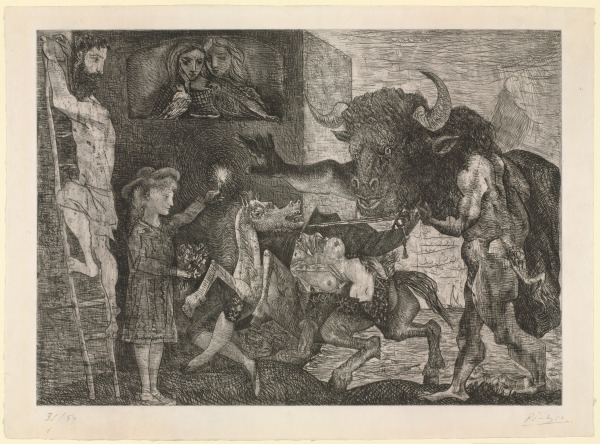
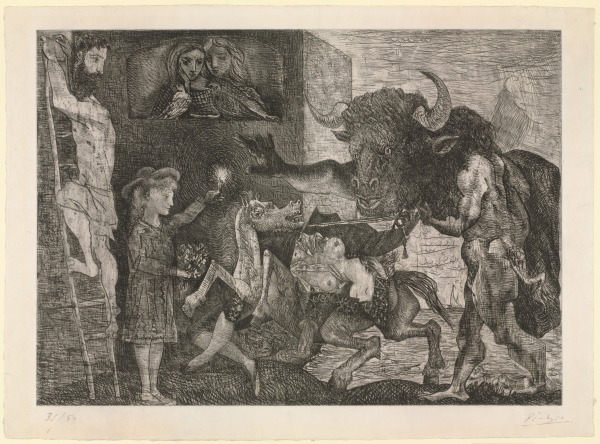
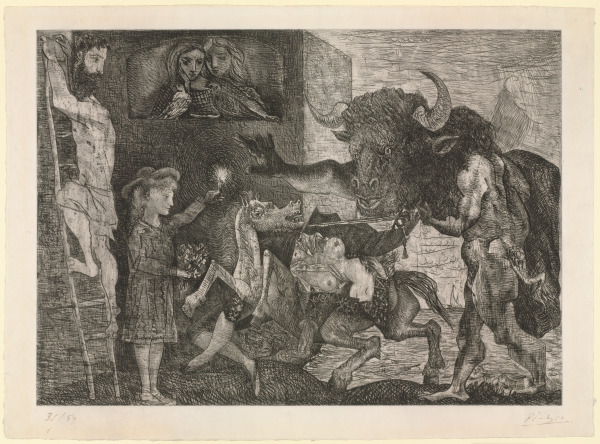
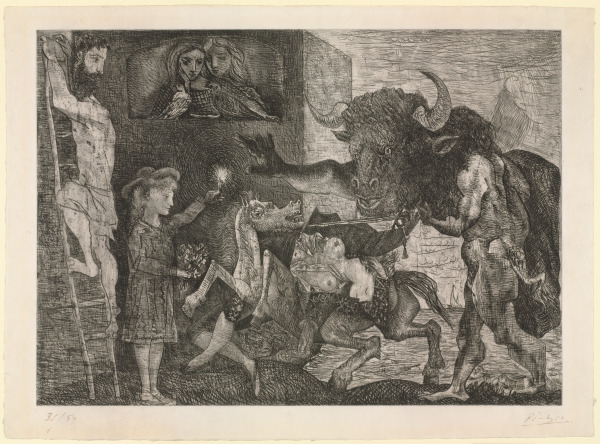
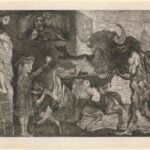
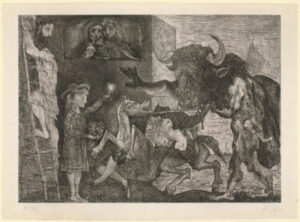
Minotauromachy
1934
Scroll
Physical Qualities
Etching and engraving with scraping, Sheet: 570 × 776 mm. (22 7/16 × 30 9/16 in.)
Plate: 496 × 692 mm. (19 1/2 × 27 1/4 in.)
Credit Line
Gift of Israel and Selma Rosen, Baltimore
Object Number
1979.72
Minotauromachy, Picasso's most important etching, was done in the spring of 1935, a barren period in the artist's life in terms of the number of paintings he produced. He gave up painting for a period of over a year. Picasso's relationship with Olga, his wife since 1918, had become unbearable. Marie-Therese Walter, with whom he had been involved since 1927, became pregnant. Olga, with 14-year-old son Paulo, moved out. Picasso describes the end of 1935 as "the worst period of my life."
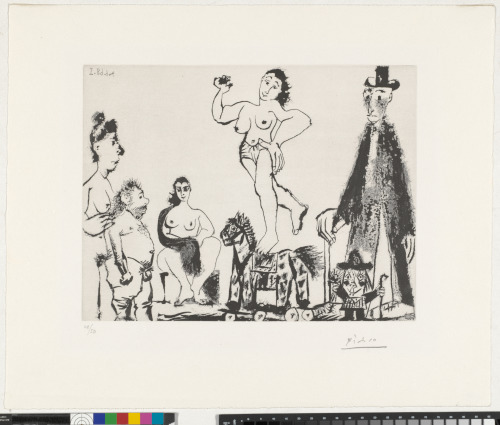
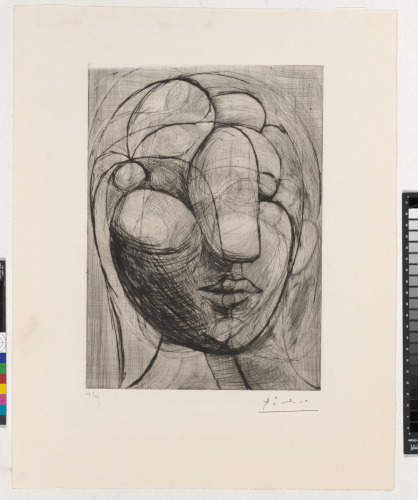
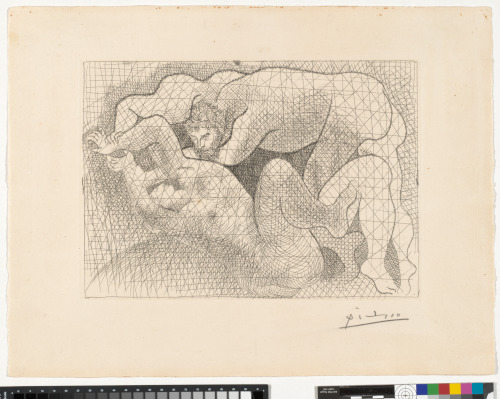
During the troubled years of the mid-1930s the medium of etching became especially important to Picasso. In 1933-34 he not only completed six etchings for Gilbert Selde's adaptation of Aristophanes' Lysi strata, but produced 82 of the 100 etchings which were later collected as the Voliard Suite (1930-37). As a whole the prints of the Suite allow an important insight into the composition of Minotauromachy. Most of the prints of the Suite adhere to a classical motif. They depict emotions of violence, of passion, of contemplation, and of love and center thematically around the artist figure, his model and his art.
Francoise Gilot, in her book Life With Picasso, recalls an episode in 1943 when Picasso showed her the Suite. Her often-cited account of this encounter is one of the most revealing sources for interpretation of the prints. The prints, she observes, are "filled with bearded and clean-shaven men, with minotaurs, centaurs, faunlike figures, and all kinds of women. Everyone was nude or nearly so and they seemed to be playing out a drama from Greek mythology."
"The Baltimore Museum of Art: Celebrating a Museum," The Baltimore Museum of Art, 2014, p. 220.
"BMA Today," July -August 2004, p. 7, ill.
"BMA Today," January - February 2004, p.8, ill.
"Newsletter," The Print and Drawing Society of the Baltimore Museum of Art, Volume XXI, No. 2, Fall 2003, p. 16, ill.
Greeley, Robin Adele, Samantha Kavky, Oliver Shell, and Oliver Tostmann. "Monsters & Myths: Surrealism and War in the 1930s and 1940s." New York, NY: Rizzoli Electa in association with The Baltimore Museum of Art and Wadsworth Atheneum Museum of Art, 2018, ill.
Inscribed: Recto: at lower left, in brown ink: "31/50"; at lower right, in brown ink: "Picasso [underlined]": verso: none