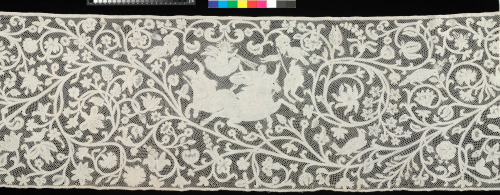
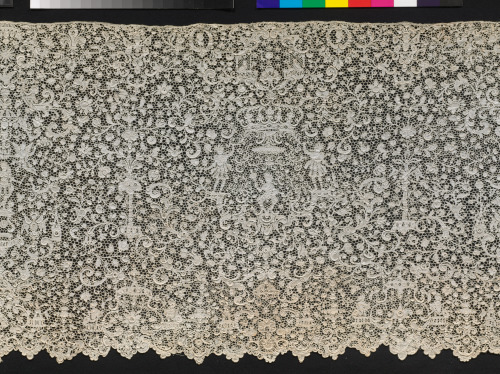
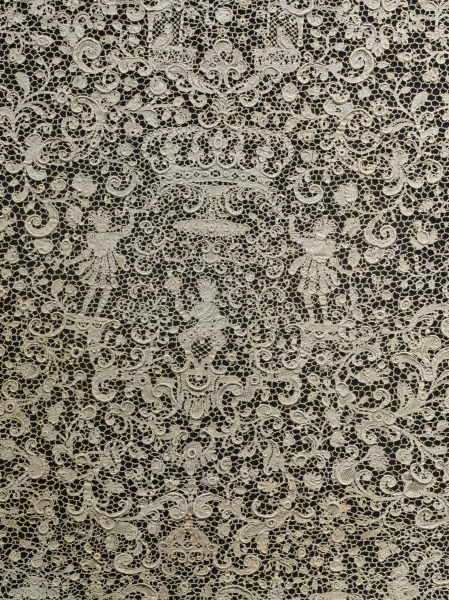
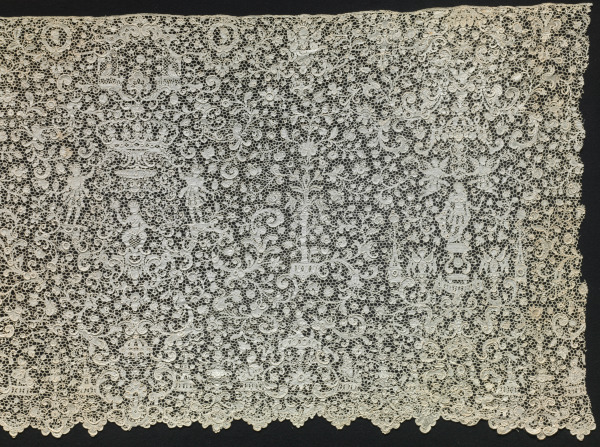
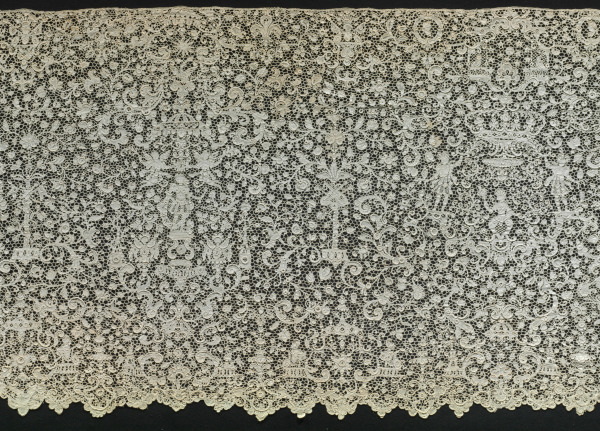
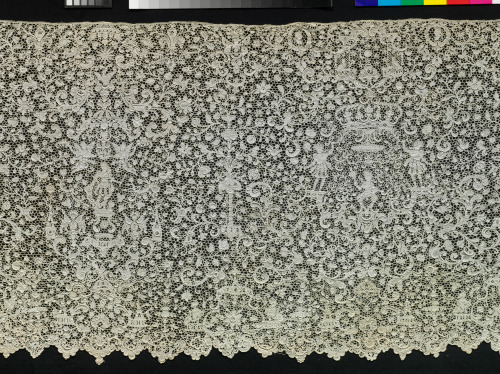
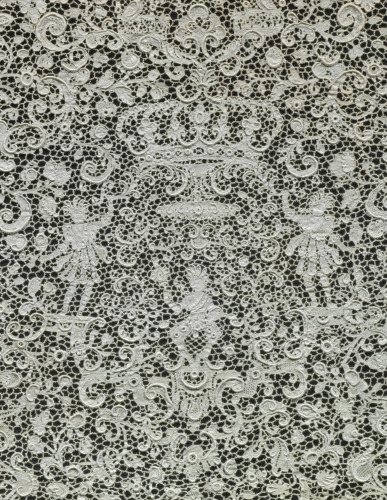
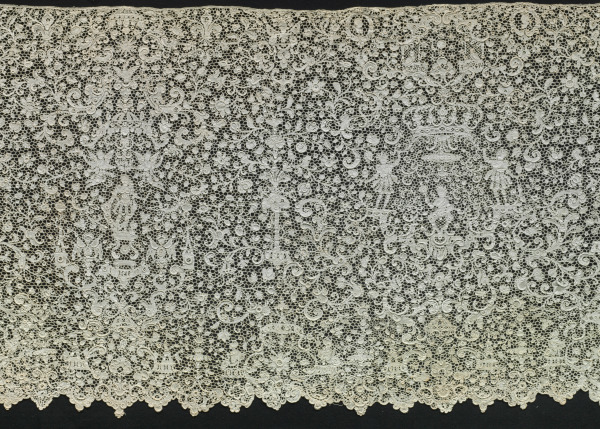
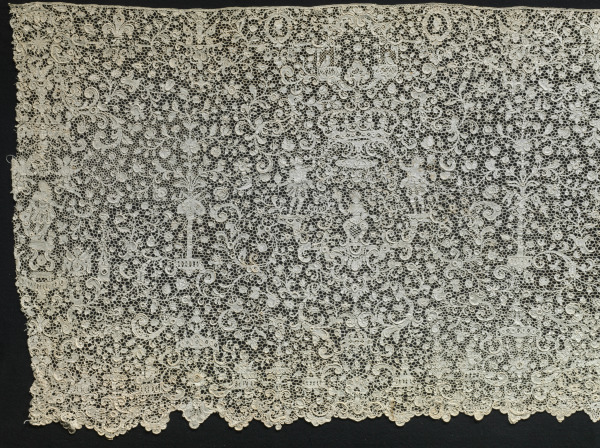
Point de France Needle Lace Furnishing Flounce
1667-1699
Scroll
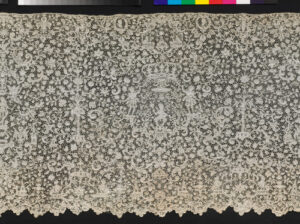
Point de France Needle Lace Furnishing Flounce
1667-1699
Physical Qualities
Linen, Overall: 105 × 23 in. (266.7 × 58.4 cm.)
Credit Line
The Cone Collection, formed by Dr. Claribel Cone and Miss Etta Cone of Baltimore, Maryland
Object Number
1950.2022.270
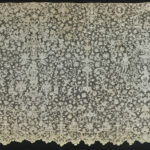
Lace was once one of the most valuable textiles in Europe, frequently produced in convents and orphanages to adorn the clothing and furnishings of the wealthy. Its astronomical cost compelled King Louis XIV of France (1638–1715) to pass a law in 1660 barring French courtiers from buying foreign lace and thus spending vast sums outside the domestic economy. In response, the Controller-General of Finances Jean-Baptiste Colbert (1619–1683) established royal lace manufacturers across France, enticing foreign lacemakers to train local women.
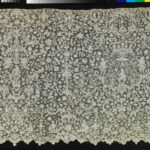
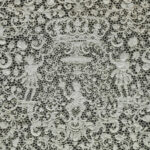
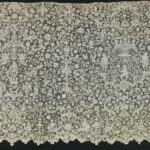
Royal support of the French lace industry enabled the production of incredibly fine work—taking at least one hour per square inch to make—on a massive scale. Point de France, as the new style came to be called, had a symmetrically repeated miniature pattern and was lightweight. Numerous hands would have created this wide decorative flounce, likely made for a bed, depicting a garden scene with a regal figure—perhaps Louis XIV himself.
The Baltimore Museum of Art by bequest, 1949; Etta Cone, Baltimore, MD by bequest, 1929; Claribel Cone, Baltimore, MD by purchase, 1925; Beulah M. Delford, Baltimore, MD
Weibel, Adele Coulin. Curator Emeritus of Textiles and Near Eastern Art, Detroit Institute of Arts [sic?]. "A Royal Flounce of Point de France." Unpublished manuscript. Cone Archives. The Baltimore Museum of Art. p. 2.
Andre, Linda, and Routhier, Jessica Skwire. Eds. The Baltimore Museum of Art: Celebrating A Museum. Baltimore, Maryland: Baltimore Museum of Art, 2014, pp.128-129.
Berliner, Rudolf Berliner. Ornamentale vorlage-Blätter, Des 15.Bis 18 Jahrhunderts. Verlag/Leipzig: Klinkhardt & Biermann, 1925. Design by Jean Louis Bérain (1636-1711), pl. 325, no. 1.
Explore the Collection Further