
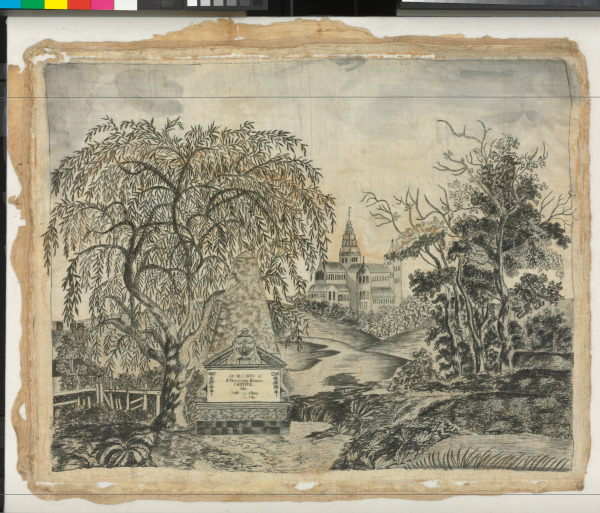
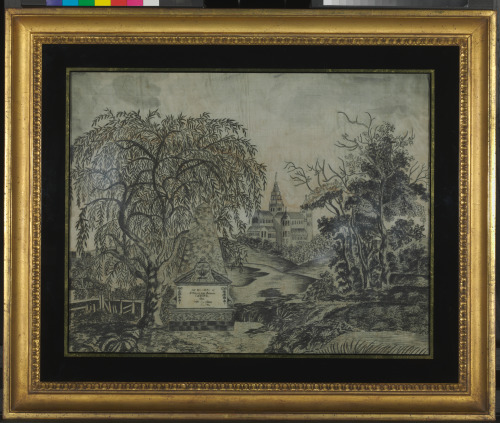
Printwork Mourning Embroidery “IN MEMORY of A Tender and Beloved FATHER”
1799-1809
Scroll
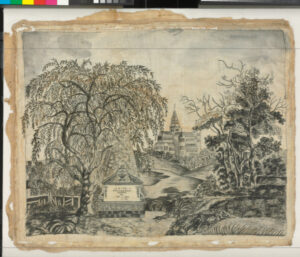
Printwork Mourning Embroidery “IN MEMORY of A Tender and Beloved FATHER”
1799-1809
Physical Qualities
Silk ground, silk embroidery threads, ink wash, lining, Sight: 15 5/8 × 20 1/8 in. (39.7 × 51.1 cm.); Framed: 23 × 27 1/2 × 2 in. (58.4 × 69.9 × 5.1 cm.)
Credit Line
Gift of Susan T. Brown
Object Number
1937.15
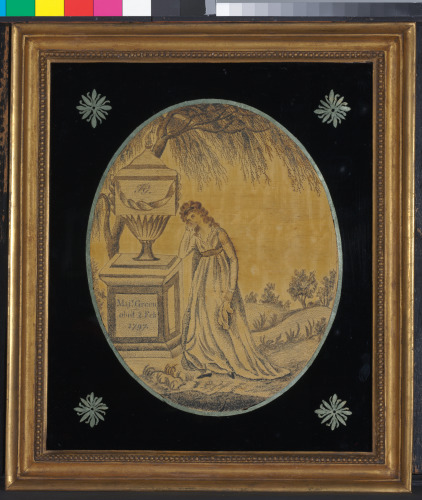
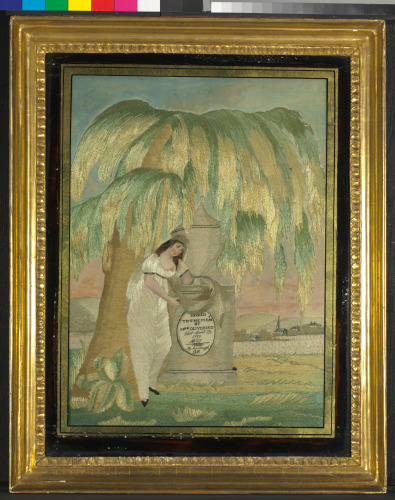
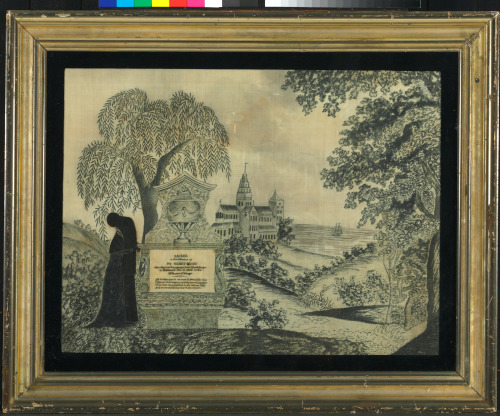
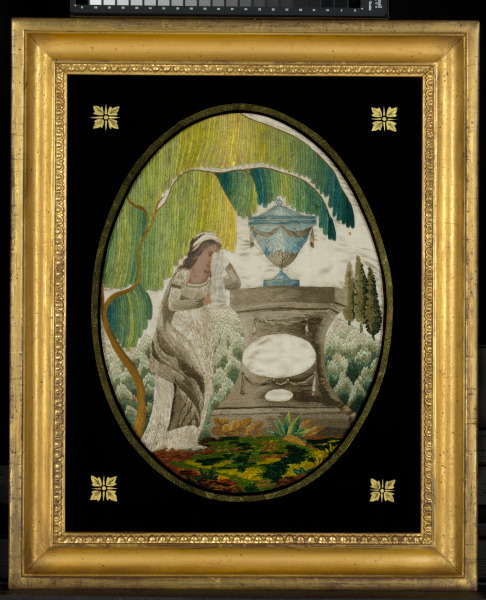
A silk on silk print work mourning embroidery that depicts a tomb dedicated to "A tender and Beloved FATHER" situated on a grassy patch of land beneath a willow tree. The monument has a deep plinth, a facade with minimal floral decoration and inscription, and a broken pediment top with draped urn. To the right and In the distance stands a large church or cathedral. Somewhat removed, but closer to the right of the monument is a group of trees, with many barren branches. The design is drawn in ink wash on a white or cream silk ground. The embroidery is worked in all black silk thread in small seed stitches that provide shading and outline. The writing on the memorial itself is embroidered.
Currently framed in custom milled frame in neoclassical style. Reproduction black églomisé mat on antique glass (based on general style of the time).
The Baltimore Museum of Art by gift, 1937; Susan T. Brown.
Susan Cumins, Baltimore Museum of Art, Period Needlework in America, 1739-1865, 1978, cat. #12.
Ring, Betty. Girlhood Embroidery: American Samplers & Pictorial Needlework 1650-1850. New York: Alfred A. Knopf, 1993, Vol. II, pp. 320-327.
Ring, Betty. American Needlework Treasures: Samplers and Silk Embroideries from the Collection of Betty Ring. New York: E.P. Dutton, 1990, pp. 94-95, figs. 150-152.
Ring, Betty. American Needlework Treasures: Samplers and Silk Embroideries from the Collection of Betty Ring. New York: E.P. Dutton, 1990, pp. 94-95, figs. 150-152.
Inscribed: Written in ink and embroidered in black silk thread: "IN MEMORY of/A Tender and Beloved/ FATHER,/Obt./ Sept. 17, 1800. /AE. 24." Written in ink at lower left side at edge of embroidery and picture: "A [?] W O [?] G" These capital letters in ink are difficult to decipher and may be inaccurate as given; however, there are definitely four initials or letters noted.