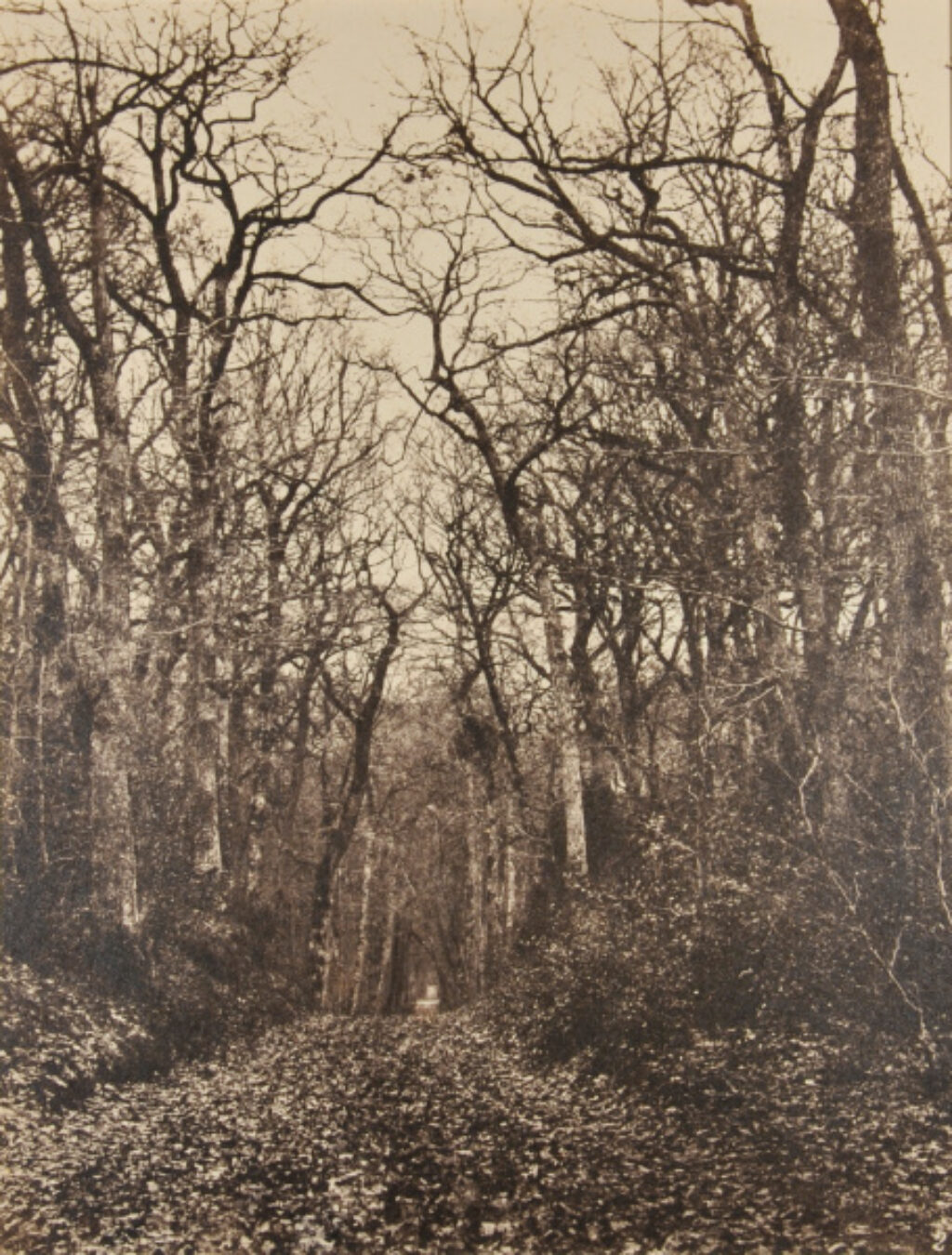
Eugène Cuvelier
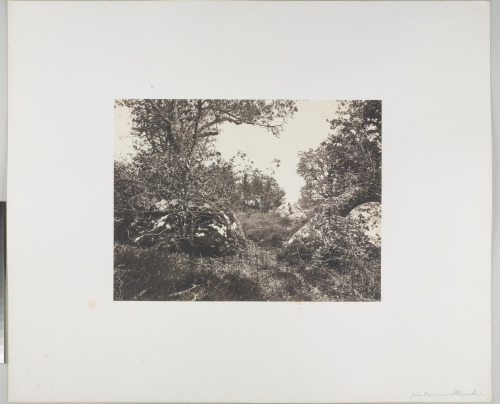
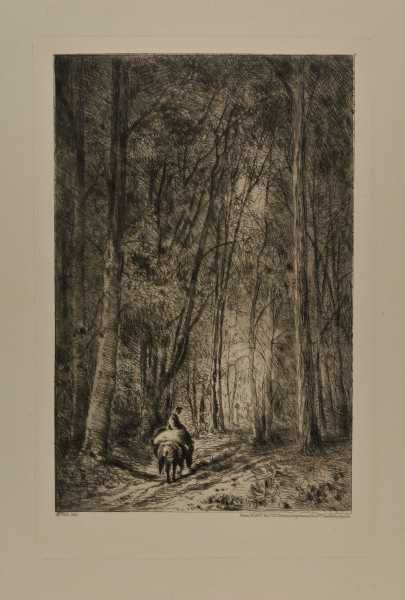
Road in the Forest
1862
Scroll
Eugène Cuvelier
Road in the Forest
1862
Physical Qualities
Albumen silver print from a waxed paper negative, Mount: 412 x 350 mm. (16 1/4 x 13 3/4 in.)
Credit Line
Purchase with exchange funds from Gift of Blanche Adler; Garrett Collection; and Gift of Mr. and Mrs. Stanley Seeb
Object Number
1988.94
Label for two Daubigny cliché-verres (1996.48.4366 and 1996.48.4368) together, plus 1988.94 (Cuvelier):
"In the 1850s, in rural and forested areas near Paris, a group of artists primarily interested in landscape, experimented with a technique called cliché-verre (glass negative or glass plate). A cliché-verre is a hybrid of printmaking and photography.
"As with the etching process, cliché-verre starts with a "plate" covered with a substance called a "ground." While the etcher produces an image by scratching lines through the ground on a copper plate, then exposes the plate to a corrosive acid, the cliché-verre artist uses a plate made of glass covered with a ground such as printer's ink. Scratching through the ground he bares the glass as he draws his composition, transforming the glass plate into a photographic negative. The glass plate is placed over a piece of paper prepared with a light sensitive coating, then exposed to light. The paper receives light only where the artist has scratched lines through the ground. When the paper is developed with chemicals, the image appears.
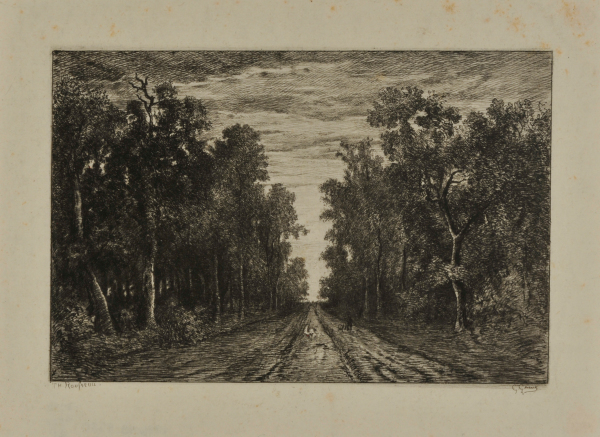
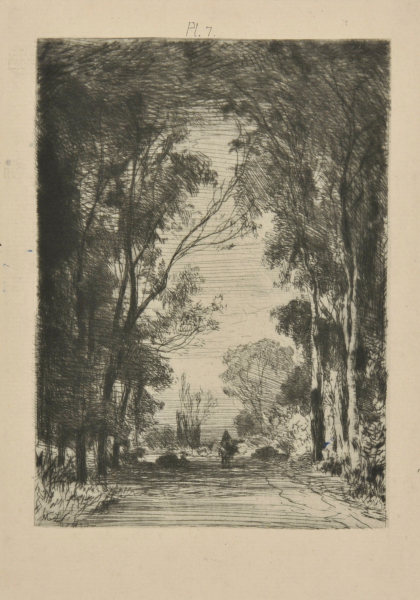
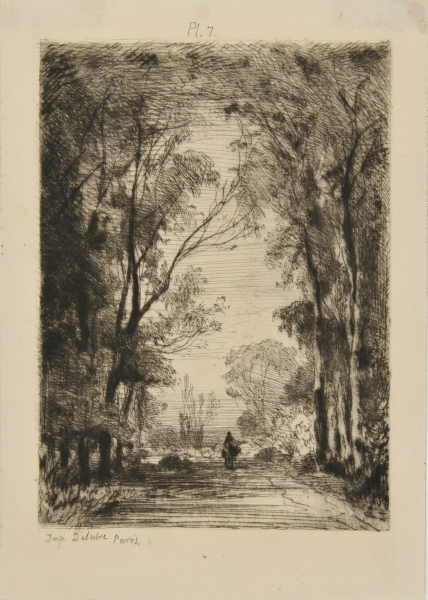
"Here, a pair of cliché-verre prints by Daubigny are juxtaposed with a photograph of a wooded landscape by Eugene Cuvelier. The similarities are immediately aparent even though one image records nature photographically while the other two are hand-drawn. Experimenting with the cliché-verre technique, Daubigny created a reverse image simply by flipping the glass plate over before exposing it to light. The more atmospheric effect of the reverse image suggests that Daubigny's glass plate was rather thick, resulting in a greater diffusion of light and blurrier landscape.
"Though photography's invention in 1839 created a medium for the production of images that potentially threatened the livelihood of painters and printmakers, it was not long before artists embraced photographic technologies to devise new possibilities for creative expression. In the 1850s, working together in the village of Barbizon, on the outskirts of the Forest of Fontainebleau, a group of painters and printmakers including Corot, Daubigny, Millet, and Rousseau, collaborated with photographers such as Adalbert Cuvelier and his son Eugene, to explore the artistic potential of the cliché-verre process."
(Jay Fisher, Jacobs Wing rotation, August 2004)
John Chandler Bancroft (1835-1901), Middletown, R.I.
Jay Fisher, BMA, Jacobs Wing rotation, August 2004.
Sona K. Johnson et al, "Barbizon and Impressionist Works from The Baltimore Museum of Art," Tokyo: "Barbizon and Impressionist Works from The Baltimore Museum of Art" catalogue committee, 2003, p. 139, ill. p. 138
Inscribed: In negative, at lower right: "26"