
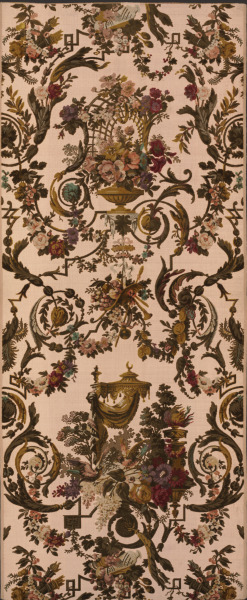
Arthur Martin Studio (c. 1860-1914), Maison Hamot, and others
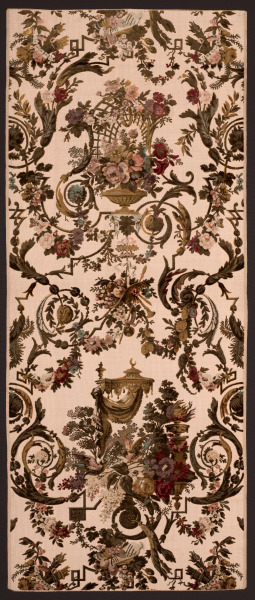
Rococo Revival Voided Ciselé Velvet with Arbor Design
1859-1878
Scroll
- Designer: Arthur Martin Studio (c. 1860-1914)
- Manufacturer: Maison Hamot
- Manufacturer: Georges and René Hamot
Rococo Revival Voided Ciselé Velvet with Arbor Design
1859-1878
Physical Qualities
Silk, 62 x 25 5/8 in. (157.5 x 65.1 cm.)
Credit Line
Textile Acquisition Fund
Object Number
2007.314
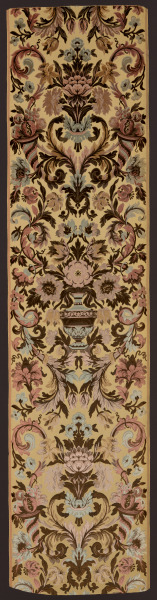
During the mid-to-late 19th century, Victorian tastes in Western Europe and America embraced revivals of many previously known styles. With its pastoral trophies, garlands, acanthus scrolls, brackets, and vases overflowing with flowers, this fabric echoes rococo themes of the 18th century. An element of that era's taste for chinoiserie or oriental exoticism is seen in the crescent-topped canopy surrounded by floral sprays and birds. This lavish fabric is the product of Maison Hamot, a prestigious firm in the history of the French silk industry. Founded in 1762, during the reign of Louise XV, it remained in the hands of the same family and produced silks, carpets, and tapestries for generations of wealthy Europeans until ceasing production in 1999. A testament to the highly developed skills of Hamot's silk weavers, this fabric combines a champagne-pink cannetillé ground( woven with short ribs on the surface to give the appearance of small monochrome checks), with a ciselé (cut and uncut pile) velvet where the multicolored pile is carefully designed to give the effect of lush natural textures and visual depth.
Baltimore Museum of Art by purchase, 2007; Cora Ginsburg, LLD, New York. NY; Private Collector by purchase, 2005 ; Maison Hamot.
Curator's Choice Rotation
Coutau-Bégarie,Olivier - commissaire priser, and Petitcol, expert, "Successsion Hamot," 2 ème vente, Drouot- Paris, 15 & 16 février 2005. lot 481 [note another example has same number, but is not of same design.]
Andre, Linda, and Jessica Skwire Routhier, eds. The Baltimore Museum of Art: Celebrating A Museum. Baltimore, Maryland: Baltimore Museum of Art, 2014, ill. p. 127.
Francesca Galloway and Sue Kerry, Neoclassicism to Pop, Part 1: Late 18th and 19th Century Textiles. Francesca Galloway in association with Antique Collectors' Club, 2007, p.170. (information about Arthur Martin Studio.)
French Textiles from the Middle Ages to the Second Empire, p. 174.
Fairchild's, p. 90)
French Textiles from the Middle Ages to the Second Empire, p. 174.
Fairchild's, p. 90)
Inscribed: Hamot company paper tag stapled to length of textile. Removed by conservator, Louise Wheatley, 6/17/08. (Stored in file): Handwritten in black ink: "us" "hsz" Printed: "No........pon [pattern]." Handwritten: "4488" "Velours 65 fd. [fond=ground?] rose/ Cannetille Tonnelle" [abor] Handwritten at lower right: "1.55" Stamped red: "NON EN MAGASIN" Second tag [dealer's] written in hand in pencil?: "W1662a/Furnishing panel of ciselé velvet w/floral vase, trellis, garlands, baldaquin, acanthus/scrolls in beige, blue, green, red, purple on pink; French, 1850s-60s; 61" x 25" oxo $2500-"