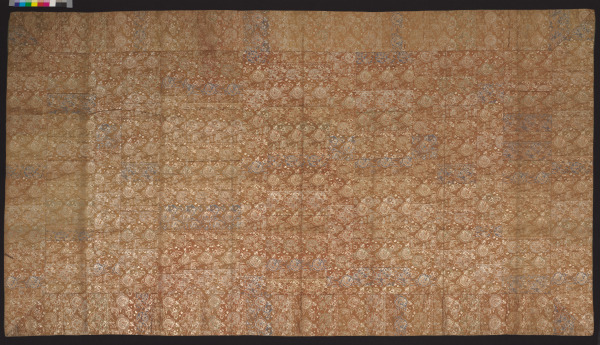
Seven Column Kesa with Lions, Dragon, and Phoenix
1700-1799
Scroll
Seven Column Kesa with Lions, Dragon, and Phoenix
1700-1799
Physical Qualities
Silk, silver-leafed mulberry paper strips, 47 5/8 x 85 3/4 in. (121 x 217.9 cm)
Credit Line
The Cone Collection, formed by Dr. Claribel Cone and Miss Etta Cone of Baltimore, Maryland
Object Number
1950.1999.18
The use of luxury fabrics for kesa in Japan resulted in large part from contact with Chinese Buddhists and from the importation of elaborate Chinese kesa in the years prior to the development of Japan's own textile industry. Centuries later Chinese textiles still influenced the design of Japanese fabrics. The lions and dragons of this seven column kesa are traditional motifs in Chinese art. In this case, they are framed within circular snowflake medallions (yukiwa) and paired with scalloped medallions containing chrysanthemum blossoms. The background contains chrysanthemums, plum blossoms, and phoenix-- also popular Chinese images. The complex woven fabric has a warp-faced satin ground with patterning provided by supplemental wefts of blue, green, off-white, and beige silk, as well as silver-gilded paper cut into thin strips woven into the fabric. The original impact of this fabric can only be imagined as the background has faded from a bright orange-red and many of the circular designs also featured black silk wefts which contrasted with the silver and colored threads. These black silk wefts, which are particularly subject to deterioration, have all but completely disappeared. The four corner patches on this kesa are created from the same fabric as the body rather than from squares of contrasting colored fabric. The patches representing the Bodhisattva in this instance are formed as part of the third and fifth columns rather than added separately.
The Baltimore Museum of Art by bequest, 1949; Etta Cone, Baltimore
Collecting Matisse and Modern Masters: The Cone Sisters of Baltimore
Karen Levitov, "Collecting Matisse and Modern Masters: The Cone Sisters of Baltimore," New York: The Jewish Museum, 2011, p. 78.