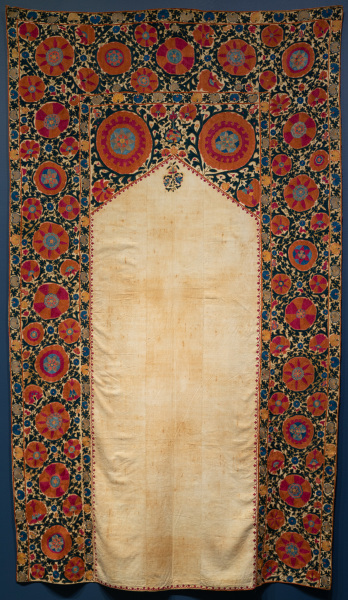
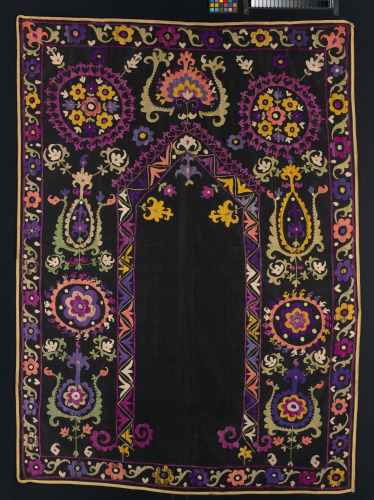
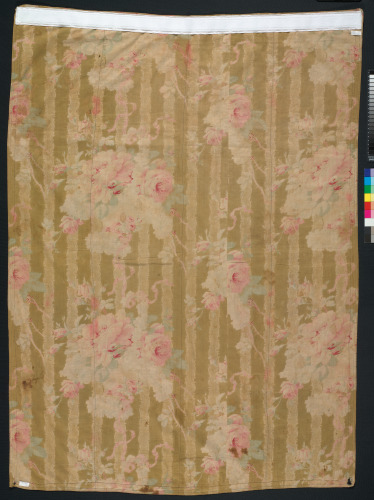
Small Embroidered Hanging or Prayer Mat (nimsuzani or djoinamaz)
1900-1932
Scroll
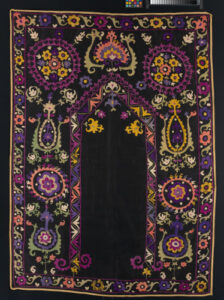
Small Embroidered Hanging or Prayer Mat (nimsuzani or djoinamaz)
1900-1932
Physical Qualities
Cotton ground, silk embroidery threads, cotton backing, 53 x 38 1/4 in. (134.7 x 97.2 cm.)
Credit Line
Gift of Jerry Maizlish, Sparks, Maryland
Object Number
1991.460
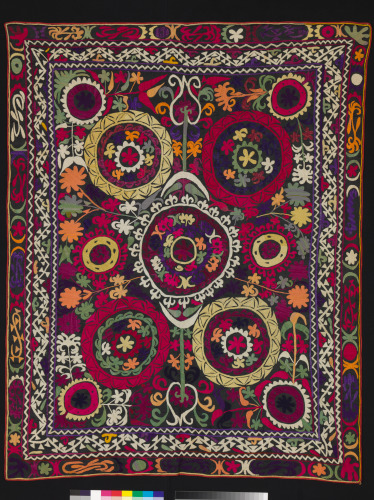
In the settled towns of Central Asia, girls began preparing their dowries early, perhaps around the age of seven or eight years old. A child learned basic skills by watching her mother and may also have received additional lessons from an expert. The trousseau had to be beautiful and comprehensive in order to prove the prospective bride's skill, education, and patience, and to reflect well on the reputation of her family. The requirements differed from one region to another, but most families required at least one (or more often two) small hangings in the form of djoinamaz (prayer mats) to be among the dowry textiles. This example emphasizes elaborate vertical floral elements alternating with floral rosettes around the central arch or mihrab. Such hangings may have served secular purposes as well, as covers for storage spaces or decorations for walls. Larger embroidered textiles of similar design, called ruidjo or joipush, were used for sheets on the bridal bed.
Baltimore Museum of Art by gift, 1991; Gerald (Jerry) Maizlish by purchase, c. 1973 Sparks, MD; Afghanistan or Baltimore, MD.
Embroidered Treasures: Textiles from Central Asia
Imagining Home
Elizabeth E. Bacon, Central Asians Under Russian Rule, Ithaca, N.Y.: Cornell University Press, 1980, reprint of 166 ed., p. 15, pp. 17-19, map 2 facing p. 18, p. 25, p. 110.
Sheila Paine, Embroidered Textiles, Traditional Patterns from Five Continents, New York: Rizzoli, 1990, p. 26, pp. 108-109.
Pamela Clabburn, The Needleworker's Dictionary, New York: William Morrow & Co., 1976, p. 33.
Y. Levinsteyn, 'Unravelling Central Asian Embroidery,' Hali Magazine, Vol. 4, No. 2, 1981, pp. 152-153.
Thomas Knorr and David Lindahl Uzbek: The Textiles and Life of the Nomadic and Sedentary Uzbeks of Central Asia, Basel, Switzerland: Zhinden Druck und Verlag AG, 1975.
Cathryn M. Cootner, 'Gardens of Paradise,' and David Shaffer, 'History and Technique,' in 'Suzani,' Hali Magazine (April/May/June 1986), pp. 44-51.
Tent & Town: Rugs & Embroideries from Central Asia: The H. McCoy Jones Collection, San Francisco: The Fine Arts Museum of San Francisco M.H. DeYoung Memorial Museum, Nov. 1982-Feb. 1983).
Michael Franses and Robert Pinner, 'Large Medallion Suzani from South-- West Uzbekistan, Hali Magazine, Vol. 1, No. 2 (Summer 1978), pp. 128-133.
Adaksina, Svetlana and Larissa KulaKova, 'Textile Architecture: The Emir of Bukhara's Tent in the State Hermitage', Hali, Issue 161. 70-73.
Corbet, Mary. "Bokhara Couching Embroidery Video Tutorial." Needle’nThread. 2 Jan. 2008. Web. 15 Aug. 2011. <http://www.needlenthread.com/2008/01/bokhara-couching-embroidery-video.html>.
Konig, Hans, 'From Tartary', Hali, Issue 1612 (Winter 2008). 30-33.
Lubell, Cecil. France: an illustrated guide to textile collections in French museums. New York: Van Nostrand Reinhold Company, 1977.
Sheila Paine, Embroidered Textiles, Traditional Patterns from Five Continents, New York: Rizzoli, 1990, p. 26, pp. 108-109.
Pamela Clabburn, The Needleworker's Dictionary, New York: William Morrow & Co., 1976, p. 33.
Y. Levinsteyn, 'Unravelling Central Asian Embroidery,' Hali Magazine, Vol. 4, No. 2, 1981, pp. 152-153.
Thomas Knorr and David Lindahl Uzbek: The Textiles and Life of the Nomadic and Sedentary Uzbeks of Central Asia, Basel, Switzerland: Zhinden Druck und Verlag AG, 1975.
Cathryn M. Cootner, 'Gardens of Paradise,' and David Shaffer, 'History and Technique,' in 'Suzani,' Hali Magazine (April/May/June 1986), pp. 44-51.
Tent & Town: Rugs & Embroideries from Central Asia: The H. McCoy Jones Collection, San Francisco: The Fine Arts Museum of San Francisco M.H. DeYoung Memorial Museum, Nov. 1982-Feb. 1983).
Michael Franses and Robert Pinner, 'Large Medallion Suzani from South-- West Uzbekistan, Hali Magazine, Vol. 1, No. 2 (Summer 1978), pp. 128-133.
Adaksina, Svetlana and Larissa KulaKova, 'Textile Architecture: The Emir of Bukhara's Tent in the State Hermitage', Hali, Issue 161. 70-73.
Corbet, Mary. "Bokhara Couching Embroidery Video Tutorial." Needle’nThread. 2 Jan. 2008. Web. 15 Aug. 2011. <http://www.needlenthread.com/2008/01/bokhara-couching-embroidery-video.html>.
Konig, Hans, 'From Tartary', Hali, Issue 1612 (Winter 2008). 30-33.
Lubell, Cecil. France: an illustrated guide to textile collections in French museums. New York: Van Nostrand Reinhold Company, 1977.
Inscribed: Written in pen on the reverse side, top right corner: ' '