
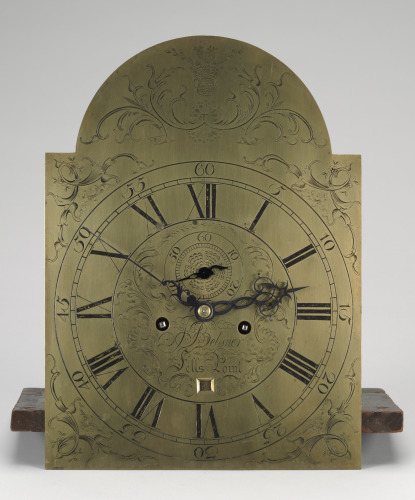
John Belsner
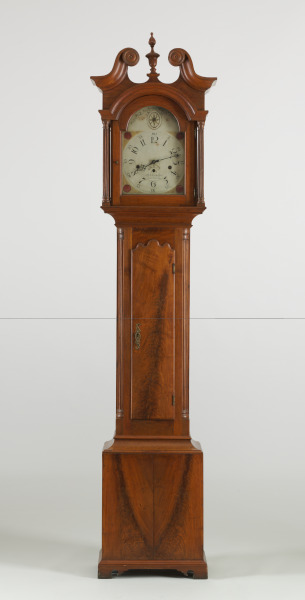
Tall Case Clock
American, 1769-1779
Scroll
John Belsner
Tall Case Clock
American, 1769-1779
Physical Qualities
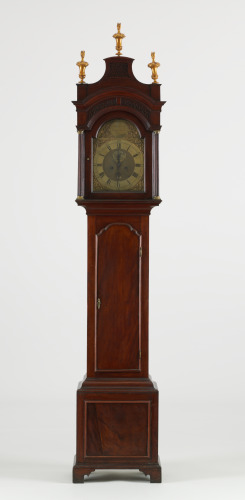
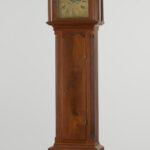
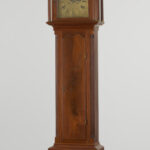
Mahogany, mahogany laminate, tulip poplar, yellow pine, brass escutcheons; eight-day movement with recoil escapement, 98 x 22 7/8 x 11 7/8 in. (248.9 x 58.1 x 30.2 cm.)
Credit Line
Purchased as the gift of Mr. and Mrs. Francis C. Taliaferro
Object Number
1967.3.2
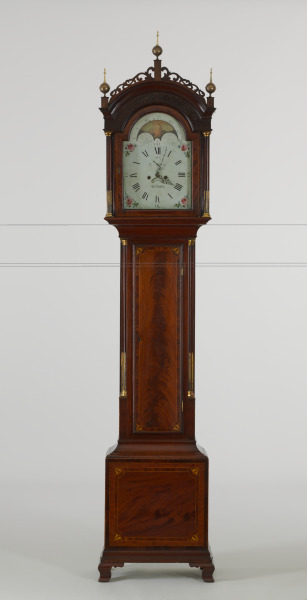
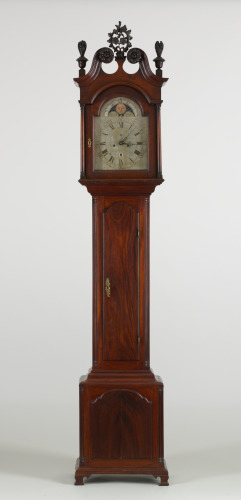
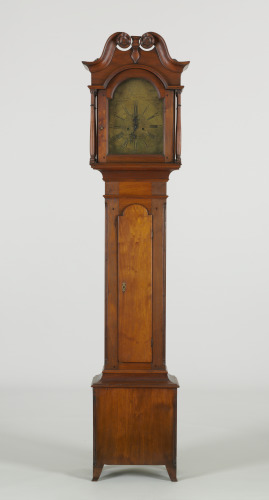
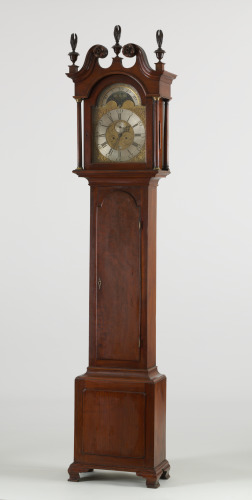
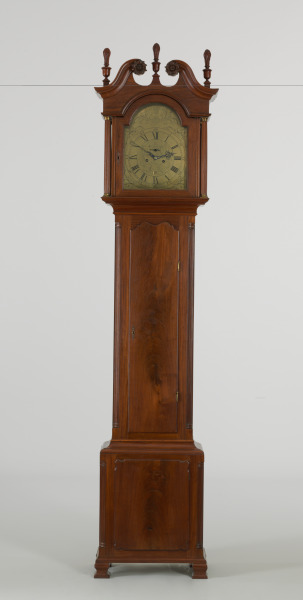
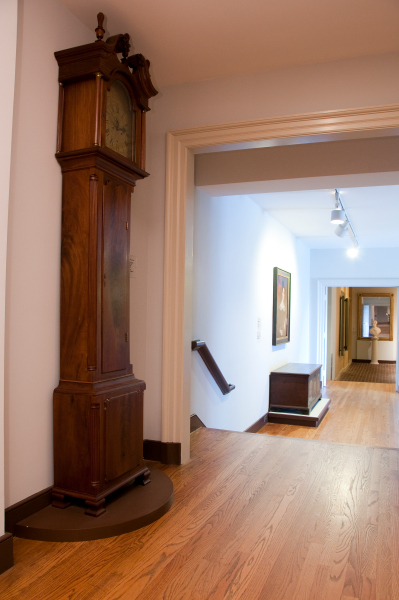
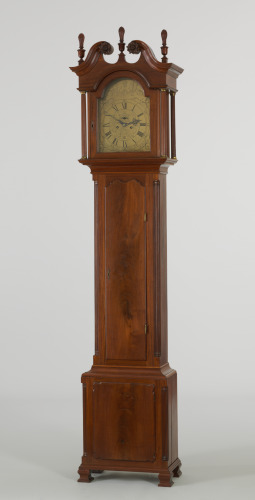
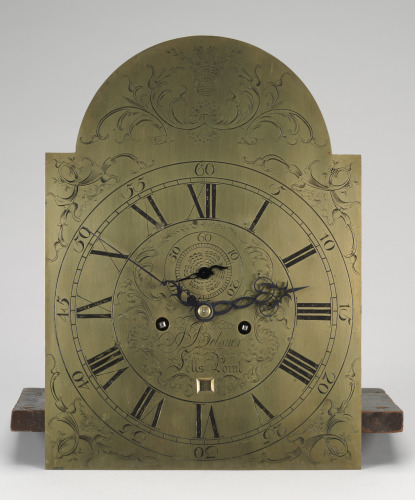
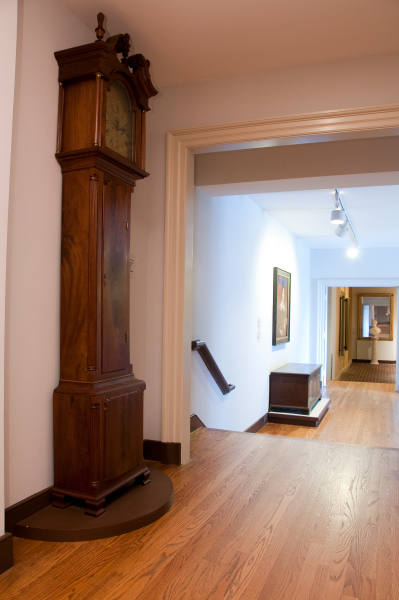
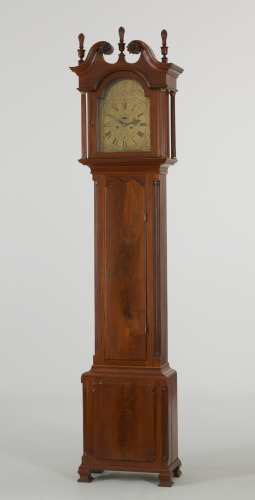
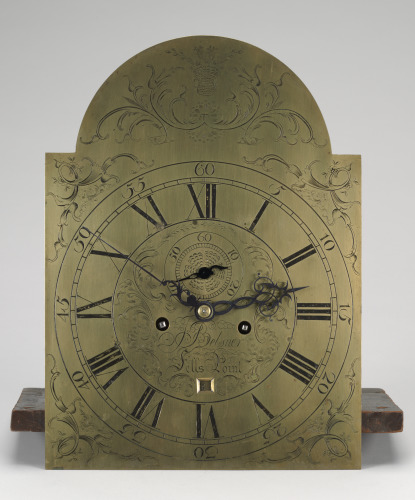
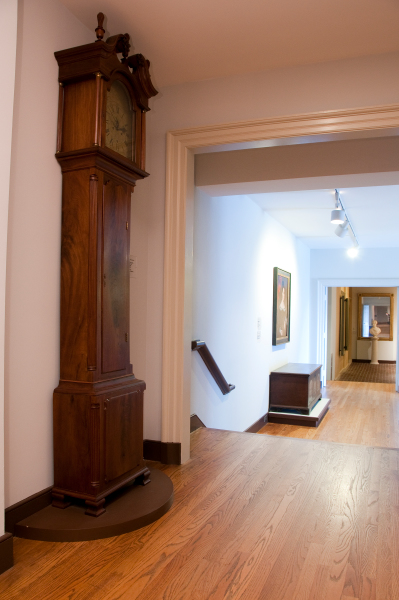
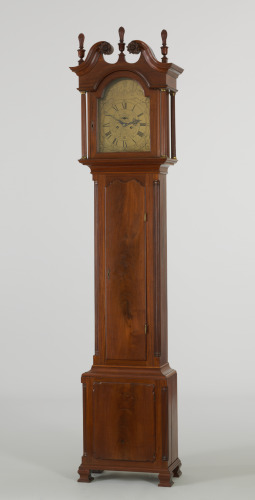
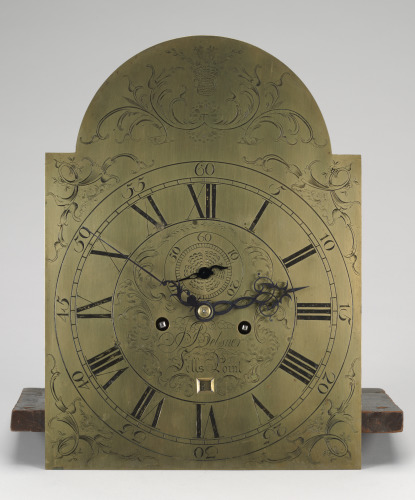
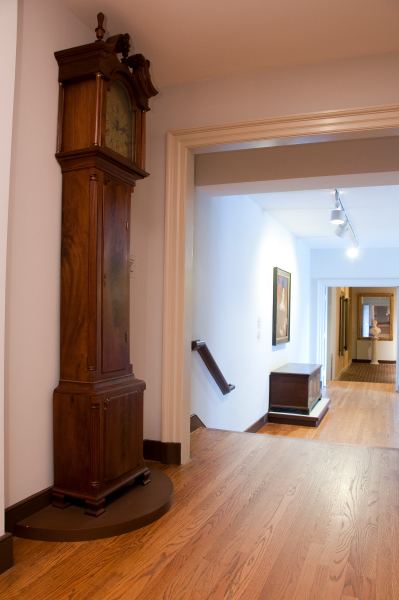
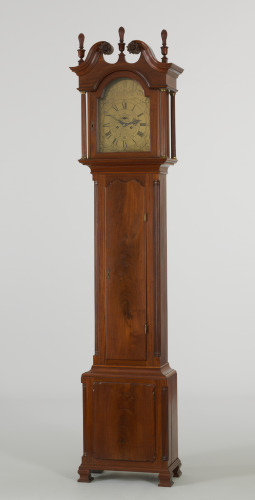
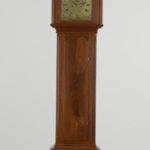
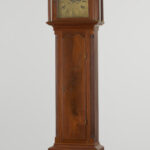
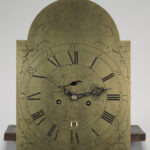
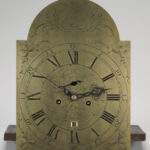
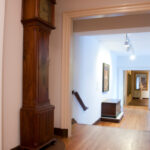
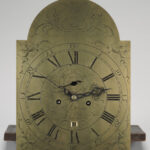
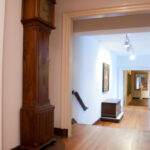
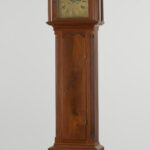
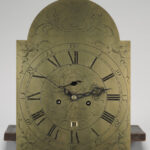
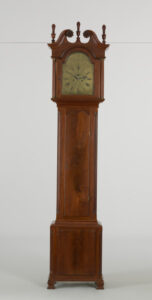
BONNET: Broken scroll pediment with applied cavetto cornice terminating at center front with carved rosettes, and three finials raised on plinths. Fluted columns at front and half-columns at rear having simple brass capital and base. Arched door has quarter-round molding above continuing around sides. Door flanked by cove molding. Door frame has quarter-round molded inner edge. Interior of bonnet has cream colored paint sloppily painted on sides and top. CASE: Bonnet rests on deep cove molding at top of waist. Thumbnail molded waist door edges the top with ogee and scallop shaping. Cove molding on top of base quarter-round edge. Fluted corner columns flank door, each having turned wooden capital and base. Base has raised panel with serpentine notched corners flanked by quarter columns as at waist. Core molding surrounds base above feet each with ogee shaping on front and sides. Inside face of backboard painted cream behind clock works. DIAL: Brass elaborately engraved John Belsner in script with 'Fells Point' in Gothic print below. Hours marked in Roman numerals with 'IIII' for 4; minutes marked in arabic outside these. A seconds dial engraved with blossom center is in inner circle of dial above the hand pivot point. Date indicator below signature. Engraved scrollwork on each corner of dial and in arch with small somewhat primitive basket of flowers at the top.
*Feet and finials are replaced.
WORKS DESCRIPTION: German/Pennsylvania influences. Catalogue entry from Silver in Maryland: "The movement of this clock shows Germanic influences undoubtedly acquired by Belsner in Ephrata, PA. The strike arrest system has both German and English features and the extension of pillars past the dial plate is often found in Pennsylvania-German clocks. 1974 movement overhauled, dial and hands repaired and new cable put on by Nelson Coleman.
The Baltimore Museum of Art, by purchase, 1967; Pattison & Co., sale 26 Jan. 1967; Milton Finch; Mary Frances DuVal Sill (Mrs. Howard Sill), Baltimore, Maryland; Howard Sill (1867-1927), Baltimore, Maryland, by 1927.
Clock and Watchmaking in Early Maryland
Distin, William and Robert Bishop. The American Clock. New York: Bonanza Books, 1976 (reprint).
Elder III, William Voss and Jayne E. Stokes. American Furniture 1680-1880: From the Collection of the Baltimore Museum of Art. Baltimore: Museum of Art, 1987, p.117-118, ill. 84.
Goldsborough, Jennifer Faulds, "Silver in Maryland", Baltimore: Maryland Historical Society, 1983. p.83, ill.
Stillinger, Elizabeth. The Antiques Guide to Decorative Arts in America 1600-1875. NY: E.P. Dutton, 1972. p. 279.
Goldsborough, Jennifer F. Silver in Maryland. Baltimore: Maryland Historical Society, 1984. p. 83 BMA News. Vol. 30, No. 1-2, 1968. ill. p. 39
Examination of clock done 12/05/1979 by Museum of Early Southern Decorative Arts (Examiners: Bradford L. Rauschenberg, Frank L. Horton, Jane Webb Smith)
Goldsborough, Jennifer F. Silver in Maryland. Baltimore: Maryland Historical Society, 1984. p. 83 BMA News. Vol. 30, No. 1-2, 1968. ill. p. 39
Examination of clock done 12/05/1979 by Museum of Early Southern Decorative Arts (Examiners: Bradford L. Rauschenberg, Frank L. Horton, Jane Webb Smith)
Inscribed: 'P' incised in lower left base board interior - thought to be the marks of a mahogany inspector. Chalk inscription on backboard '7_____6' (covered by repair). Label of Nelson R. Coleman, Baltimore, Maryland (clock man) Nov. 22, 1974.
Markings: Clock face: "Jon Belsner/Fells Point"