Arshile Gorky
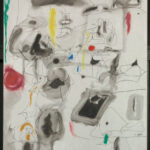
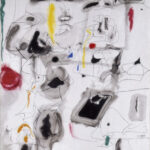
The Unattainable
1944
Scroll
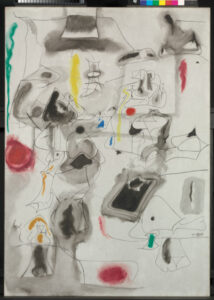
Arshile Gorky
The Unattainable
1944
Physical Qualities
Oil on canvas, Framed: 43 7/8 x 31 7/8 x 2 3/8 in. (111.4 x 81 x 6 cm) Unframed: 41 1/4 x 29 1/4 in. (104.8 x 74.3 cm)
Credit Line
Purchase with exchange funds from Blanche Adler Bequest, Frederic W. Cone, William A. Dickey, Jr., Nelson and Juanita Greif Gutman Collection, Wilmer Hoffman, Mr. and Mrs. Albert Lion, Saidie A. May Bequest, Philip B. Perlman Bequest, Leo M. Rogers, Mrs. James N. Rosenberg, and Paul Vallotton
Object Number
1964.15
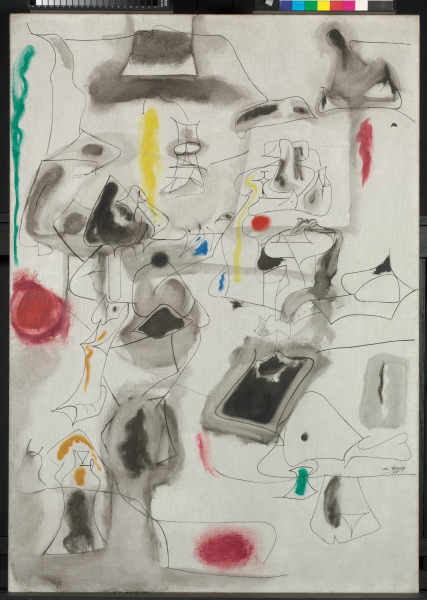
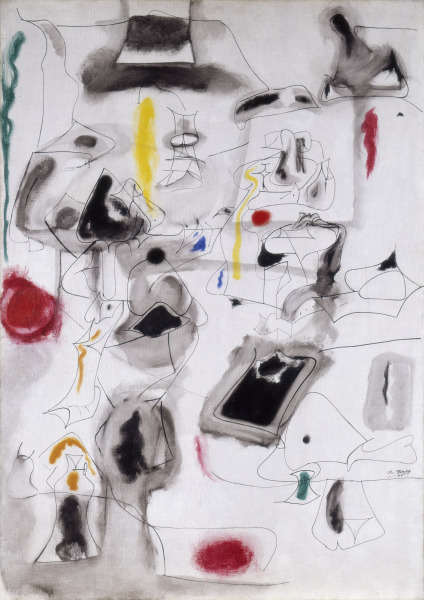
Delicate forms made of thinned paint seem to appear and fade away. Arshile Gorky embraced Surrealism, an approach to art that sought to give visual form to subconscious thoughts, and infused it with his memories of Armenia. With The Unattainable, Gorky used oil paint as a medium for fine, calligraphic drawing,
as if to channel the unfiltered impulses of his mind more fluidly. Gorky and his sister immigrated to America in 1920 as refugees from the Armenian Genocide. Their forced departure and their mother’s death during the journey had a lasting impact on his art. By the 1940s, Gorky was established in New York and in the
circles of Surrealist artists who had relocated from Europe due to the turmoil of World War II (1939–1945).
Edgar A Levy; Julien Levy; Sidney Janis Gallery; Barney Rosset; purchased from Harold Diamond; Paul Kantor Gallery
Surrealism USA
Surrealism: USA and Europe
Painting in the United States
Arshile Gorky retrospective
Contemporary Wing Reinstallation
Abstract Expressionism
Arshile Gorky; 1902-1948 A Retrospective survey
American Wing Rotations 2020
American Wing Rotations 2021
American Modernism Reinstallation
American Wing Rotations 2023
American Wing Rotations 2024
In Creative Harmony: Three Artistic Partnerships
American Wing Rotations 2025
Ethel K. Schwabacher, 'Arshile Gorky,' New York, 1957, pp. 102, 115, ill. pl. 46.
Robert Rosenblum, Arshile Gorky, 'Arts,' 32:4, January 1958, p. 31.
Harold Rosenberg, 'Arshile Gorky,' New York, 1962, ill. p. 93.
William Rubin, Arshile Gorky, Surrealism and the New American Painting, 'Art International,' 7:2, February 1963, p. 36.
'Baltimore Museum of Art, News,' 27:2-4, 1964, ill. p. 48.
Accessions, 'Art Quarterly,' 27:3, 1964, p. 375, ill. p. 391.
Acquisitions, 'The Burlington Magazine,' 107:742, January 1965, p. 54, ill. p. 52, no. 69.
Robert L. Delevoy, 'Dimensions of the 20th Century 1900-1945,' Skira, 1965, p. 207, ill. p. 210.
David Sylvester, ed., 'The Book of Art,' vol. 8, Grolier Series, New York, 1965, ill. p. 62.
Julien Levy, 'Arshile Gorky,' New York, 1966, p. 35, ill. pl. 134.
William S. Rubin, 'Dada and Surrealist Art,' New York: Harry N. Abrams, Inc., 1969, ill. p. 392.
Henry Geldzahler, 'New York Painting and Sculpture: 1940-1970,' New York: E.P. Dutton, 1969, ill. p. 159.
Diane Waldman, 'Arshile Gorky 1904-1948: A Retrospective,' New York, Solomon R. Guggenheim Museum and Harry N. Abrams, Inc., 1981, pl. 183.
J. Jordan and Robert Goldwater, 'The Paintings of Arshile Gorky,' New York: New York University Press, 1982, p. 464, no. 302.
Diane Waldman, 'Willem de Kooning,' New York: Harry N. Abrams, Inc., in Association with The National Museum of American Art, Smithsonian Institution, 1988, ill. 38.
'Arshile Gorky: Late Paintings,' New York, Gagosian Gallery, 1994, ill. 33.
Barbara Ann Boese Wolanin, "The Orchestration of Color: The Paintings of Arthur B. Carles," New York: Hollis Taggart Galleries, 2000. p. 67, ill.
Brooke Kamin Rapaport and Kevin L. Stayton, 'Vital Forms: American Art and Design in the Atomic Age, 1940-1960,' Brooklyn Museum of Art (in association with Harry N. Abrams, Inc.), 2001, p. 98, ill.
Peter Walsh, "The Surreal Thing," 'Museums' (Winter 2005), pp. 57-59, p. 57 ill.
Michael R. Taylor, ed. "Arshile Gorky: A Retrospective," Philadelphia: Philadelphia Museum of Art, 2009, no.134, p. 295, ill.
Matthew Gale, "Arshile Gorky: Enigma and Nostalgia," London: Tate Publishing, 2010, p. 96.
Greeley, Robin Adele, Samantha Kavky, Oliver Shell, and Oliver Tostmann. "Monsters & Myths: Surrealism and War in the 1930s and 1940s." New York, NY: Rizzoli Electa in association with The Baltimore Museum of Art and Wadsworth Atheneum Museum of Art, 2018, ill.
Inscribed: Lower Right: A. Gorky/45
 On View at the BMA
Explore the Collection Further